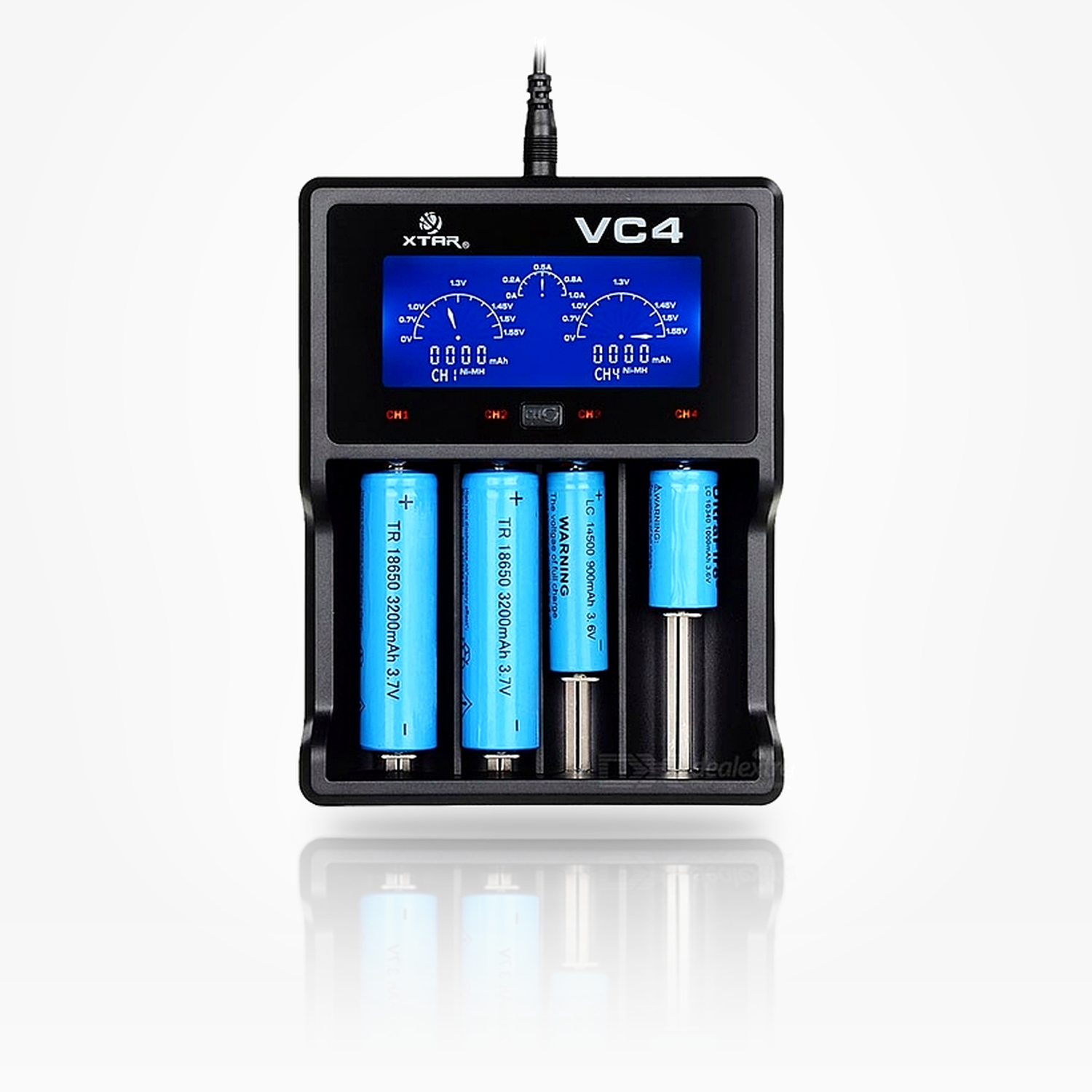
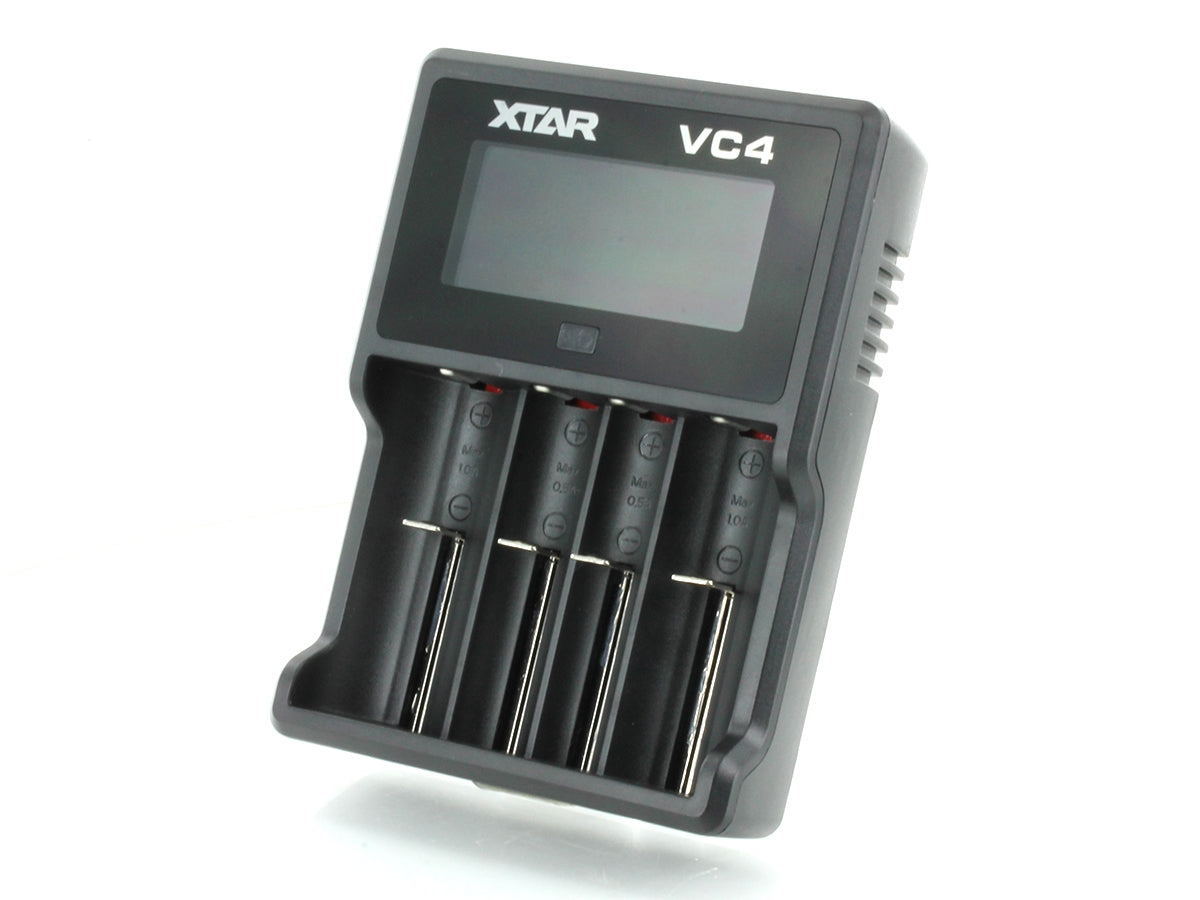
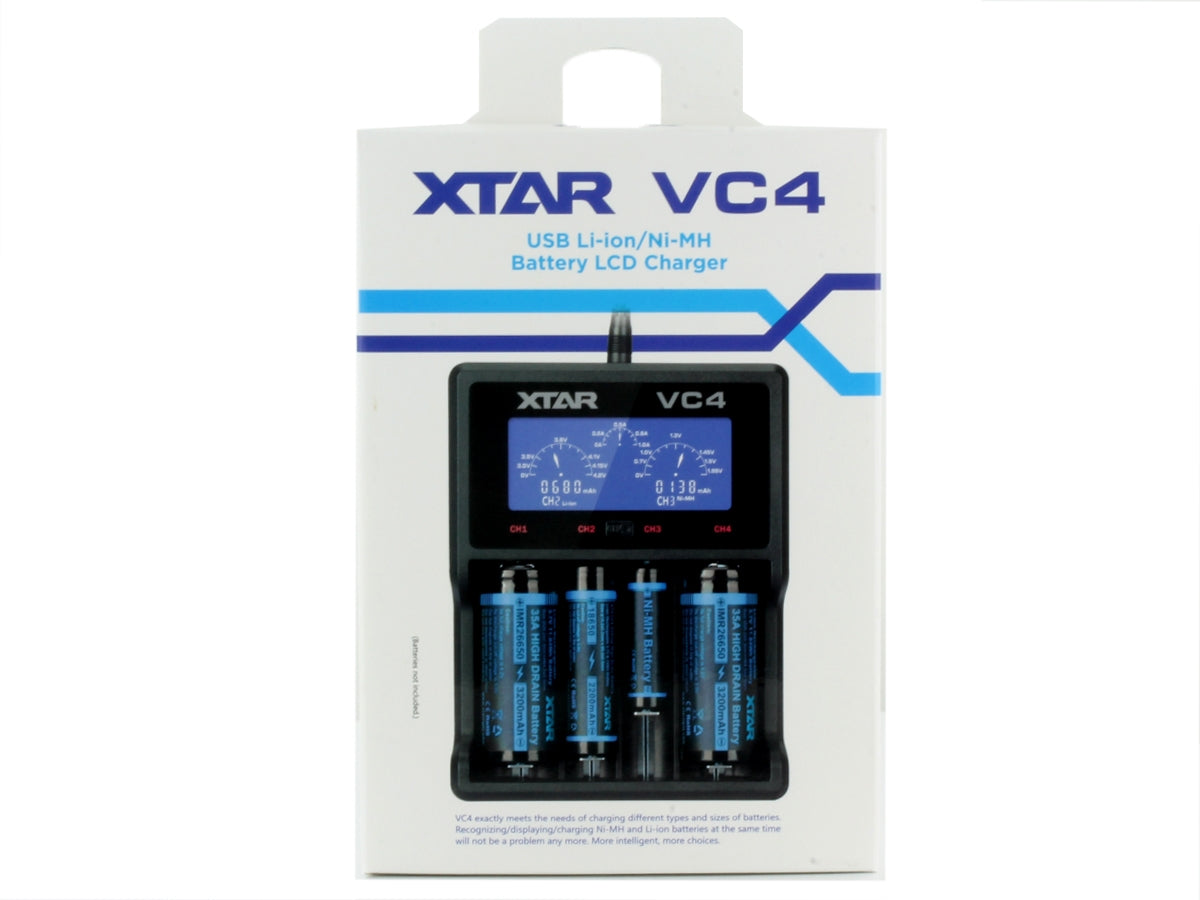
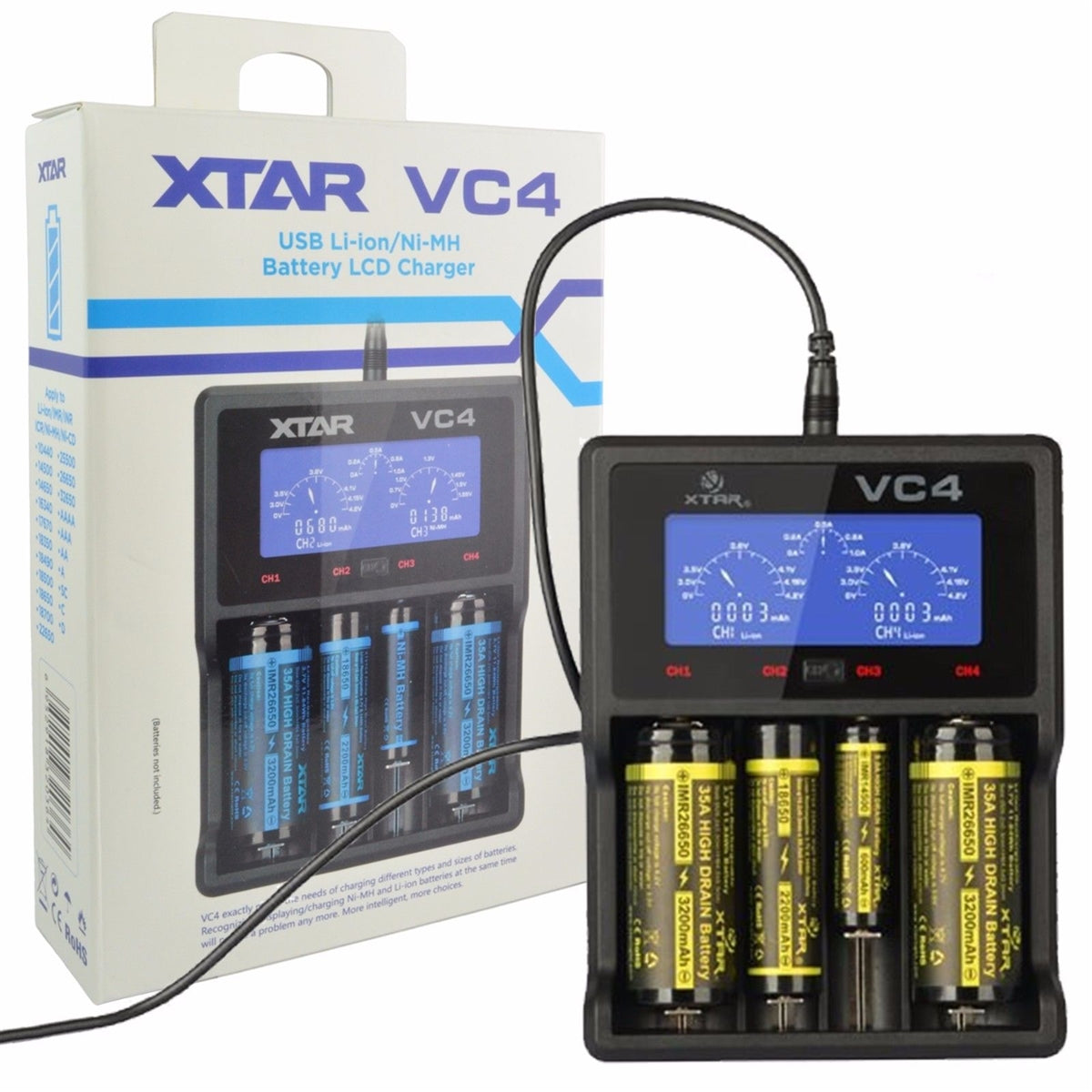
A four-slot charger for 3.6/3.7 V lithium-ion and 1.2 V Ni-MH/Ni-Cd cells, with an LCD: 0.5 A in all four slots or 1 A in two, ending at 4.2 ± 0.05 V for lithium-ion and 1.45 ± 0.1 V for Ni-MH, on a 5 V 2.1 A input [1]. Below: every rating XTAR prints with its condition, the screen and light, which of our cells it suits, and charge times we calculated, so you can check each number.
INPUT5 V2.1 A DC [1]; “DC3.5 port” [3]
PER SLOT1 Ain CH1 and CH4; 0.5 A in all four [1]
END OF CHARGE4.2 V± 0.05 V Li-ion; 1.45 ± 0.1 V Ni-MH [1]
SLOTS4Li-ion and Ni-MH in the same charge [1]
CELL TYPESLi-ion3.6/3.7 V, 10440 to 32650; and 1.2 V Ni-MH/Ni-Cd, AAAA to D [1]
XTAR lists 3.6/3.7 V lithium-ion and 1.2 V Ni-MH/Ni-Cd cells [1], and says the VC4 can’t charge protected 20700/21700 cells [1]. Don’t use it for LiFePO4, 1.5 V lithium AA/AAA or alkaline cells.
01SPEC PLATE
Every rating, with its condition.
XTAR prints the VC4’s ratings in its user manual [1], again in a more detailed specification table on its VC4 page [2], and in its charger chart [3]. The manual’s ratings come first, copied as printed; then what the page and chart add, where they differ, and our arithmetic. Each row names its source or shows its formula.
SPEC PLATE · XTAR VC4 USER MANUAL SOURCE [1]
SPECIFICATION
VALUE
CONDITION · SOURCE
RATED · MANUFACTURER copied from the manual’s specification table and drawings [1]
MODEL
VC4
as printed [1]
INPUT
5 V · 2.1 A
“DC 5V 2.1A” [1]
CONSTANT CURRENT, ALL FOUR
0.5 A
“0.5A×4” [1]
CONSTANT CURRENT, CH1 AND CH4
1 A
“1A×2 (CH1 & CH4)” [1]; the drawing marks CH1 and CH4 “Max 1.0A”, CH2 and CH3 “Max 0.5A” [1]
CUT-OFF VOLTAGE, LI-ION
4.2 V
“4.2±0.05V” [1]
CUT-OFF VOLTAGE, NI-MH
1.45 V
“1.45±0.1V” [1]
CUT-OFF CURRENT
≤ 120 mA
“≤120mA” [1]; the product page prints lower figures, below [2]
OPERATING TEMPERATURE
0 to 40 °C
“0-40℃” [1]
LI-ION CELLS
3.6/3.7 V
“3.6V/3.7V Li-ion/IMR/INR/ICR”, eighteen sizes, 10440 to 32650 [1]
NI-MH CELLS
1.2 V
“1.2V Ni-MH/Ni-CD”: AAAA, AAA, AA, A, SC, C, D [1]
PROTECTED 20700/21700
No
“Can not charge protected 20700/21700 batteries.” [1]
0 V ACTIVATION
Yes
“Insert batteries, revivable batteries will start charging within 10 minutes.” [1]
+ Source: [1] XTAR, VC4 User Manual, multilingual leaflet marked “V2” (file title dated 2018-05-10), English section: introduction, “Apply to”, Specification table, Operation, Indicator Color Meaning, Warning; in XTAR’s download library, listed as last updated 2024-01-31 · XTAR download page
FROM XTAR’S VC4 PAGE specification table and panels [2], as printed
0.5 A CONSTANT CURRENT
500 mA
“500±50mA” [2]
1.0 A CONSTANT CURRENT
1,000 mA
“1000±80mA” [2]
END OF CHARGE, AT 0.5 A
≤ 60 mA
“0.5A End of Charge Current ≤60mA” [2]; the manual prints ≤120 mA [1]
END OF CHARGE, AT 1.0 A
≤ 100 mA
“1.0A End of Charge Current ≤100mA” [2]
END-OF-CHARGE VOLTAGE
4.20 V
“4.20±0.05V/1.45±0.1V” [2]
CURRENT CHOICE
0.1–1 A
“Intelligently chooses charging currents from 0.1A to 1A” [2]
CELL TEMPERATURE RISE
≤ 15 °C
“15℃ maximum temperature rise”, “surface temperature rise” [2]
SIZE
149 × 115 × 35 mm
“L149mm x W115mm x H35mm” [2]; “L149 x W115 x H35mm” [3]
NET WEIGHT
210 g
[2][3]
IN THE BOX
Charger, cable, manual, pouch
“VC4 charger, manual, USB cable, hop-pocket, warranty card” [2]; “VC4 charger*1, DC Charging cable*1, Manual *1, Portable bag*1, Color paper box*1” [3]
FROM XTAR’S CHARGER CHART [3], as printed, where it adds to or differs from [1]
INPUT PORT
DC3.5
“DC 5V 2.1A DC3.5 port” [3]
NI-MH SIZES
AAAA to C
AAAA/AAA/AA/A/SC/C, without D [3]; the manual adds D [1]
CALCULATED arithmetic on [1], shown so you can check it
TOTAL CHARGE CURRENT
2 A
1 A × 2 or 0.5 A × 4 [1]
INPUT POWER
10.5 W
5 V × 2.1 A [1]
LI-ION CHARGE POWER, ALL SLOTS
8.4 W
4.2 V × 2 A, at the end of constant current [1]
LI-ION END-OF-CHARGE BAND
4.15–4.25 V
4.2 ± 0.05 V [1]
NI-MH END-OF-CHARGE BAND
1.35–1.55 V
1.45 ± 0.1 V [1]
+ Source: [1] XTAR, VC4 User Manual, multilingual leaflet marked “V2” (file title dated 2018-05-10), English section: introduction, “Apply to”, Specification table, Operation, Indicator Color Meaning, Warning; in XTAR’s download library, listed as last updated 2024-01-31 · XTAR download page + Source: [2] XTAR, VC4 product page, xtar.cc: its feature list, “VC4 Specification” table and image panels (charge graphs, temperature, 0 V activation, package contents), retrieved 2026-10-31 · XTAR VC4 page + Source: [3] XTAR, XTAR Charger Range Comparison Chart, the VC4 and VC4SL rows; 3 pages, no version printed; listed in XTAR’s download library as last updated 2024-01-21 · XTAR download page
RATED · [1]FIG 1.1
End of charge, lithium-ion
4.15 Vlowest4.2 Vrated4.25 Vhighest
Orange band: the lithium-ion end-of-charge voltage, “4.2±0.05V” [1]; XTAR’s page prints “4.20±0.05V” [2]. Scale 4.10–4.30 V.
RATED · [1]FIG 1.2
End of charge, Ni-MH/Ni-Cd
1.35 Vlowest1.45 Vrated1.55 Vhighest
Orange band: the Ni-MH/Ni-Cd end-of-charge voltage, “1.45±0.1V” [1][2]. Scale 1.30–1.60 V.
DOCUMENTS · [1][2]FIG 1.3
End-of-charge current, by document
Manual “≤120mA”, no current named [1]
≤ 120
Product page, 1.0 A “≤100mA” [2]
≤ 100
Product page, 0.5 A “≤60mA” [2]
≤ 60
0306090120150 mA
The current at which a charge ends, as each XTAR document prints it: one limit in the manual [1], one per current on the product page [2]. Neither says how it is measured. Scale 0–150 mA.
02 · CHARGE CURRENT
Up to 1 A in two slots, 0.5 A in four.
The manual rates the VC4 at 0.5 A in each of its four slots, or 1 A in CH1 and CH4, and its drawing marks those two slots “Max 1.0A” and the middle two “Max 0.5A” [1]. XTAR’s page says the VC4 picks the current itself, from 0.1 to 1 A [2]; neither document describes a way to set it. Both of the manual’s current ratings total 2 A (1 A × 2 or 0.5 A × 4, our arithmetic).
CH1 AND CH41 A“1A×2 (CH1 & CH4)” [1]
ALL FOUR0.5 A“0.5A×4” [1]
PRINTED · [1]FIG 2.1
Current per slot, by slots in use
Each slotTotal of the slots in use
CH1 and CH4 “1A×2 (CH1 & CH4)” [1]1 A each2 A total
All four slots “0.5A×4” [1]0.5 A each2 A total
Data: “0.5A×4 / 1A×2 (CH1 & CH4)” [1] · black: each slot; gray: the slots together, our arithmetic · scale 0–4 A · the product page prints the tolerances, 500 ± 50 mA and 1,000 ± 80 mA [2]
03CHARGE TIME
Hours at 1 A and 0.5 A, by cell.
Hours = capacity ÷ current, as if the whole charge ran at that current. A real charge from empty takes longer, because the current tapers in the constant-voltage finish, and a cell that isn’t empty needs less. Capacities are each cell’s own printed figure [C].
HOURSmAh ÷ mAat full current, from empty
CH1 AND CH41 A“1A×2 (CH1 & CH4)” [1]
ALL FOUR0.5 A“0.5A×4” [1]
3,000 mAh CELL3.0 h3,000 ÷ 1,000 at 1 A; 6.0 h at 0.5 A
Samsung 25R 2,500 minimum2.5 h at 1 A5.0 h at 0.5 A
Samsung 30Q 3,000 nominal3.0 h at 1 A6.0 h at 0.5 A
Sony/Murata VTC6 3,120 nominal3.1 h at 1 A6.2 h at 0.5 A
Molicel P28A 2,800 typical2.8 h at 1 A5.6 h at 0.5 A
Samsung 35E 3,350 minimum3.4 h at 1 A6.7 h at 0.5 A
Molicel M35A 3,450 typical3.5 h at 1 A6.9 h at 0.5 A
EVE 33V 3,200 typical3.2 h at 1 A (> 15 °C)6.4 h at 0.5 A
Samsung 40T 4,000 minimum4.0 h at 1 A8.0 h at 0.5 A
Samsung 50E 4,900 minimum4.9 h at 1 A9.8 h at 0.5 A
Samsung 50S 5,000 typical5.0 h at 1 A10.0 h at 0.5 A
Molicel P50B 5,000 typical5.0 h at 1 A10.0 h at 0.5 A
Hours = capacity ÷ current, from each cell’s printed capacity [C] and the VC4’s current [1]; scale 0–11 h. As if the whole charge ran at that current. A time marked > 15 °C holds only for a cell in that range: outside it, the cell’s printed limit is under this current (section 04).
Arithmetic, not a measurement. XTAR’s charge graphs on its VC4 page [2] are labeled “Li-ion: IMR XTVTC4 / 2200mAh - 1.0A”, plotted to 2.8 h, and “Ni-MH: ENELOOP2000 - 0.5A”, plotted to 4.7 h. At constant current alone, 2,200 ÷ 1,000 gives 2.2 h and 2,000 ÷ 500 gives 4.0 h. Both graphs have unevenly labeled time axes, so we quote them rather than redraw them. 1 and 0.5 A are inside every listed cell’s printed limit, within the charge temperatures each prints [C]. The one exception is 1 A for an EVE 33V at 0–15 °C (cell surface), which is above its “≤ 0.2C (620mA)” (section 04). Ni-MH cells aren’t listed here.
04COMPATIBILITY
Li-ion 10440 to 32650; Ni-MH AAAA to D.
The manual lists eighteen 3.6/3.7 V lithium-ion sizes, 10440 to 32650, and seven 1.2 V Ni-MH/Ni-Cd sizes, AAAA to D [1]. XTAR’s chart [3] lists the same lithium-ion sizes and six Ni-MH sizes, without D. XTAR says the VC4 can’t charge protected 20700/21700 cells [1].
Sizes exactly as printed in the manual [1]. The chart [3] lists the same lithium-ion sizes and omits D. Not protected 20700/21700 [1].
DATA SHEETS · [1][C]FIG 4.2
Charge current against each cell’s printed limit
Samsung 25R 18650 · 4 A rated charge
Samsung 30Q 18650 · 4 A rated charge
Sony/Murata VTC6 18650 · 5.0 A continuous max. · 2 A from 0 to below 10 °C
Molicel P28A 18650 · 8.4 A max. at 23–45 °C (chart) · our chart reading: 2.8 A at 0–23 °C, 1.4 A at 0–10 °C in the specified region
Samsung 35E 18650 · 2.0 A, “not for cycle life”
Molicel M35A 18650 · 1.7 A max.
EVE 33V 18650 · 3.1 A at 15–50 °C · 0.62 A at 0–15 °C
Samsung 40T 21700 · 6 A rated charge
Samsung 50E 21700 · 4.9 A, “not for cycle life”
Samsung 50S 21700 · 6 A, continuous charge
Molicel P50B 21700 · 25 A, 70 °C cut-off
0123456 A
Bars: each cell’s printed charge limit [C], on a 0–6 A scale; limits above 6 A run to the edge, and every limit is written above its bar, with any lower limit the cell prints for the cold. Black marks: the VC4’s currents [1]. No bar is orange: every cell’s highest printed limit, the bar, is at or above them. In the cold some printed limits are lower. EVE 33V: its limit is “≤ 0.2C (620mA)” at “Charge: 0 to 15 °C” (cell surface), so 1 A is above it. Every verdict in fig 4.2 is for a cell from 0 to 40 °C; ten of the eleven cells print no charge range below 0 °C [C]. At 0–15 °C (cell surface), charge an EVE 33V in CH2 or CH3, which XTAR marks “Max 0.5A” [1]. In the data table, each limit starts with the data sheet’s own row label; text in quotation marks is copied as printed, and notes after it are ours.
DATA TABLE · FIG 4.2
Fig 4.2 data: each cell’s charge limit as printed [C], against the VC4’s currents [1]
Rated charge: “CCCV, 4A, 4.20V, 100mA cut-off” (the spec prints no separate maximum charge current); pre-charge 0.1–0.5C at 1.0–3.0 V in its pack design guideline, at most 1.5 A (our arithmetic)
Continuous Maximum Charge Current: “5.0A” (“Continuous”); “2.00A” from 0 to below 10 °C cell surface, for a charge that ends at 4.25 V or less (its 4.00 A figure needs one that ends at 4.15 V)
Maximum charging current: “8.4A” (“See Section 4.14”); its §4.14 chart reaches 8.4 A only from 23 to 45 °C, in its safe region (5.6 A in its specified region); 2.8 A at 0–23 °C in its §4.14 chart’s safe region, and above 10 °C in its specified region; 1.4 A at 0–10 °C in its chart’s specified region (the safe region stays at 2.8 A); the chart figures are our reading
Maximum charging current: “1.7 A” (“See Section 4.14”); its §4.14 chart, against cell surface temperature, stays at 1.7 A from 0 to 60 °C (our reading of the chart); Molicel’s older public data sheet prints 3.4 A, and this page uses the lower 1.7 A of Molicel’s newer specification
Rated charge: “CCCV, 6A, 4.20 V, 100mA cut-off” (the spec prints no separate maximum charge current); pre-charge 0.1–0.5C at 1.0–3.0 V in its pack design guideline, at most 2 A (our arithmetic)
The LCD shows the charging current, the cell’s voltage, the capacity charged in, the cell type and the slot number [1]. A colored LED gives the state [1].
dial marked for Ni-MH and Li-ion: 0V; 0.7V/3.0V; 1.0V/3.5V; 1.3V/3.8V; 1.45V/4.1V; 1.5V/4.15V; 1.55V/4.2V
Charging capacity
four digits, mAh
Battery type
Ni-MH or Li-ion
Slot number
CH and a digit
The manual labels one button and doesn’t say what it does [1]; XTAR’s VC4 page lists an “Energy-saving LCD backlight, can be turned off at your will” [2]. The capacity readout counts what goes in during this charge; XTAR lists no discharge or capacity test for the VC4 [1][2].
06SAFETY
Protections, in XTAR’s words.
XTAR prints these for the VC4 [1][2], without a test method, so they appear as XTAR’s claims, quoted.
What XTAR lists
“Green: standby/fully charged/polarity reversed. Red: self-examining/charging/activating/short circuit.” [1] Green can mean a full cell or a reversed one, and red can mean charging or a short, so check each cell’s polarity as you put it in.
“Keep your batteries cool during the charging. 15℃ maximum temperature rise.” [2] XTAR doesn’t say at what current or room temperature.
“When the power supply is insufficient, the charger will reduce the charging current correspondingly.” [1]
0 V activation: “revivable batteries will start charging within 10 minutes” [1].
The charge ends at 4.2 ± 0.05 V for lithium-ion and 1.45 ± 0.1 V for Ni-MH [1].
Before you charge
Charge on a hard, non-flammable surface, away from anything that burns, and stay within reach while it charges.
Use only the cell types and sizes XTAR lists (section 04), inside each cell’s own charge limit [C].
Keep the charger between 0 and 40 °C while it works [1].
“Do not charge unsuitable batteries with the charger.” “Keep the charger away from humidity, water, and excessive dust.” “Children should use the charger accompanied by an adult.” “Do not disassemble or use the charger if it is damaged.” [1]
Let a cold cell warm up to room temperature before you charge it, and don’t charge any cell below 0 °C.
Don’t charge a cell with a torn wrap until it is rewrapped. Recycle a cell that is dented or leaking.
If a cell gets hot, smells or swells, unplug the charger and keep clear of it. Once it has cooled, move it onto a non-flammable surface and recycle it. If it smokes or catches fire, leave the room and call 911.
If a lithium-ion cell has sat deeply discharged, check its voltage with a meter before you put it in: the charger starts reviving such cells on its own [1], and a cell can be damaged even if it takes a charge. Six of the eleven cells in section 04 should not be charged once they have fallen under 1.0 V: the Samsung 30Q, 40T, 50E and 50S specifications each print “Do not charge the battery under 1.0V voltage.” The Samsung 35E’s says the same, and the Sony/Murata VTC6’s forbids charging a cell at 1.0 V or less [C]. Recycle such a cell rather than reviving it.
07COMPARE
Where the VC4 sits.
The XTAR chargers in our store, each from its own XTAR manual, product page or chart [X]. The table quotes each one’s current as printed.
The highest per-slot current each charger’s XTAR manual, product page or chart prints [X], on a 0–3 A scale. Orange: the VC4. More current per slot shortens a charge; use it only where the cell’s printed limit allows it, which for some cells is lower in the cold.
Current is copied as printed in each charger’s source [X], largest first; input and cell types are condensed from it. * Most at once: the largest current × slots among the rows XTAR prints, our arithmetic. Links go to each charger in our store.
08USE IT RIGHT
Charge inside the cell’s limit.
What the VC4 is for, and how to use it inside XTAR’s ratings and your cell’s limits.
XTAR lists 3.6/3.7 V lithium-ion cells in eighteen sizes and 1.2 V Ni-MH/Ni-Cd AAAA to D [1], and says the VC4 can’t charge protected 20700/21700 [1]. Don’t use it for LiFePO4, alkaline or 1.5 V lithium AA/AAA.
CH1 and CH4 are marked “Max 1.0A”, CH2 and CH3 “Max 0.5A” [1]. Use CH1 or CH4 only for cells whose data sheet allows 1 A at the cell’s temperature; some print a lower limit in the cold (section 04). Charge small cells such as 10440, 16340, AAAA or AAA only if their data sheet allows 0.5 A, and put them in CH2 or CH3.
Power: 5 V 2.1 A DC [1], through the cable in the box, which XTAR calls a “USB cable” [2] and a “DC Charging cable” [3]. On a weaker supply the charger reduces the current [1].
1 and 0.5 A are inside the printed charge limit of every cell in section 04, within the charge temperatures each prints [C]. The one exception is the EVE 33V at 0–15 °C (cell surface), where its limit is “≤ 0.2C (620mA)” and 1 A is above it, so put an EVE 33V that cold in CH2 or CH3, at 0.5 A at most [1].
Use the charger between 0 and 40 °C [1]. Never charge a cell colder than 0 °C: ten of the eleven cells in section 04 print 0 °C as their lowest charge temperature [C], and a cell brought in from the cold stays colder than the room for a while.
Take cells out once the LED turns green (green also shows standby or a reversed cell [1]), and don’t leave the charger running unattended.
The manual [1] is XTAR’s, linked as published (a multilingual leaflet; English is one panel). XTAR’s VC4 page [2] and charger chart [3] are linked too.
Ships from Stockbridge, GA. Most in-stock orders ship within 1 business day.
09QUESTIONS
Questions, answered.
Short answers. Where an answer comes from a document, it carries its source; the rest is standard handling practice. Anything else: call 1-800-547-3050 or text 1-833-419-2192.
Can it charge AA and AAA batteries?
Yes, 1.2 V Ni-MH or Ni-Cd: AAAA, AAA, AA, A, SC, C and D [1]. Not alkaline, and not 1.5 V lithium AA/AAA: the manual lists only 1.2 V Ni-MH/Ni-Cd and 3.6/3.7 V lithium-ion [1].
Can I charge lithium-ion and Ni-MH at the same time?
Yes: “Charge Li-ion and Ni-MH batteries at the same time with different but suitable charging methods.” [1] The screen shows each cell’s type [1].
Which slots charge at 1 A?
CH1 and CH4, marked “Max 1.0A”; CH2 and CH3 are marked “Max 0.5A” [1]. The manual prints “0.5A×4 / 1A×2 (CH1 & CH4)” [1].
How long does a charge take?
For a 3,000 mAh cell from empty, 3.0 h at 1 A or 6.0 h at 0.5 A by our arithmetic, plus a slower finish (section 03). XTAR’s charge graph on its VC4 page, “Li-ion: IMR XTVTC4 / 2200mAh - 1.0A”, runs to 2.8 h [2].
What power supply does it need?
5 V 2.1 A DC [1]. XTAR’s chart lists a “DC3.5 port” as the charger’s input and a “DC Charging cable” in the box [3], and XTAR’s page says it is “Powered by any 5V USB power” [2]. On a weaker supply the charger reduces the current [1]. No wall adapter comes in the box; XTAR lists wall adapters as optional accessories [2].
Can it charge protected 21700 cells?
No: “Can not charge protected 20700/21700 batteries.” [1] Bare 20700 and 21700 cells are on its list [1].
Can it charge 26650 or 32650 cells?
Yes. Both are on XTAR’s lists [1][3].
Can it test a cell’s capacity?
No. The capacity readout counts what goes in during this charge [1]; XTAR lists no discharge or capacity test for the VC4 [1][2]. For one, see the XTAR VC8.
Is it the same as the VC4S or VC4SL?
No. XTAR’s download library has separate manuals for the VC4S and VC4SL, and its chart lists the VC4SL with its own ratings [3]. This page covers the VC4 only.
10SOURCES
Sources and method.
Where every number on this page comes from.
+ Source: [1] XTAR, VC4 User Manual, multilingual leaflet marked “V2” (file title dated 2018-05-10), English section: introduction, “Apply to”, Specification table, Operation, Indicator Color Meaning, Warning; in XTAR’s download library, listed as last updated 2024-01-31 · XTAR download page
+ Source: [3] XTAR, XTAR Charger Range Comparison Chart, the VC4 and VC4SL rows; 3 pages, no version printed; listed in XTAR’s download library as last updated 2024-01-21 · XTAR download page
+ Source: [C] Each cell’s manufacturer data sheet or specification, as transcribed and second-read for the cell pages in our store (the cell names link to them): its capacity (typical or nominal where printed, else the minimum) and its charge limit, with the printed wording and conditions, including any lower limit it prints for the cold, any pre-charge range it prints for a run-down cell, and any cell voltage below which it says not to charge.
+ Source: [X] XTAR VC2: XTAR VC2 product page, “VC2 Specification” table (“Max Constant current 500±50mA”, “Input Power DC 5.0V/1.0A”); XTAR Charger Range Comparison Chart, VC2 row (“DC 5V 1A Micro USB”, “0.5A x 2”) (retrieved 2026-10-31) · source
+ Source: [X] XTAR MC1: XTAR MC1 (Type-C) user manual, Version 6 2023, Specification table (“DC 5V 0.5A”, “0.5A x 1”); title “Type-C Li-ion Battery Charger” (retrieved 2026-10-31) · source
+ Method: every charger figure on this page is XTAR’s, read from [1], [2] and [3] (and, in section 07, from the documents listed under [X]) and checked against them by a second reading, or arithmetic on XTAR’s figures with the formula shown. Arithmetic is rounded half up. The manual is a multilingual leaflet; only its English panel is used. Where the documents differ (end-of-charge current, the D size), each is quoted. The charge graphs in [2] have unevenly labeled time axes, so we quote their labels and don’t redraw them.
+ Not shown from [1] and [2]: warranty terms, anti-counterfeit steps and certification marks.
+ Not shown: measurements of our own units. We will add Measured rows only once our test procedure is published, with sample size, instrument and date.
Customer Reviews
Overall rating: 4.8 / 5 from 156 reviews.
The batteries i used were new old stock, I'm talking years old, they measured 1.2V-1.1V. The pack's BMS would not allow charging, the XTAR VC4 brought them back to life. I have only done one second charge after a complete discharge, the batteries picked up an additional 300mah, from 2200 to 2500mah. I can't complain, I got all the cells for free. Great charger, great build. I def recommend.
Nice to have a battery charger that has all the security built in to prevent batteries from over charging so I can have the piece of mind to leave batteries unattended
Worked perfectly for Wave Share UGV Robot charges fast. Shows how much charge you are getting into the batteries and how many volts the batteries are currently at during the charge.
Absolutely perfect! I had 4 freshly charged batteries ready for my new vaporizer when it came in the mail! I was ready to let it rip.
It's great not having to worry about the deterioration of the charging port, because I'll never, ever have to use it!
Had a different battery charger that never seemed to work well and never gave me a good indication. Your device charged all of my batteries and did it quickly.
Solid, reliable model that has been around for a while. The print in the instruction manual is minuscule. Would be better if it shipped with its own wall wart.
Great charger for my 18650 batteries. Charging 2 batteries lets them charge at 1 amp which gets them to 100% in about 2.5 hours. Easy to use and easy to read display. Doesn't get warm.
I've loved my XTAR VC4 it charges my 18650's nicely and is even reverse polarity protected (I am dumb and put them in wrong so it was nice!!) the display on it is easy to understand and read. very bright.
with all 4 slots occupied it only charges at .5A which I am ok with. I charge my 4 Muratas together and my 4 Samsung's together each time I use it (I switch out between the 4) and .5A seems to charge them within 3-4 hours.
it's also stops charging when batteries are full. so that's nice I usually throw them in the charger at night and then in their boxes during the day.
I've had this charger for about 3 years and it continues to provide great performance. I just ordered a second to keep at another location so I didn't have to keep remembering (or forgetting) to bring my charger when traveling for a weekend or week.
This is a fantastic battery charger. The meters are so much better than the lights. With the meters I have a good idea about how long it’s going to take to get the batteries up to a full charge.
Had one that worked for almost 6 years, no issues. Hopefully this one will be as durable. I like it mostly because I can choose whether I want to speed charge or not, because sometimes I do and sometimes I don't. The dials come in handy to determine battery health.