
Great product replaced my original Vaultek gun safe discontinued batteries perfectly.
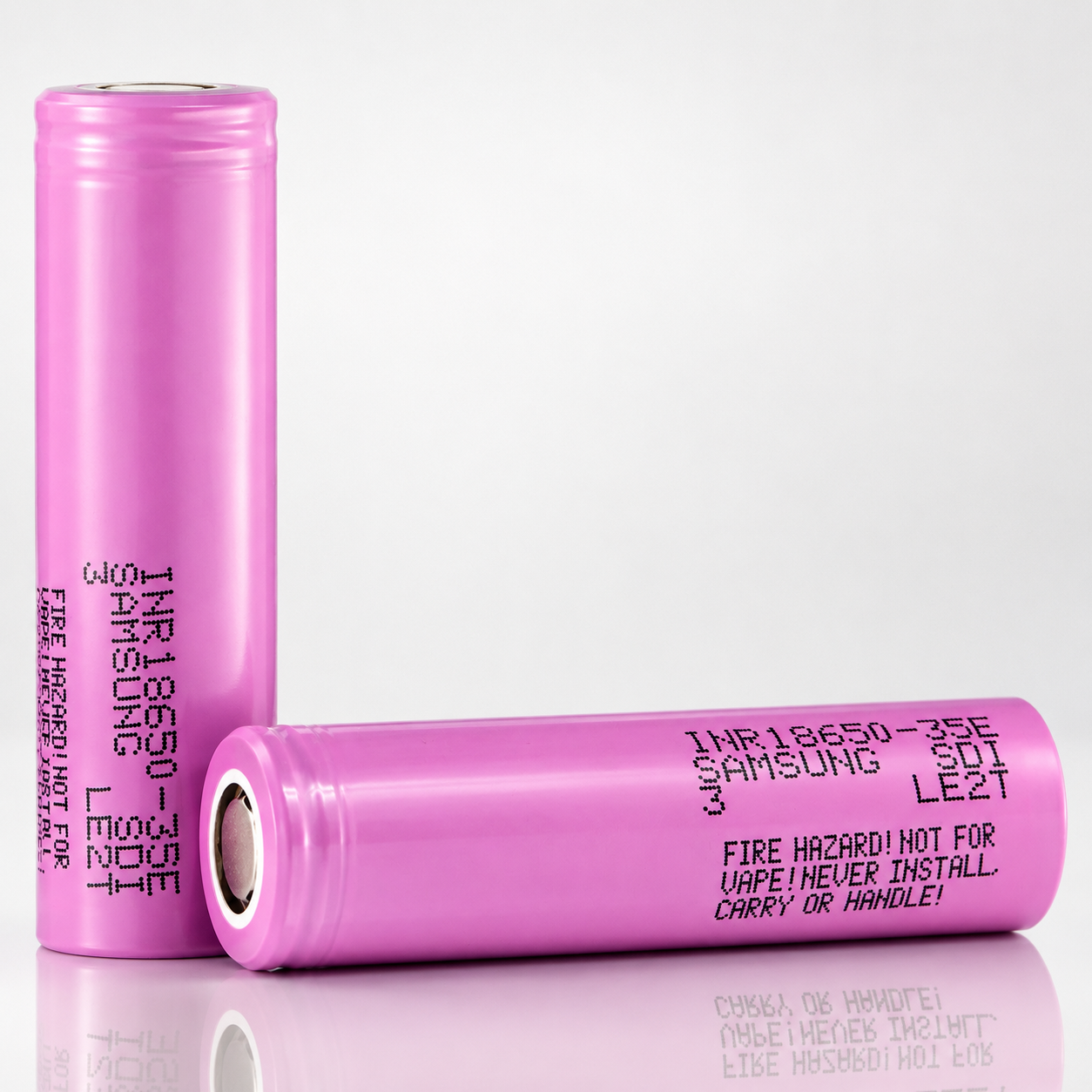
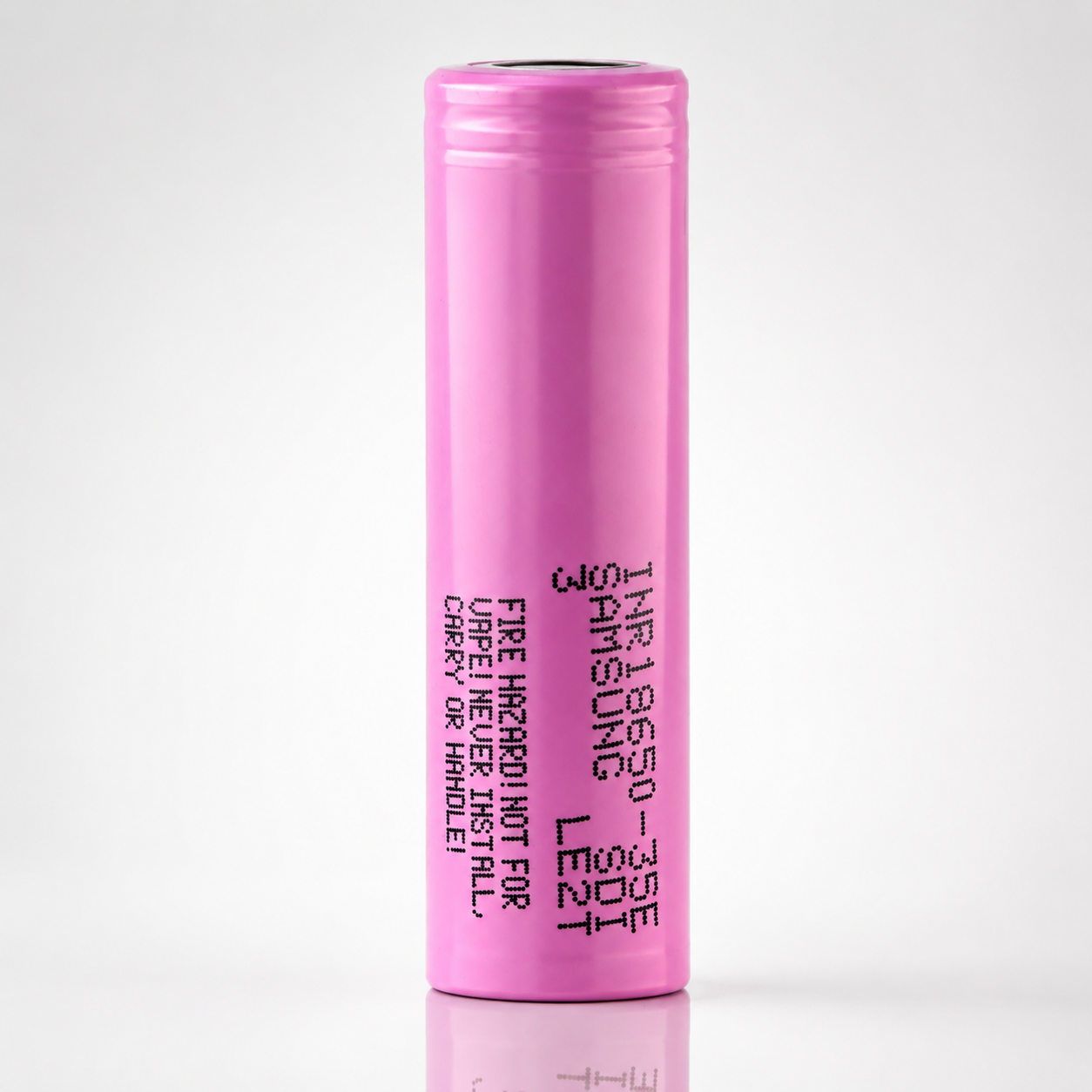
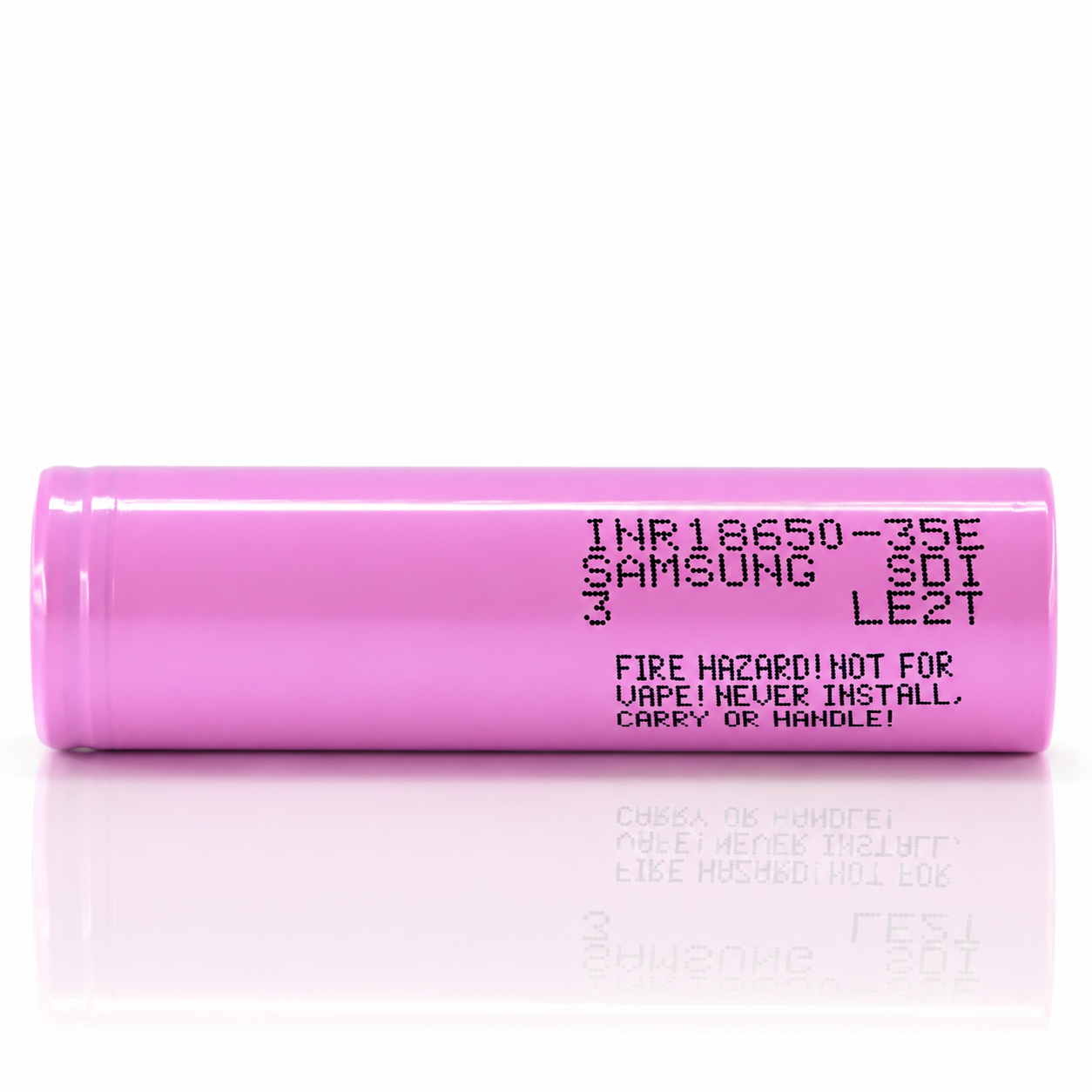


product description
Samsung 35E 18650
Samsung 35E 18650
3500mAh / 8A
High-capacity 18650 lithium-ion energy cell designed for moderate-drain applications that prioritize long runtime, dependable voltage delivery, and proven Samsung SDI pack integration.
3500mAh Product Listing 3350mAh Samsung Min. Standard Capacity 8A Continuous Discharge 3.6V Nominal Voltage 18650 Flat Top / Unprotected
3500mAhProduct Listing Capacity
3350mAhSamsung Min. Standard Capacity
8AMax Continuous Discharge
2AMax Charge Current
≤35mΩInitial AC Impedance
18.55 × 65.25mmMax Cell Envelope
Samsung 35E 18650 3500mAh 8A Battery
The Samsung 35E is a high-capacity 18650 cell designed for applications where runtime and stable moderate-current operation matter more than extreme high-drain output. It is widely used in battery packs, power banks, backup modules, medical/industrial equipment, low-to-moderate drain lighting, and portable electronics that can stay within its 8A continuous current rating.
| Brand / Model | Samsung SDI INR18650-35E |
|---|---|
| Cell Type | 18650 cylindrical lithium-ion rechargeable cell |
| Product Listing Capacity | 3500mAh |
| Samsung Standard Capacity | 3350mAh minimum after 0.5C charge and 0.2C discharge to 2.65V |
| Rated Capacity | 3250mAh minimum at 1C discharge to 2.65V |
| Nominal Voltage | 3.60V |
| Charge Voltage | 4.20V |
| Discharge Cut-Off Voltage | 2.65V Samsung data-sheet test cut-off; live listing states 2.5V |
| Charging Method | CC-CV with limited current |
| Standard Charge Current | 1.7A, 4.2V, 68mA cut-off |
| Cycle-Life Charge Current | 1.02A with 100mA cut-off |
| Maximum Charge Current | 2A, not for cycle-life condition |
| Maximum Continuous Discharge | 8A for continuous discharge |
| Non-Continuous Discharge Reference | 13A, not for continuous discharge |
| Initial Internal Impedance | ≤35mΩ AC at 1kHz after standard charge |
| Dimensions | 18.55mm max diameter × 65.25mm max height |
| Weight | 50g max; product listing states approximately 48g |
| Operating Temperature | Charge: 0°C to 45°C; Discharge: -10°C to 60°C |
| Storage | 1 year: -20°C to 25°C; 3 months: -20°C to 45°C; 1 month: -20°C to 60°C at ex-factory state |
| Protection | No — unprotected bare cell |
Electrical operating envelope at a glance.
These quick-reference visuals summarize the 35E’s energy-cell profile, voltage window, charge/discharge rates, and C-rate interpretation.
1. Current Capability Stack
A simple comparison of key charge, discharge, and non-continuous reference points.
2. Voltage Operating Window
Samsung test cut-off, listing cut-off, nominal voltage, and full-charge reference points.
3. Capacity and Energy Translation
Headline watt-hours use the product listing capacity; conservative pack math can use Samsung’s minimum capacity.
4. C-Rate Conversion
Samsung defines 1C as 3.4A in the INR18650-35E specification.
| 0.2C | 680mA standard capacity discharge test |
|---|---|
| 0.5C | 1.7A standard charge |
| 1C | 3.4A rated capacity discharge test |
| 2C | 6.8A discharge-rate capability test |
| 8A | ≈2.35C continuous discharge rating |
| 13A | ≈3.82C non-continuous reference |
Runtime-focused 18650 behavior with moderate discharge capability.
Samsung’s 35E is optimized for capacity and longevity rather than high-drain output. The data-sheet rate table shows relative capacity of 100% at 0.2C, 97% at 1C, 95% at 2C, and 92% at 8A. That means the cell remains usable at the 8A limit, but voltage sag and heat should still be considered in pack design.
The simplified discharge-curve graph below illustrates voltage versus delivered capacity under light, moderate, and maximum-continuous loading. It is a presentation graph for customer education, not a digitized laboratory curve.
Discharge rate capability summary
| 0.2C / 680mA | 100% relative capacity |
|---|---|
| 1C / 3.4A | 97% relative capacity |
| 2C / 6.8A | 95% relative capacity |
| 8A | 92% relative capacity |
| Interpretation | The 35E is best for long-runtime moderate-drain systems; use high-power cells for heavier continuous loads. |
5. Simplified Discharge-Curve Graph
Voltage vs. capacity illustration under 0.68A, 3.4A, 6.8A, and 8A discharge. Simplified for product-page visualization.
6. Estimated IR Voltage Drop
Using the published ≤35mΩ AC impedance as a quick order-of-magnitude planning reference. Real DC sag depends on temperature, SOC, age, and pack interconnects.
Temperature, charge rate, and cycle-life behavior.
The 35E is best deployed in a controlled moderate-load environment. Samsung’s test tables show lower cold-temperature capacity, strong room-temperature charge capability, and a 500-cycle criterion under a reduced cycle-life charge current.
7. Charge Profile Reference
Standard charge is 1.7A CC/CV to 4.2V with a 68mA cut-off; max charge current is 2A, not for cycle life.
8. Charge Temperature / Charge Rate Effects
Samsung’s relative capacity tables for charge temperature and 0.5C vs. 1C charge conditions.
| Charge at 0°C | 60% relative capacity after subsequent 23°C discharge |
|---|---|
| Charge at 23°C | 100% relative capacity |
| Charge at 45°C | 100% relative capacity |
| 0.5C / 1.7A charge | 100% relative capacity reference |
| 1C / 3.4A charge | 97% relative capacity reference |
| Recommended interpretation | Use standard charge current when cycle life and repeatability matter. |
9. Thermal Operating Envelope
Samsung operating ranges based on cell-surface temperature.
10. Temperature Discharge Capacity
Relative discharge capacity at 1C / 3.4A after standard charge at 23°C.
11. Discharge Rate Capability
Relative capacity by current after standard charge at 23°C.
12. Cycle-Life Visualization
Samsung criterion: ≥2010mAh after 500 cycles using 1.02A charge and 3.4A discharge.
Storage-performance note: after 20 days at 60°C following standard charge, Samsung specifies storage recovery of at least 3183mAh, or 95% of standard discharge capacity.
18650 dimensional envelope for holders, pack CAD, weld fixtures, and chargers.
The Samsung data-sheet envelope gives a maximum 18.55mm diameter and 65.25mm height. Confirm physical fit in any device, holder, charger bay, tube light, or welded battery pack.
13. Cell Dimension Diagram
Mechanical envelope based on Samsung INR18650-35E maximum dimensions.
14. Pack Scaling Formulas
Quick math for series/parallel planning. Use Samsung minimum capacity for conservative engineering estimates.
Pack Voltage ≈ Series Count × 3.6V
Pack Capacity ≈ Parallel Count × 3.5Ah listing
Conservative Capacity ≈ P × 3.35Ah
Pack CDR ≈ Parallel Count × 8A
15. Example Parallel Scaling
Approximate scaling, assuming balanced cells and proper thermal/electrical design.
| 1P | 3.5Ah listing capacity, approx. 12.6Wh, 8A CDR |
|---|---|
| 2P | 7.0Ah, approx. 25.2Wh, 16A CDR |
| 3P | 10.5Ah, approx. 37.8Wh, 24A CDR |
| 4P | 14.0Ah, approx. 50.4Wh, 32A CDR |
| 5P | 17.5Ah, approx. 63.0Wh, 40A CDR |
16. Common Series Voltage Examples
Nominal voltage examples only. Full-charge and cut-off pack voltages scale separately.
| 1S | 3.6V nominal / 4.2V full |
|---|---|
| 3S | 10.8V nominal / 12.6V full |
| 4S | 14.4V nominal / 16.8V full |
| 5S | 18.0V nominal / 21.0V full |
| 10S | 36.0V nominal / 42.0V full |
| 13S | 46.8V nominal / 54.6V full |
Use the 35E inside a moderate-current, voltage-managed system.
The 35E is an unprotected high-capacity 18650 cell. It should be used only inside compatible devices or battery packs that provide proper lithium-ion charge control, discharge cutoff, current limiting, and temperature protection.
17. Suggested Control Threshold Map
System-level control guidance derived from the listing and Samsung specification.
| Charge upper limit | 4.20V per cell |
|---|---|
| Samsung test cut-off | 2.65V per cell |
| Live listing cut-off | 2.50V per cell |
| Charge temperature gate | 0°C to 45°C surface temperature |
| Discharge temperature gate | -10°C to 60°C surface temperature |
| Continuous current | 8A per cell maximum continuous discharge |
| Non-continuous current | 13A is not a continuous rating and should not be advertised as CDR |
18. Risk-Control Checklist
Recommended pack-building and use practices.
- Use only in devices or packs designed for lithium-ion 18650 cylindrical cells.
- Use a BMS or controller that monitors voltage, current, and temperature.
- Do not charge above 4.20V per cell.
- Do not design finished packs above the verified 8A per-cell continuous rating.
- Do not use if the wrap, terminal, or top insulator ring is damaged.
- Spot weld for pack assembly; do not solder directly to the cell body.
- Never carry loose cells with keys, coins, tools, or other conductive objects.
- Do not mix old/new cells or different models in the same pack.
Best suited for runtime-first 18650 systems with moderate current demand.
Battery Packs
- Excellent fit for high-capacity moderate-current 18650 packs.
- Popular for packs where runtime matters more than peak power.
Power Banks
- Strong choice for portable energy storage and USB power systems.
- High capacity helps reduce cell count for a given watt-hour target.
Backup Systems
- Appropriate for standby and low-to-moderate discharge systems.
- Pack protection and storage conditions are still essential.
Medical / Industrial Devices
- Useful for long-runtime equipment with controlled current draw.
- Best in products that manage cutoff and charge behavior precisely.
Efficient Lighting
- Good for regulated LED lights that stay under the 8A cell limit.
- Not the ideal choice for extreme-output high-drain flashlights.
Consumer Electronics
- Useful in moderate-drain electronic products where energy density is the priority.
- Confirm physical fit and protection requirements before installation.
19. Selection Bias: Runtime vs. Current
for shoppers comparing high-capacity and high-drain cells.
20. Application Suitability Matrix
Simple product-page fit guidance.
| Power banks | Strong fit |
|---|---|
| Runtime-focused packs | Strong fit |
| Backup systems | Strong fit |
| Efficient flashlights | Good if current-limited |
| Power tools | Choose high-drain cells |
| Extreme-output lighting | Choose higher CDR cells |
Safety, Handling & Compatibility Notice
This product is an unprotected lithium-ion cell. It should only be used by customers who understand cell-level lithium-ion safety and who are using the battery in compatible hardware, managed packs, or professionally designed assemblies. Improper use can lead to overheating, venting, fire, or explosion.
- Charge only with lithium-ion chargers or managed battery systems designed for the correct chemistry and cell count.
- Never short circuit, crush, puncture, incinerate, or expose the cell to water.
- Do not use cells with damaged wraps, dented cans, or missing top insulator rings.
- Do not mix with cells of different age, model, capacity, or state of charge in the same pack.
- For assembly, use spot welding rather than direct soldering to reduce heat damage risk.
- Store and transport in non-conductive cases; never carry loose cells in pockets or bags.
- Keep away from children and from applications for which the product is not specified.
- Not for e-cigarette, vape, or similar use.
Common technical questions about the Samsung 35E.
What is the capacity of the Samsung 35E?
The product listing advertises 3500mAh. Samsung’s specification lists 3350mAh minimum standard discharge capacity and 3250mAh rated capacity under its defined test conditions.
What is the continuous discharge rating?
The maximum continuous discharge rating is 8A. Samsung also lists 13A, but clearly identifies it as not for continuous discharge.
Is the Samsung 35E a high-drain battery?
No. It is better described as a high-capacity, moderate-drain 18650 cell. Choose the 35E when runtime matters most and current demand remains within the 8A continuous rating.
What charger should be used?
Use a lithium-ion charger or pack-management system with a CC-CV profile to 4.20V per cell. Samsung’s standard charge current is 1.7A, with a 2A maximum charge current not intended for cycle-life testing.
What is the discharge cut-off voltage?
The live listing states 2.5V. Samsung’s data sheet uses 2.65V for its capacity and rate tests. Pack designers should set cut-off according to the latest data sheet, device needs, and desired service life.
Can the Samsung 35E be used in battery packs?
Yes. It is a common cell for custom packs where runtime and energy density matter. Proper cell matching, spot welding, insulation, fusing, BMS protection, and thermal validation are required.
Can I solder wires directly to this cell?
Direct soldering is not recommended. Spot welding is the preferred pack-assembly method because it reduces the risk of heat damage to the cell.
What are the cell dimensions?
Samsung’s maximum dimensions are 18.55mm diameter and 65.25mm height. The product listing describes approximately 18.3mm diameter and 65.0mm length.
What temperature range is allowed?
Samsung specifies 0°C to 45°C for charging and -10°C to 60°C for discharging based on cell-surface temperature.
What does ≤35mΩ internal resistance mean?
It is Samsung’s initial AC impedance limit at 1kHz after standard charge. It can help with comparison, but real pack voltage sag also depends on temperature, state of charge, wiring, welds, nickel, holders, and BMS resistance.
How many cycles should I expect?
Samsung’s criterion states capacity of at least 2010mAh after 500 cycles under its defined cycle-life condition. Actual cycle life depends on charge voltage, discharge current, temperature, depth of discharge, storage, and pack design.
Can I carry this battery loose?
No. Loose transport is unsafe because conductive objects can short the terminals. Always use a non-conductive battery case.
Customer Reviews
Overall rating: 4.8 / 5 from 196 reviews.
Delivery was prompt. All six batteries charged quickly and provide the power promised.

Almost got scammed by a fake store, but this is the real deal. The batteries are legit, the checkout was easy & fast, and the delivery was quick. Would definitely buy again.
quality items and great price
Best site to order the batteries you need. Fast delivery and they charge up perfectly.
Battery’s lasted one day
Muy buenas y buen presio
Easy ordering and a very nice selection. Will order from again!
Work well in Fatshark Recon goggles, will be moving a set to my RadioMaster Pocket in the near future.

Yeah so I have an 18650 inside a Sega Dreamcast because the original battery died. Why did I do this? I don't ever want to change the battery again :)
The fit and finish all these batteries is really good. I’m using them in a lab 599 TX – 550 MP..
I'm happy with my purchase. Price was reasonable and shipping was fast. Thanks for everything.
Arrived early, exactly what I wanted. Very happy with the whole transaction. Easy
Great batteries!
Batteries delivered as expected and work great.
Good quality product, responsive shipping, very consistent specs on the batteries upon arrival. Will definitely use them again.
Came very quickly and well packaged. All batteries worked great. ThankYou
Fast shipping! Product as described! Will shop here again!

Love these batteries! Very fast and reliable shipping 👍🤘
Quick delivery.
Just what I needed to power my home made radio control transmitters!
Great batteries and quick delivery
Purchased 4 18650 batteries. They came in 2 plastic carrying/storage cases and work great. Couldn't be happier.
Great battery and fast shipment.
Works perfectly !
Fantastic
These are batteries. They do battery things.
It charges and works, what more is there to say.
Perfect replacement for the dead batteries in my portable fan. Right power with more longevity.
Fast shipping and a great price for very well made cells.
Works great in my radiomaster pocket.
Battery works great. Packaging was awesome and very safe. Very happy with my purchase.
great batteries at a good price delivered quickly
The batteries received does not have "Samsung" in the printed marking, although the picture in the listing shows Samsung clearly. Makes me think the batteries shipped to me are Knock-offs!

It's nice to know you can still trust Honest Company to sell the real deal. Way too many big vendors advertise the battery is a Samsung and turn out to be bogus. It's the guts inside, and the tests prove it. Don't fall for the cheap, ridiculously low price; it's not what you think, from you know where, far, far away. And if you are using these in something you need to rely on, these are your go-to vendor. Remember, fire is also a top priority when it comes to any install. Brew P. from AirSignal.LBI Repeaters
These batteries work great for my Monster Speakers and last at least 6 hours during a pool party.
Ordered these rechargeable batteries for some LED flow art and they work great! Shipped out quickly too – thanks!
Very fast shipping

These batteries are amazing! The battery life is great and the effortlessly power two autonomous robotics I built. Learn more at lumalien.com
Perfect battery cells for building a pack to replace the expired 18650 2S pack in a small solar panel that drives a fountain in my garden. I was able to re-use the BMS chip from the original 2S pack. Might want to think about selling those battery BMS circuits for those building packs so buyer won't have to go to AliExpress.