

I love these particular cells. They are very reliable for building battery packs.
Ships from Stockbridge, GA · Most in-stock orders ship within 1 business day · Call 1-800-547-3050
Wholesale and bulk pricingMost in-stock orders ship within 1 business dayCall 1-800-547-3050Wholesale and bulk pricing
Call or text a person
Call 1-800-547-3050Text 1-833-419-2192support@18650batterystore.comMonday to Friday, 9 AM to 5 PM Eastern
Other sizes
Other sizes: see allCell sizes
Household sizes
Which size do I have?
The number is the size. An 18350 is 18 mm across and 35 mm long; a 26650 is 26 mm across and 65 mm long.
18650 sizing explainedCan't find your size? Call 1-800-547-3050
Learn
Learn: overview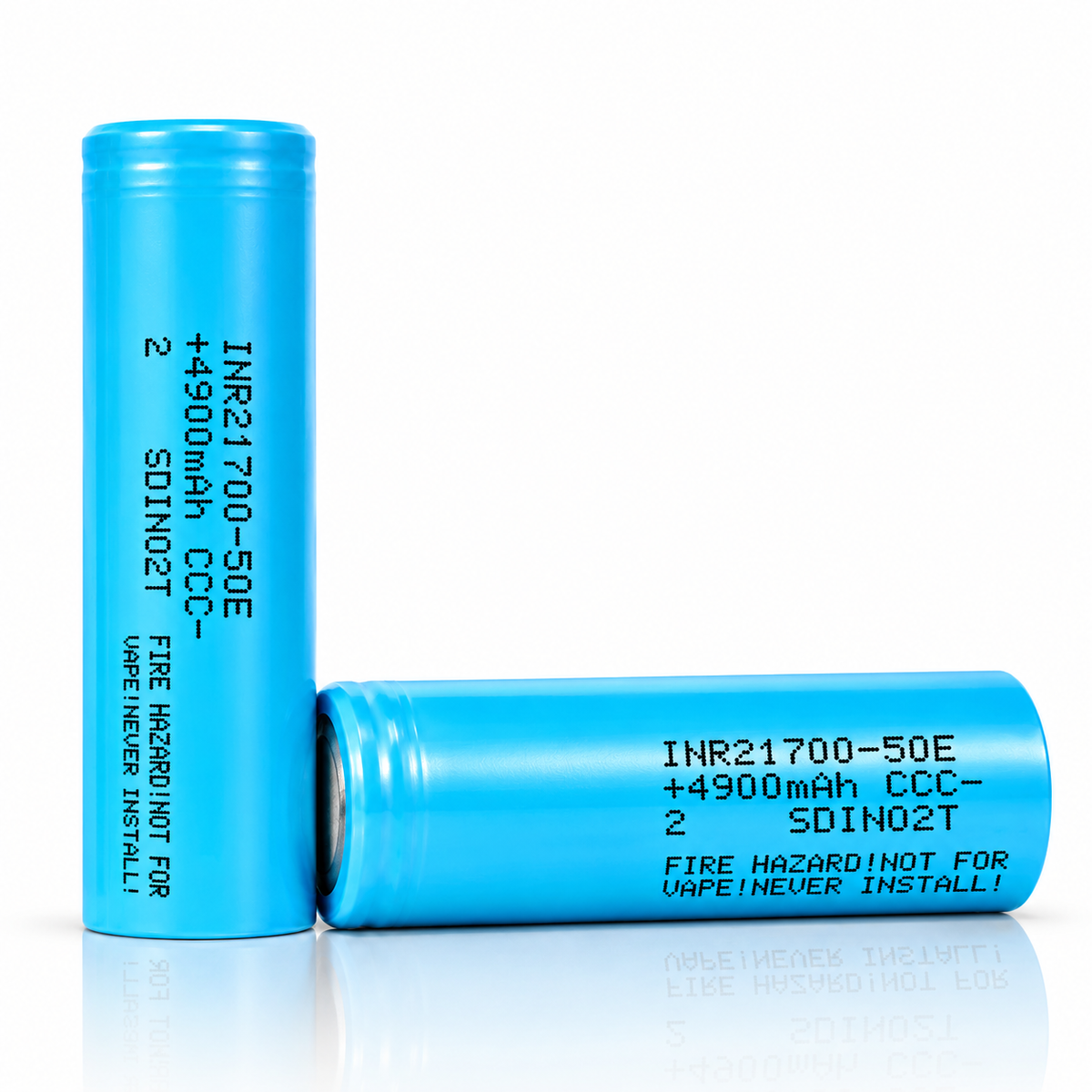
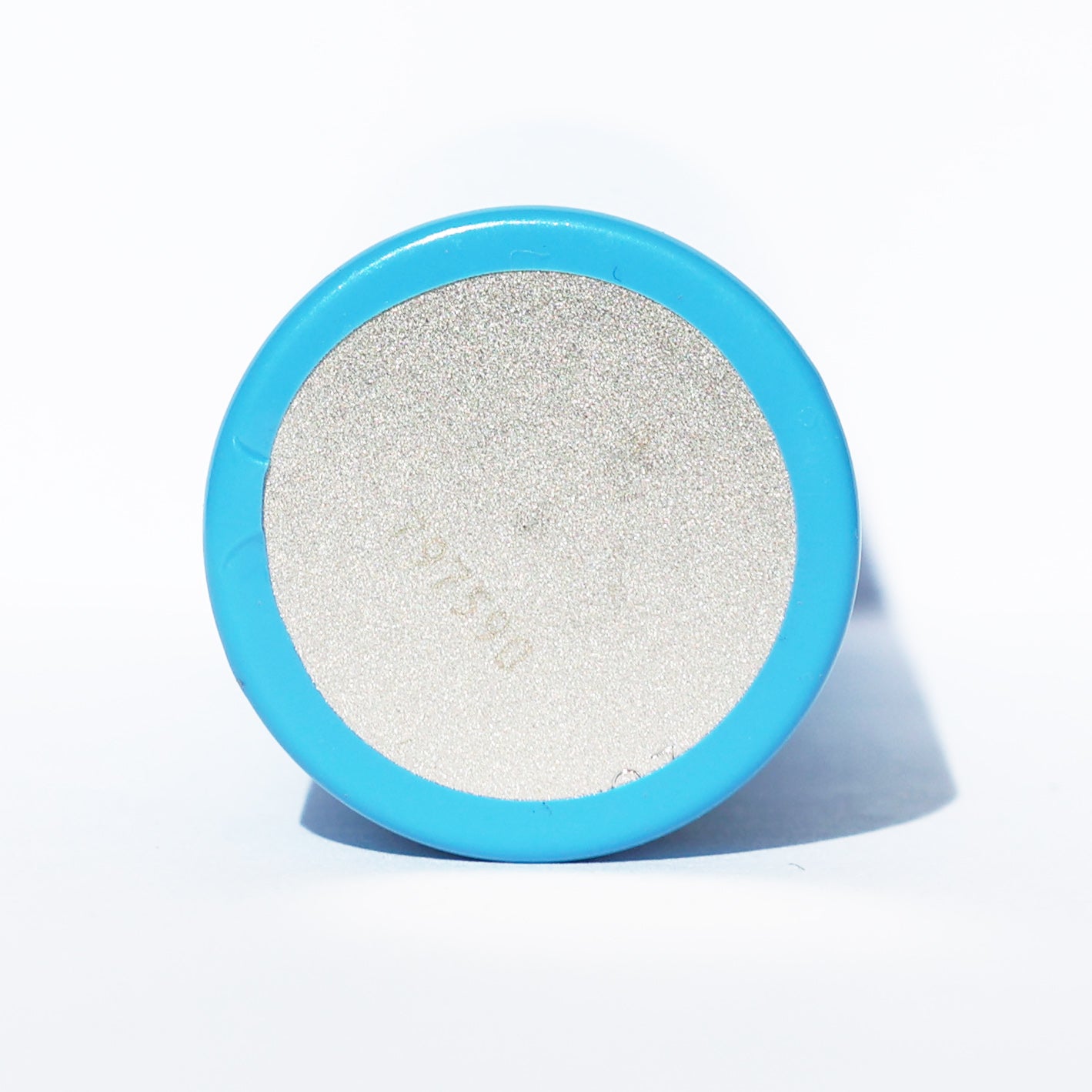


[1] Specification of Product, SDI Model INR21700-50E, Version No. V1.0, on file since 2025-12-08
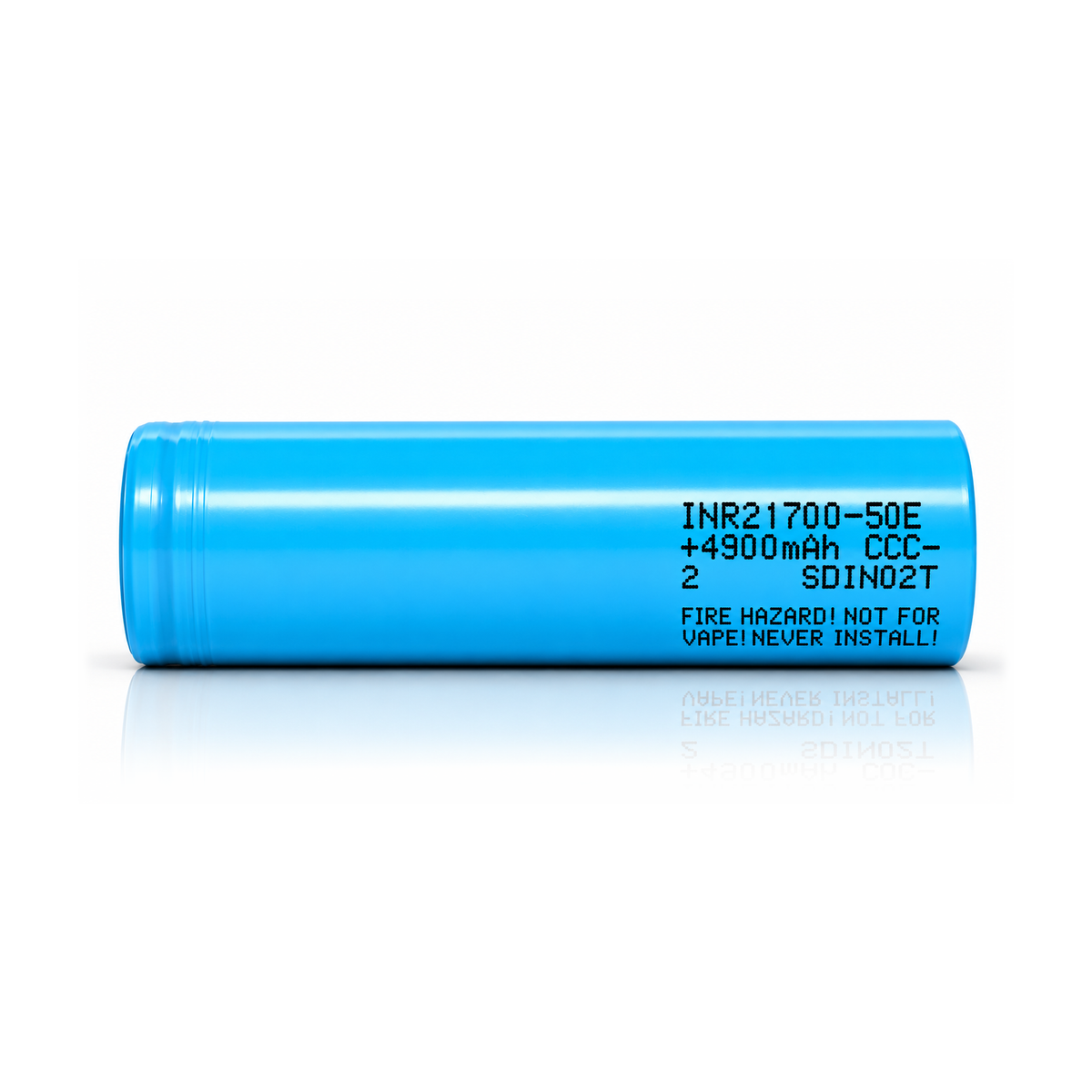
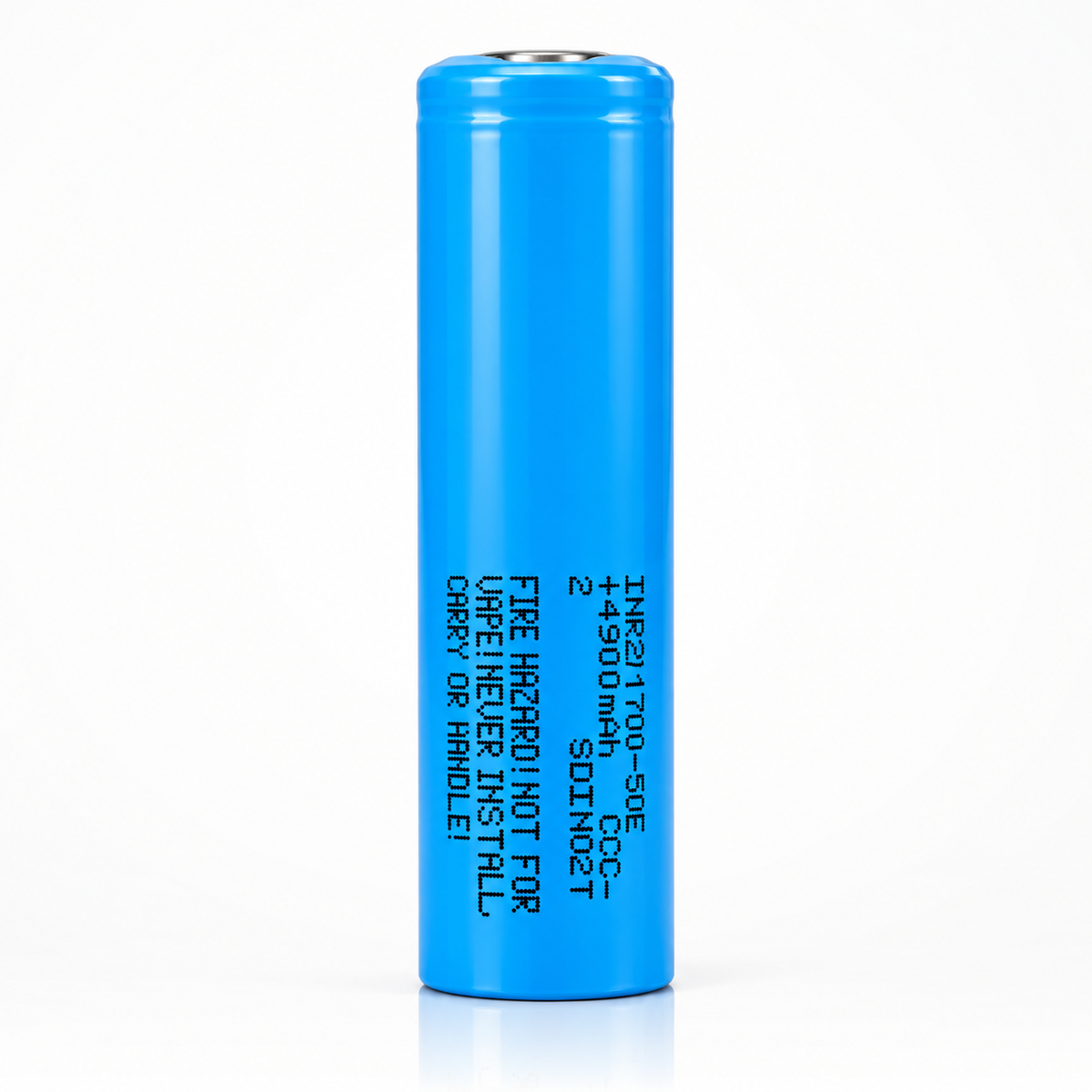
A 21700 lithium-ion cell: 4,900 mAh standard minimum capacity at 0.2C, 4,753 mAh rated minimum at 1C, and 9.8 A maximum discharge current, printed “9,800mA (for continuous discharge)” [1]. Below: every rating with its condition, the figures Samsung prints in its tables and reports, and what we calculated from them, so you can check each number.
A bare cell: a component for protected packs and devices built for it. Not for vaping. Charge on a lithium-ion (Li-ion) charger that stops at 4.2 V.
01SPEC PLATE
Samsung’s data sheet for the 50E is titled Specification of Product [1]; this page calls it the specification. The newest we hold is Version No. V1.0, dated 2018-07-11. Its ratings come first, copied as printed. Then the capacity figures its tables print, our arithmetic, and facts from the safety data sheet (SDS) [3] and the UN38.3 transport test report [4]. Each row names its source or shows its formula.
| SPECIFICATION | VALUE | CONDITION · SOURCE |
|---|---|---|
| RATED · MANUFACTURER copied from specification [1] | ||
| MODEL CODE | INR21700-50E | Spec. No. and SDI Model, as printed [1] |
| CAPACITY, STANDARD | 4,900 mAh | minimum; 0.2C (980 mA) to 2.5 V after standard charge, at 23 °C [1] |
| CAPACITY, RATED | 4,753 mAh | minimum; 1C (4,900 mA) to 2.5 V after standard charge, at 23 °C; printed as 97 % of 4,900 mAh [1] |
| CAPACITY, TYPICAL | — | Not stated by manufacturer [1] |
| 1C | 4,900 mA | the current [1] defines as 1C |
| NOMINAL VOLTAGE | 3.63 V | [1] |
| CHARGE VOLTAGE | 4.2 V | charging method “CC-CV (constant voltage with limited current)” [1] |
| DISCHARGE CUT-OFF | 2.5 V | end of discharge [1] |
| STANDARD CHARGE | 2.45 A | 0.5C (2,450 mA), CC-CV to 4.2 V, 0.02C (98 mA) cut-off, at 23 °C; charging time 4 hours [1] |
| MAX. CHARGE CURRENT | 4.9 A | “4,900mA (not for cycle life)”; no charging time printed for it [1] |
| MAX. DISCHARGE CURRENT | 9.8 A | “9,800mA (for continuous discharge)”; no temperature or other condition printed with it; the non-continuous figure is left out [1] |
| CHARGE TEMPERATURE | 0 to 45 °C | ambient [1] |
| DISCHARGE TEMPERATURE | −20 to 60 °C | ambient; a pack’s discharge over-temperature protection “should not be over 70°C of Cell surface temperature” [1] |
| AC IMPEDANCE | ≤ 28 mΩ | initial internal impedance, AC 1 kHz, after standard charge [1] |
| CYCLE LIFE | ≥ 3,802 mAh | after 500 cycles: 2,450 mA charge to 4.2 V, 0.05C (245 mA) cut-off; 1C (4,900 mA) discharge to 2.5 V; room temperature; 80 % of the rated discharge capacity [1] |
| RECOVERY AFTER STORAGE | ≥ 4,410 mAh | 20 days at 60 °C from standard charge, then 0.2C (980 mA) to 2.50 V at 23 °C; 90 % of the standard discharge capacity [1] |
| RECOVERY 80 % AFTER STORAGE | −20 to 23 °C | for 1 year; −20 to 45 °C for 3 months; −20 to 60 °C for 1 month; kept at the ex-factory “30% of charge” [1] |
| STORAGE | 0 to 23 °C | humidity below 65 %; long-term at the shipping voltage; the pack guideline recommends 20 °C [1] |
| AS SHIPPED | 3.53–3.63 V | ex-factory voltage; 30 % of charge [1] |
| DIAMETER | 21.25 mm | maximum, “Top Diameter”, with sleeve [1] |
| HEIGHT | 70.80 mm | maximum, with sleeve [1] |
| MASS | 69.5 g | maximum [1] |
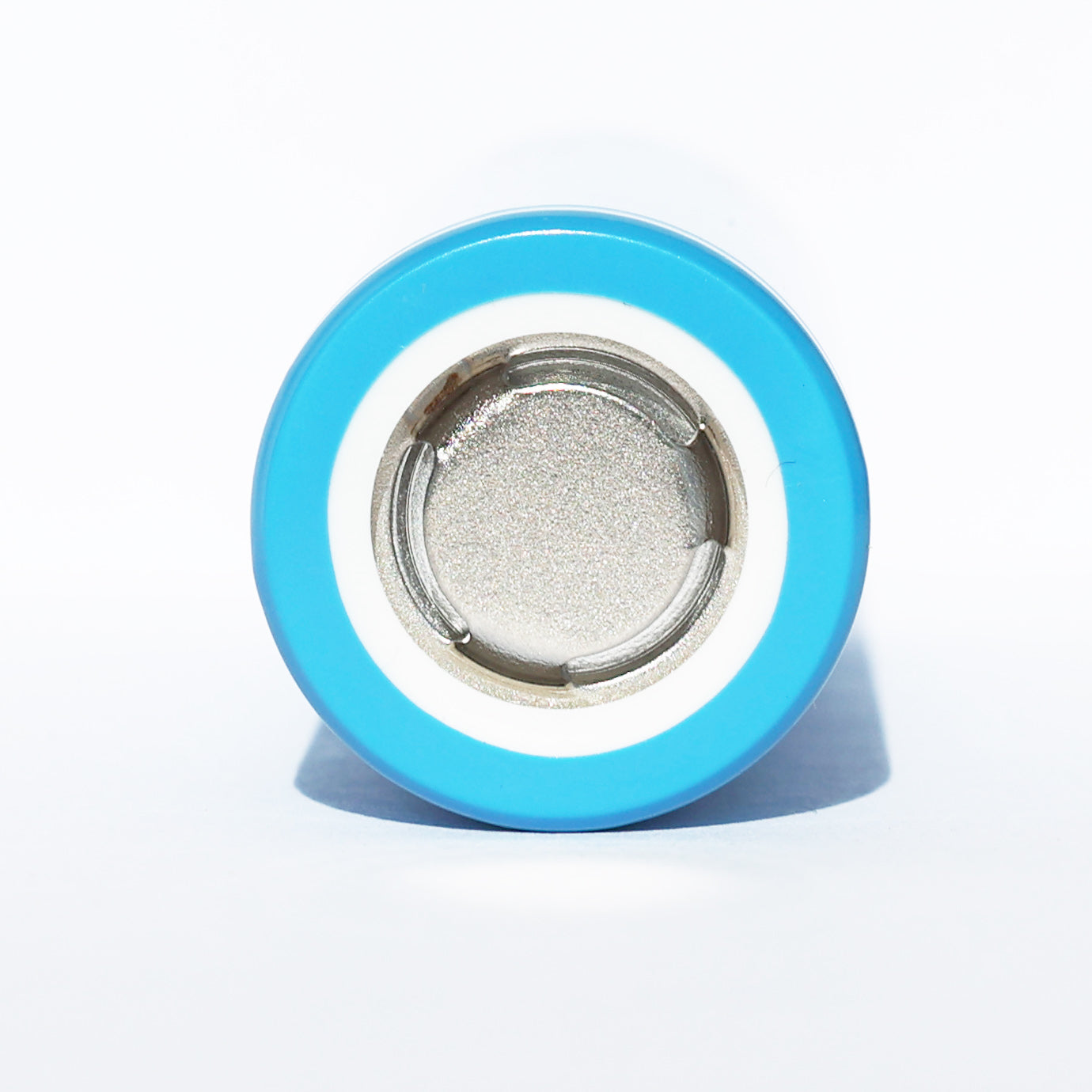
| TERMINAL · PROTECTION | Flat top · none | as sold: bare cell, no protection circuit; terminal style not stated in [1] |
| + Source: [1] Samsung SDI, Specification of Product, Spec. No. INR21700-50E, SDI Model INR21700-50E, Version No. V1.0 (“General Version” in its revision history), Date of Application 2018/07/11 (as printed); on file since 2025-12-08; not linked, because every page is headed “SAMSUNG SDI Confidential Proprietary” and watermarked with the name of the customer it was issued to. Call or text to ask about it | ||
| SPECIFICATION | VALUE | CONDITION · SOURCE |
|---|---|---|
| PRINTED IN THE SPECIFICATION’S TABLES percent of the 4,900 mAh standard discharge capacity, as printed; mAh calculated [1] | ||
| CAPACITY AT 2C (9.8 A) | 95 % | ≈ 4,655 mAh; to 2.50 V after standard charge at 23 °C; [1] §7.6 |
| CAPACITY AT 1C (4.9 A) | 97 % | ≈ 4,753 mAh, matching the 4,753 mAh rated minimum; [1] §7.6 |
| DISCHARGE AT −10 °C | 70 % | ≈ 3,430 mAh at 1C (4,900 mA), after standard charge at 23 °C; [1] §7.5 |
| DISCHARGE AT 40 °C | 97 % | ≈ 4,753 mAh at 1C; 23 °C also prints 97 %, because the table discharges at 1C; [1] §7.5 |
| CALCULATED arithmetic on [1], shown so you can check it | ||
| MAX. DISCHARGE AS C-RATE | 2C | 9,800 mA “for continuous discharge” ÷ 4,900 mA, the 1C in [1]; [1] §7.6 prints “2C (9,800mA)” |
| MAX. CHARGE AS C-RATE | 1C | 4,900 mA “not for cycle life” ÷ 4,900 mA [1] |
| RUNTIME AT 9.8 A | 28.5 min | 4,655 mAh ÷ 9.8 A, from [1] §7.6 |
| ENERGY, MINIMUM | 17.79 Wh | 3.63 V nominal × 4,900 mAh standard minimum [1]; 17.25 Wh with the 4,753 mAh rated minimum |
| VOLUME | 25.1 cm³ | π × (21.25 ÷ 2)² × 70.80 mm³, the maximum size [1] |
| FROM THE SAFETY DATA SHEET (SDS) AND UN38.3 TRANSPORT TEST REPORT copied as printed from [3] and [4] | ||
| CHEMISTRY | Li-ion | [1] says lithium-ion only; the SDS prints “Battery-System: Lithium-ion (Li-ion)” and describes the cathode as “based on lithiated metal oxide (Cobalt, Nickel)” [3] |
| ENERGY RATING | 17.787 Wh | “Wh rating: 17.787 Wh”, SDS [3]; “17.78Wh” in the UN38.3 report [4] |
| RATED CAPACITY, SDS | 4.90 Ah | “Rated Capacity: 4.90 Ah”, no condition printed [3]; “4900mAh” in [4]; not the same figure as [1]’s 4,753 mAh rated discharge capacity at 1C |
| TRANSPORT | UN3480 · Class 9 | “UN Number : 3480”, packing group II; UN3481 when packed with or contained in equipment [3] |
| UN38.3 | SDI-UN-200714-03 | Ver.03, issued 2020-07-14, test dates 2018-11-27 to 2018-12-29; T1–T6 and T8 PASS; T7 N/A, remark “Battery only” (a test for batteries, not cells); Samsung SDI is named as both lab and manufacturer; cited, not linked [4] |
| MASS · UN38.3 TEST CELLS | 69.011–69.283 g | the 10 cells weighed before T1 [4]; not our lot; maximum 69.5 g [1] |
| SAFETY DATA SHEET | Revision no.: 01 | dated 2020-01-01; section 16.1 prints “Date Updated : 28 June. 2018”; MODEL INR21700-50E [3] |
| STORAGE · SDS | ≈ 20 °C | “Storage at room temperature (approx. 20℃) at approx. 40% of the nominal capacity” [3] |
| + Source: [1] Samsung SDI, Specification of Product, Spec. No. INR21700-50E, SDI Model INR21700-50E, Version No. V1.0 (“General Version” in its revision history), Date of Application 2018/07/11 (as printed); on file since 2025-12-08; not linked, because every page is headed “SAMSUNG SDI Confidential Proprietary” and watermarked with the name of the customer it was issued to. Call or text to ask about it + Source: [3] Samsung SDI, Safety Data Sheet, MODEL INR21700-50E, Revision no.: 01, January 1st 2020 (its section 16.1 prints “Date Updated : 28 June. 2018”); prepared “In accordance with Regulation (EU) 2015/830 (REACH), Annex II, and OSHA 29 CFR 1910.1200”; its closing section XVI names other product codes (PA0001N0006A/PA0001N0007A/PA001N0008A), as printed, while its page headers and section 1.1 name the INR21700-50E; on file 2026-10-20 · SDS PDF + Source: [4] Samsung SDI, UN TEST REPORT, Test Summary, Model Name INR21700-50E, SDI-UN-200714-03 Ver.03, issued 2020.07.14; test dates 2018.11.27~2018.12.29; to the “Manual of Tests and Criteria, section 38.3 Sixth revised edition Amendment 1”; Samsung SDI Co., Ltd is named as both the testing laboratory and the manufacturer, Cheonan, Korea; on file 2026-10-20; quoted and cited here but not linked, because its first page carries a Samsung SDI notice, in Korean, that the information may not be printed, distributed or taken out without the permission of Samsung SDI’s information-asset manager (our translation). Call or text to ask about it | ||
Black marks: rated voltages [1]. Orange band: the voltage cells ship at, 3.53–3.63 V, 30 % of charge [1]; its top equals the 3.63 V nominal voltage.
Currents as rated in [1], each with its condition. C-rates against the 4,900 mA that [1] defines as 1C. Its cycle-life rating charges at the same 2,450 mA as the standard charge. [1] also prints a second discharge figure, “not for continuous discharge”, with no duration or pulse definition; a non-continuous figure is not a rating, so it is left out.
Operating ranges as rated in [1], in °C, labeled ambient. Note (*2) of [1] adds that a pack’s discharge over-temperature protection “should not be over 70°C of Cell surface temperature”, set where the pack heats most. Last row: the temperatures of the capacity table in [1] §7.5, shown in section 04 below.
Storage time and temperature for which [1] specifies more than 80 % capacity recovery, with the cell kept as shipped, at 30 % of charge. Its handling section says to store cells at 0 to 23 °C, humidity below 65 % [1].
Each document’s capacity figure, as printed, on a 4,700–4,950 mAh scale; the axis doesn’t start at zero. 4,900 mAh is a minimum at 0.2C in [1] and a figure with no condition in [3] and [4]; [1]’s minimum at 1C is 4,753 mAh. “Rated” means different figures: the SDS calls its 4.90 Ah “Rated Capacity”, while [1]’s rated discharge capacity is the 4,753 mAh minimum at 1C. [1] prints no typical or nominal capacity, and none of the four documents prints a higher capacity figure.
Wh as printed in [3] and [4], beside our arithmetic for the specification [1], which prints no Wh figure. The SDS’s 17.787 Wh equals 3.63 V × 4.90 Ah; [4] prints “17.78Wh”. Scale 17.0–18.0 Wh.
The table in [1] §7.6 prints the 50E’s capacity at three currents, from 0.2C (980 mA) to 2C (9,800 mA), its maximum “for continuous discharge”, as a percent of the 4,900 mAh standard discharge capacity. At 9.8 A it prints 95 %: about 4,655 mAh, or about 28.5 minutes at 9.8 A by our arithmetic.
Data: [1] §7.6, discharge rate · after standard charge at 23 °C, to 2.50 V · percent of 4,900 mAh, mAh calculated · the line joins the three printed points; Samsung prints no curve between them · 9.8 A is the maximum “for continuous discharge” · axis starts at 4,600 mAh · data table under fig 3.1
03BY CURRENT
The table in [1] §7.6 prints the capacity at 0.2C, 1C and 2C (980, 4,900 and 9,800 mA) as a percent of the 4,900 mAh standard discharge capacity. The mAh and the runtime are arithmetic on those percents, with the formula under each.
Capacity to 2.50 V at each current, after standard charge at 23 °C, printed in [1] §7.6 as a percent of the 4,900 mAh standard discharge capacity; mAh = percent × 4,900. The 1C row matches the ≥ 4,753 mAh rated capacity [1]. Orange: 9.8 A, the maximum “for continuous discharge” [1].
| CURRENT | C-RATE | PRINTED % | mAh | RUNTIME |
|---|---|---|---|---|
| 0.98 A | 0.2C | 100 | 4,900 | 5 h 00 min |
| 4.9 A | 1C | 97 | 4,753 | 58.2 min |
| 9.8 A | 2C | 95 | 4,655 | 28.5 min |
Runtime = capacity ÷ current, from the mAh in fig 3.1: one full standard charge, constant current to 2.50 V at 23 °C. A device whose average draw is below its peak current runs longer than the figure at that peak.
04TEMPERATURE
One table in [1]: capacity when the discharge runs at −10, 23 and 40 °C, after a standard charge at 23 °C, all at 1C (4,900 mA). At −10 °C it prints 70 % of the standard discharge capacity. [1] prints no charge-temperature table.
Capacity when the discharge runs at each temperature: 1C (4,900 mA) to 2.50 V after standard charge at 23 °C, with 3 h at the test temperature first where it differs from the 23 °C charge. Printed in [1] §7.5 as a percent of the standard discharge capacity, 4,900 mAh at 0.2C; because this table discharges at 1C, 23 °C reads 97 %, not 100 %. mAh calculated. −10 °C is the coldest point printed; the rated discharge range goes down to −20 °C.
| DISCHARGE °C | CHARGE °C | PRINTED % | mAh | RUNTIME AT 4.9 A |
|---|---|---|---|---|
| −10 °C | 23 °C | 70 | 3,430 | 42.0 min |
| 23 °C | 23 °C | 97 | 4,753 | 58.2 min |
| 40 °C | 23 °C | 97 | 4,753 | 58.2 min |
Runtime = capacity ÷ 4.9 A, from fig 4.1: arithmetic on [1] §7.5. At −10 °C the same discharge ends after about 42.0 min, against 58.2 min at 23 °C.
05CHARGING
The specification rates a 2,450 mA standard charge, CC-CV to 4.2 V, with a printed charging time of 4 hours, and a 4,900 mA maximum that is “not for cycle life” [1]. Its cycle-life rating charges at 2,450 mA. Charge between 0 and 45 °C ambient [1].
Charging time as each specification prints it: “Standard charge: 3hours” in the tentative issue [2], “Standard charge : 4hours” in V1.0 [1], for the same 2,450 mA charge. Neither prints a time for the 4,900 mA maximum charge, or a charge curve. Values also in the section 08 table.
Voltage thresholds for a pack’s battery management system (BMS): the cell ratings in [1], and the pre-charge, re-charge and do-not-charge levels from the pack design guideline printed in [1]. The re-charge mark sits at 4.1 V, the highest the guideline allows. Below 1.0 V, the guideline says not to charge the cell at all.
Where charging is rated, in °C. V1.0 labels the range ambient [1]; the tentative issue [2] printed the same numbers as cell surface temperature. Orange: the V1.0 rating this page uses; black: the same range in the pack guideline [1]; gray: the tentative issue [2]. [1] prints no capacity table for charge temperature. Below 0 °C, don’t charge.
The values in fig 5.2 are printed as text in the pack design guideline of [1]; Samsung draws no chart of them. The guideline prints the charge cut-off as “must be under 4.2V” and the discharge cut-off as “must be over 2.5V”; the cell ratings are 4.2 V and 2.5 V [1]. In this section, figs 5.1 and 5.3 show the tentative issue [2] beside V1.0; section 08 below lists every changed figure.
06CYCLE LIFE AND STORAGE
[1] rates at least 3,802 mAh after 500 cycles, and at least 4,410 mAh after 20 days at 60 °C. It prints no cycle-life curve, so these are the two points on the page.
Minimum capacity as rated in [1]. New at 0.2C and after 20 days at 60 °C: 980 mA to 2.50 V at 23 °C. New at 1C and after 500 cycles: 4,900 mA to 2.5 V; each cycle charges at 2,450 mA to 4.2 V with a 0.05C (245 mA) cut-off, at room temperature. A rating, not a warranty, and not a curve: [1] prints no capacity between cycle 1 and 500.
State of charge for storage, as each document prints it. [1] says capacity recovers to more than 80 % after storage at the as-shipped charge (fig 1.4), and asks for long-term storage at the shipping voltage.
Storage temperature as each document prints it; each includes about 20 °C. Orange: the handling section’s range, which this page follows; gray: the 1-year recovery range from fig 1.4. For 3 months or more, [1] says “It is strongly recommended that the Cell is preserved at dry and low-temperature.”
07TRANSPORT TESTS
Samsung’s UN38.3 report [4] records PASS for T1–T6 and T8 on the INR21700-50E. T7, overcharge, is marked N/A with the remark “Battery only”: the UN38.3 overcharge test is for batteries, and this report covers the bare cell. Its tables also print what each cell did. Samsung SDI is named as both the testing laboratory and the manufacturer. The tests ran from 2018-11-27 to 2018-12-29, and the report was issued 2020-07-14, so it describes a manufacturer sample, not our lot. The report also records its packaging test, P1: a 1.2 m drop of a box of 130 cells, “Without release of contents”. We quote the report but don’t link it, because its first page carries a Samsung SDI notice restricting printing and distribution.
Highest external temperature of each cell, as printed in [4]: one tick per cell; the bar spans the lowest to the highest. T5 external short circuit: 10 fully charged cells, 5 at first cycle and 5 after 25 cycles (sample conditions A and B, which [4] prints for T1–T5); [4] prints no short-circuit resistance, temperature or duration. T6 impact (the report ticks impact, not crush): 10 cells at 50 % charge, 5 at first cycle and 5 at the 25th; no impact mass or drop height printed. T8 forced discharge: 20 fully discharged cells, 10 at first cycle and 10 after 25 cycles, initial current 4 A for 1 h, as printed. That is below the 9,800 mA maximum continuous discharge in [1]; [4] doesn’t say how the current was chosen. [4] prints no T8 temperatures, so T8 has no row. Pass criteria, condensed: T5 and T6, not over 170 °C, with no disassembly or fire (T5: or rupture) within 6 h; T8, no disassembly or fire within 7 days. [4] marks all 40 samples “O”: no disassembly and no fire, and in T5 no rupture.
| TEST | SAMPLE CONDITION, AS PRINTED | CELLS | MAX °C, EACH CELL | RANGE |
|---|---|---|---|---|
| T5 external short, first cycle | A: at first cycle, in fully charged states(5 pcs) | 5 | 103, 96, 105, 99, 112 | 96–112 °C |
| T5 external short, after 25 cycles | B: after 25th cycles ending in fully charged states(5 pcs) | 5 | 103, 95, 92, 106, 114 | 92–114 °C |
| T6 impact, first cycle | C: at first cycle, in 50% charged states(5 pcs) | 5 | 21, 22, 21, 22, 22 | 21–22 °C |
| T6 impact, 25th cycle | D: at 25th cycle, in 50% charged states(5 pcs) | 5 | 21, 21, 21, 22, 21 | 21–22 °C |
Open-circuit voltage after each test, as a percent of the voltage before it, printed in [4]: 10 cells, fully charged, 4.136–4.137 V before T1 and 4.035–4.036 V after T4. The same 10 cells ran T1 to T4: each test’s before-values are the previous test’s after-values in [4]. Where [4] prints a range, the mark shows its lower end. The scale starts at 85 %.
Mass of the 10 cells weighed before T1, as printed in [4]: 69.011–69.283 g (mean 69.17 g, our arithmetic), against the 69.5 g maximum in [1] and [4]. Percent of weight loss after each of T1–T4: 0.00–0.02 %, as printed [4]; cells 1 and 7 weighed 0.001 and 0.002 g more after T2 than before it, printed as 0.00 %. The axis starts at 68.8 g. A 2018 manufacturer sample, not our lot.
| CELL | BEFORE T1 g | AFTER T1 | AFTER T2 | AFTER T3 | AFTER T4 |
|---|---|---|---|---|---|
| 1 | 69.283 | 69.280 | 69.281 | 69.277 | 69.277 |
| 2 | 69.126 | 69.126 | 69.115 | 69.115 | 69.115 |
| 3 | 69.221 | 69.221 | 69.213 | 69.213 | 69.213 |
| 4 | 69.169 | 69.165 | 69.162 | 69.162 | 69.162 |
| 5 | 69.185 | 69.182 | 69.177 | 69.173 | 69.169 |
| 6 | 69.253 | 69.253 | 69.251 | 69.251 | 69.251 |
| 7 | 69.065 | 69.065 | 69.067 | 69.062 | 69.062 |
| 8 | 69.169 | 69.166 | 69.163 | 69.163 | 69.163 |
| 9 | 69.238 | 69.238 | 69.233 | 69.228 | 69.221 |
| 10 | 69.011 | 69.011 | 69.010 | 69.010 | 69.010 |
| TEST | METHOD, CONDENSED FROM [1] | CRITERIA | STANDARD NAMED | SECTION |
|---|---|---|---|---|
| Drop | Fully standard-charged cells dropped onto a concrete floor from 1.0 m, 3 times, in random orientations; at least 1 h of rest, then a visual inspection | No fire, no explosion. | IEC62133 | [1] §8.1 |
| Vibration | Per UN38.3, for each axis (X and Y for cylindrical cells): 7 Hz → 200 Hz → 7 Hz in 15 min, repeated 12 times, 3 h in total; 1 g from 7 to 18 Hz, and 8 g (amplitude 1.6 mm) to 200 Hz | No leakage, with less than 10% of OCV drop | UN38.3 | [1] §8.2 |
| Overcharge | Fully discharged cell charged at 4.6 V and 3C (14.7 A), at 23 °C, for 7 h | No fire, and no explosion. | UL1642 | [1] §9.1 |
| External short-circuit | Fully standard-charged cell shorted through an 80 ± 20 mΩ load until fire or explosion, or until it is below 0.2 V and its case is back within ± 10 °C of ambient; run at 20 ± 5 °C and at 55 ± 5 °C | No fire, and no explosion. | UL1642 | [1] §9.2 |
| Forced discharge | Discharged cell reverse-charged at 1.0C (4,900 mA) for 90 min | No fire, and no explosion. | IEC62133 | [1] §9.3 |
| Heating | Standard-charged cell heated at 5 °C per minute to 130 °C, then held 30 min in an oven | No fire, and no explosion. | UL1642 (10 min) and GB31241 (30 min) | [1] §9.4 |
Methods condensed in our words from sections 8 and 9 of [1]; criteria as printed, with the standard each names. [1] lists these as tests the cell is specified to meet and prints no results. Their voltages and currents, such as 4.6 V and 3C in the overcharge test, are abuse conditions, not ratings. The UN38.3 results above are a different set of tests, from [4].
08WHAT CHANGED
[2] is a 4-page specification marked Tentative, dated 2018-05-06, with blank signature blocks. [1]’s revision history lists one earlier version, v0.0 of 2017-10-13, “First version (Tentative)”, and no 2018-05-06 issue; neither document says whether [2] is that version. Some listings still quote [2]’s figures. In short, V1.0 prints a 3.63 V nominal voltage (was 3.6 V), a 69.5 g maximum mass (was 69 g) and a 4-hour standard charging time (was 3 hours) for the same 2,450 mA charge. Its diameter entry reads 21.25 mm, the figure [2]’s own drawing already printed; [2]’s table said 20.25 mm. It changes the recovery-after-storage test to 20 days instead of 30, discharged at 0.2C instead of 1C, so its 4,410 mAh doesn’t compare directly with [2]’s 4,278 mAh. It labels the operating temperatures ambient instead of cell surface, with the same values, and raises the discharge over-temperature limit from 60 to 70 °C. [1] doesn’t say why these changed, or whether anything changed inside the cell. Every rating on this page follows [1].
| ITEM | TENTATIVE, 2018-05-06 [2] | V1.0, 2018-07-11 [1] |
|---|---|---|
| Nominal voltage, §3.4 | “3.6V” | “3.63V” |
| Charging time, §3.7 | “Standard charge: 3hours” | “Standard charge : 4hours” |
| Recovery after storage: capacity, §3.13 | “Capacity recovery (after the storage) ≥ 4,278mAh” | “Capacity recovery (after the storage) ≥ 4,410mAh” |
| Recovery after storage: basis, §3.13 | “(90% of the Rated Discharge Capacity @ RT)” | “(90% of the Standard discharge capacity @ RT)” |
| Recovery after storage: storage, §3.13 | “- Storage : 30 days @ 60’C” | “- Storage : 20 days @ 60’C” |
| Recovery after storage: discharge, §3.13 | “- Discharge : 1.0C(4,900mA) 2.50V cut-off @ RT” | “- Discharge : 0.2C(980mA) 2.50V cut-off @ RT” |
| Cell weight, §3.14 | “69g max” | “69.5g max” |
| Diameter, §3.15 | “Diameter : Φ Max.20.25mm”; its own Fig. 1 prints “Max. 21.25” | “Top Diameter : Φ Max.21.25mm” |
| Operating temperature basis, §3.16 | “(Cell Surface Temperature)”; charge 0 to 45 °C, discharge −20 to 60 °C | “(Ambient)”; the same values |
| Discharge over-temperature protection, Note (*2) | “should not be over 60’C of the cell surface temperature” | “should not be over 70°C of Cell surface temperature” |
| Contents | §1 to §4 (Fig. 1) only; 4 pages | adds §5 to §12 (impedance, capacity tables, safety tests, warranty, packaging) and the handling and pack design appendices; 20 pages |
Text in quotation marks is copied as printed in [2] and [1], with their own symbols; the rest is our summary. Wording-only differences are left out; the storage table keeps its values, though its title changes from “Storage Temperature” to “Recovery 80% after storage”. Unchanged between them: 4,900 mAh standard and 4,753 mAh rated minimums, 1C = 4,900 mA, 4.2 V charge, the 2,450 mA standard and 4,900 mA maximum charge currents, the 9,800 mA maximum “for continuous discharge”, 2.5 V cut-off, ≥ 3,802 mAh after 500 cycles, 70.80 mm maximum height, the operating and storage temperature values, and 30 % of charge ex-factory.
09COMPARE
Twelve other 21700 cells, each from its own data sheet. The 50E’s 9.8 A is the shortest discharge bar in the chart. Two sheets print a higher minimum capacity, and both also print a higher discharge figure: the Molicel M65A (6,400 mAh, 25.6 A; preliminary R&D data) and the Samsung 58E (5,330 mAh; its 10.66 A is our arithmetic from 2C). The Samsung 50G prints the same 4,900 mAh minimum. The conditions behind each figure differ, so the table quotes each sheet’s wording.
Each cell’s figures copied from its own data sheet [1][5]. Bars start at zero: minimum capacity on a 0–7,000 mAh scale, discharge on 0–60 A. The condition sits beside each current; where a sheet prints two continuous figures, the bar shows the higher and the note gives the other. The 50E’s 4,900 mAh is its 0.2C standard minimum; its 1C rated minimum is 4,753 mAh [1]. Pulse and other non-continuous figures are left out.
| CELL | TYPICAL OR NOMINAL mAh | MINIMUM mAh | DISCHARGE AS PRINTED | CHARGE RATING AS PRINTED | MASS g |
|---|---|---|---|---|---|
|
Molicel P50B INR-21700-P50B |
5,000 typical | 4,850 | “Discharge Current, Continuous: 60 A (80°C cut-off)” | “Charge Current, Maximum: 25 A (70°C cut-off)” | 71 max |
|
Samsung 45T CC4503F101 |
4,500 typical | 4,400 | “Max. continuous discharge (Surface temperature): 35A(Without temperature cut) / 50A(With 80℃ temperature cut)” | “Max. charge current: 9A (for step charge) / 6A (continuous charge)” | 72 max |
|
Molicel P45B INR-21700-P45B |
4,500 typical | 4,350 | “Maximum continuous discharging current: 45A” (no condition printed; remark: “Cycle life is reduced at high rates.”) | “Maximum continuous charging current: 9A” (remark: “High rate charge cycle will decay fast.”) | 70 max |
|
Samsung 40T INR21700-40T |
not printed | 4,000 | “Max. continuous discharge (Surface temperature): 35A(Without temperature cut) / 45A(With 80℃ temperature cut)” | “Rated charge: CCCV, 6A, 4.20 V, 100mA cut-off” (this spec prints no separate max. charge current item) | 70 max |
|
Molicel P42A INR-21700-P42A |
4,200 typical | 4,000 | “Discharge Current, Continuous: 45 A” (no condition printed) | not printed on the Version 1.7 sheet (“Charge Current, Standard: 4.2 A”); Doc # INR21700P42A-01 Rev. 0.2: “Maximum charging current: 8.4A” | 70 max |
|
Samsung 50S INR21700-50S |
5,000 typical | Not stated by manufacturer | “Max. continuous discharge (Surface temperature): 25A(Without temperature cut) / 45A(With 80℃ temperature cut)” | “Max. charge current: 6A (continuous charge)” | 72 max |
| Sony/Murata VTC6A US21700VTC6A |
4,160 nominal | 4,000 | “Continuous Maximum Discharging Current: 40A (With 80deg.C temperature cut)” | “Maximum Charging Current: 6A (Continuous)” | not printed placeholder “xx ±1.5g” |
| Molicel M65A 21700-M65A |
6,500 ± 70 at 0.2C; no typical or nominal label printed | 6,400 | “Discharge current: 25.6A (90℃cut-off)” (the word continuous is not printed; preliminary R&D data) | “Charge current: 6.5A (Standard) / 6.5A (Max)” | 72.5 ± 1.5, as printed |
| Molicel M50A INR-21700-M50A |
5,000 typical | 4,800 | “Discharge Current, Continuous: 15 A” (no condition printed) | not printed on the V3 sheet (“Charge Current, Standard: 2.5 A”); Doc # INR21700M50A-01 Rev. 0.1: “Maximum charging current: 5.0A” | 70 max |
| Samsung 50G INR21700-50G (Ver. B) |
not printed | 4,900 | “Max. Discharge Current (*²): 3C (14,700mA, for continuous discharge @ -20℃~30℃) / 2C (9,800mA, for continuous discharge @ 31℃~60℃)” | “Max. Charge Current: 4,900mA (not for cycle life)” | 71 max |
| LG M50LT INR21700M50LT |
not printed “1C = 4800mA” | Not stated by manufacturer | “Max. Discharge Current (complete full charge)²⁾: -20 ~ 10℃ 0.5C (2,400mA) / 10 ~ 25℃ 3.0C(14,400mA) / 25 ~ 55℃ 1.5C(7,200mA)” (the sheet’s note 2 calls these the maximum continuous currents) | “Max. Charge Current (complete full charge)²⁾: 0 ~ 25℃ 0.3C (1,440mA) / 25 ~ 45℃ 0.7C (3,360mA)” | 68.2 ± 1.0, with tube and washer |
|
Samsung 58E CC5493F101 (Ver. A) |
not printed | 5,330 | “Max. Discharge Current (*²): 2C (for continuous discharge)” (the sheet prints 1C = 5,330 mA, so 10.66 A is our arithmetic; non-continuous figure not shown) | “Max. Charge Current: 1C (not for cycle life)” (1C = 5,330 mA as printed) | 74 max |
| Samsung 50E INR21700-50E |
not printed | 4,900 | “Max. Discharge Current: 9,800mA (for continuous discharge)” (non-continuous figure not shown) | “Max. Charge Current: 4,900mA (not for cycle life)” | 69.5 max |
Text in quotation marks is copied as printed from each manufacturer data sheet [1][5], newest version in our library, checked by a second reading; notes in parentheses are ours. Several of these sheets are marked draft, tentative or preliminary; Sources gives each version as printed. Links go to the bare-cell listing in our store.
10PACK MATH
How the single-cell ratings scale in series (S) and parallel (P). Illustrative arithmetic, not a pack rating.
charge voltage, 4.2 V [1]
nominal voltage, 3.63 V [1]
Ah, standard minimum at 0.2C; 4.753 × P at 1C [1]
A: the 9,800 mA maximum “for continuous discharge” [1], times P*
| CONFIG | CELLS | V MAX | V NOMINAL | Ah MINIMUM | Wh MINIMUM | CONTINUOUS A* | CELL MASS g, MAX |
|---|---|---|---|---|---|---|---|
| 1S1P | 1 | 4.2 | 3.63 | 4.90 | 17.8 | 9.8 | 69.5 |
| 2S1P | 2 | 8.4 | 7.26 | 4.90 | 35.6 | 9.8 | 139.0 |
| 3S1P | 3 | 12.6 | 10.89 | 4.90 | 53.4 | 9.8 | 208.5 |
| 4S1P | 4 | 16.8 | 14.52 | 4.90 | 71.1 | 9.8 | 278.0 |
| 2S2P | 4 | 8.4 | 7.26 | 9.80 | 71.1 | 19.6 | 278.0 |
| 3S2P | 6 | 12.6 | 10.89 | 9.80 | 106.7 | 19.6 | 417.0 |
| 4S2P | 8 | 16.8 | 14.52 | 9.80 | 142.3 | 19.6 | 556.0 |
| 7S3P | 21 | 29.4 | 25.41 | 14.70 | 373.5 | 29.4 | 1,459.5 |
| 10S3P | 30 | 42.0 | 36.30 | 14.70 | 533.6 | 29.4 | 2,085.0 |
| 10S4P | 40 | 42.0 | 36.30 | 19.60 | 711.5 | 39.2 | 2,780.0 |
| 13S4P | 52 | 54.6 | 47.19 | 19.60 | 924.9 | 39.2 | 3,614.0 |
| 14S5P | 70 | 58.8 | 50.82 | 24.50 | 1,245.1 | 49.0 | 4,865.0 |
9.8 A × P: the single-cell maximum “for continuous discharge” [1] times the parallel count. A ceiling before derating, not a pack rating.
* 9.8 A × P multiplies the single-cell figure, “9,800mA (for continuous discharge)” with no temperature condition printed [1], by the number of cells in parallel. [1]’s handling section asks for continuous discharge at less than that maximum, so treat each figure as a ceiling, not a working current. Wh = 3.63 V × 4.9 Ah × S × P, from the minimum standard capacity. [1] rates discharge between −20 and 60 °C ambient and sets the pack’s discharge over-temperature protection at no more than 70 °C on the hottest cell surface: derate for heat, size the BMS, fusing and interconnects for the derated current, and use matched cells of one model and lot. Samsung’s pack guideline in [1] also asks for a second protective device, such as a PTC or PCM, more than 1 mm between cells, a pack current under 10 µA in sleep mode, and, for all seven applications it lists, partitions between the BMS and the cells and a “non-flammable (VO level) case”. Mass counts cells only. The UN38.3 report [4] is Samsung’s report on the bare cell, not on your pack; a pack you build needs its own UN38.3 testing before it ships as UN3480.
11SIZE AND FIT
Drawn at its printed maximums, with sleeve, beside nominal 18650 and 21700 outlines at one scale. Check tight holders against the 70.80 mm maximum length and the 21.25 mm maximum diameter.
All outlines drawn to the same scale. The 50E at its maximums with sleeve [1]; the other outlines are nominal format sizes, for scale only.
| DIMENSION | VALUE | CONDITION |
|---|---|---|
| Diameter | 21.25 mm | maximum, “Top Diameter”, with sleeve [1] |
| Height | 70.80 mm | maximum, with sleeve [1] |
| Mass | 69.5 g | maximum [1]; 69.01–69.28 g for the 10 cells weighed in [4] |
| Terminal | Flat top | as sold, bare cell; not stated in [1] |
| Volume | 25.1 cm³ | π × (21.25 ÷ 2)² × 70.80 mm³, the maximum |
Check that your holder or device takes a flat-top 21700 cell 70.80 mm long and 21.25 mm across (maximums) [1]. Spot-weld nickel strip for packs; don’t solder to the cell.
12USE IT RIGHT
What this cell is, and how to use it within its ratings.
Questions? Call 1-800-547-3050 or text 1-833-419-2192 to ask a person.
The SDS [3] is linked, unaltered, as posted on our store. The specifications [1] and [2] and the UN38.3 report [4] are on file but not linked. Every page of [1] and [2] is headed “SAMSUNG SDI Confidential Proprietary” and watermarked with the name of the customer it was issued to. The first page of [4] carries a Samsung SDI notice, in Korean, that the information may not be printed, distributed or taken out without permission. This page quotes and cites all four; versions are listed as printed. Call or text to ask about them.
Ships from Stockbridge, GA. Most in-stock orders ship within 1 business day.
13QUESTIONS
Short answers. Where an answer comes from a document, it carries its source; the rest is standard handling practice. Anything else: call 1-800-547-3050 or text 1-833-419-2192.
No. It is a bare flat-top cell with no protection circuit. Use it only in packs with a battery management system (BMS) or in devices built for unprotected cells.
4,900 mAh minimum at 0.2C (980 mA), which [1] calls the standard discharge capacity, and 4,753 mAh minimum at 1C (4,900 mA), which it calls the rated discharge capacity; both to 2.5 V after a standard charge at 23 °C [1]. “Rated” means a different figure in the SDS: it prints “Rated Capacity: 4.90 Ah” [3], and the UN38.3 report prints “4900mAh” [4], both with no condition. [1] prints no typical or nominal capacity, and none of these documents prints a capacity above 4,900 mAh.
It is the maximum current [1] rates for continuous discharge, as distinct from the separate figure it marks “not for continuous discharge”. [1] prints no temperature cut-off or other condition with it; its tests run at 23 ± 3 °C unless stated otherwise [1] §6.1, and discharge is rated at −20 to 60 °C ambient. Its rate table discharges at 9,800 mA to 2.50 V after a standard charge at 23 °C and prints 95 % of the standard discharge capacity, about 4,655 mAh [1] §7.6. [1]’s handling section asks for continuous discharge at less than the maximum, so plan each cell in a pack for less than 9.8 A. This page has no 9.8 A data from our own lot.
The specification also prints a discharge figure marked “not for continuous discharge”, with no duration or pulse definition, and some listings repeat it as if it were a rating. We don’t list it. 9.8 A, the maximum “for continuous discharge” [1], is the discharge figure we publish.
Some come from Samsung’s earlier tentative specification [2], dated 2018-05-06, which printed 3.6 V nominal, 69 g maximum, a 20.25 mm diameter (its own drawing says 21.25 mm) and a 3-hour standard charging time; every changed figure is listed in section 08 above. This page follows the V1.0 specification [1]: 3.63 V nominal, 69.5 g maximum, 21.25 mm maximum diameter and a 4-hour charging time.
The standard charge is 2,450 mA (0.5C), CC-CV to 4.2 V with a 98 mA cut-off; [1] prints a charging time of 4 hours for it. The maximum is 4,900 mA (1C), marked “not for cycle life”: the 500-cycle rating in [1] charges at 2,450 mA, so it doesn’t cover charging at 4,900 mA. [1] prints no charging time for the maximum, and its handling section says charging current “should be less than maximum charge current”. Charge between 0 and 45 °C ambient [1].
A lithium-ion charger with a CC-CV profile (constant current, then constant voltage) that stops at 4.2 V. Not a NiMH, LiFePO4 or lead-acid charger.
Runtime ≈ capacity ÷ current. Calculated from the capacities in [1] §7.6, after a full standard charge at 23 °C: about 5 h 00 min at 0.98 A, 58.2 min at 4.9 A and 28.5 min at 9.8 A (fig 3.2). For your own draw, divide 4,900 mAh by your current in mA to get hours, and expect a little less at higher currents (fig 3.1).
At −10 °C, the coldest point in its temperature table, [1] §7.5 prints 70 % of the 4,900 mAh standard discharge capacity at 1C, about 3,430 mAh, against 97 % at 23 °C. Discharge is rated down to −20 °C ambient, but [1] prints no capacity below −10 °C, and no charge-temperature table. Don’t charge below 0 °C.
The specification rates at least 3,802 mAh, 80 % of the rated discharge capacity, after 500 cycles of 2,450 mA charge (245 mA cut-off) and 4,900 mA discharge to 2.5 V at room temperature [1]. It gives no figure for other currents or temperatures, and no end-of-life count. Heat, current, depth of discharge and storage all change the result.
Lithium-ion; the specification says no more than that [1]. The posted SDS describes the anode as “based on intercalation graphite” and the cathode as “based on lithiated metal oxide (Cobalt, Nickel)”, and lists lithium nickel oxide at 25–35 % and cobalt lithium dioxide at 1–5 % by weight [3]. An older SDS on file (Revision no.: 02, dated 2018-03-13, not posted) describes the anode as “based on intercalation graphite & silicon” and the cathode as “based on lithiated metal oxide (Cobalt, Nickel, Aluminium)”. Samsung doesn’t say why the editions differ; this page follows the newer, posted SDS [3].
No. It is a bare cell: a component for protected packs and devices built for it, not for vaping. The specification [1] has no clause on vaping; the wrap of the sample cell photographed in Samsung’s UN38.3 report reads “NOT FOR VAPE!” [4].
Don’t solder directly to the cell: Samsung’s handling precautions say “Don't solder on the battery directly” [1], and its pack guideline warns that soldering heat may damage components “such as separator and insulator” [1]. Spot-weld nickel strip, or use a holder.
No, not in the same pack. [1] says not to mix cell types or makers, or cells from different batches, and not to use old and new cells together. Use cells of one model and lot, at the same state of charge. In series, the weakest cell reaches 2.5 V first and limits the whole pack.
In a case, away from metal objects, somewhere dry. [1]’s handling section says to store cells at 0 to 23 °C, humidity below 65 %, and its pack guideline recommends 20 °C. For long-term storage it asks for the shipping voltage, 3.53–3.63 V, 30 % of charge [1]. The SDS suggests room temperature, approx. 20 °C, at approx. 40 % [3]; this page follows the specification. Check the voltage every few months.
As UN3480, “LITHIUM ION BATTERIES”, Class 9, packing group II, under the SDS [3]; UN3481 when packed with or contained in equipment. Samsung’s UN38.3 report [4] covers the INR21700-50E bare cell; the tests ran from 2018-11-27 to 2018-12-29, and the report was issued 2020-07-14. A pack built from these cells needs its own UN38.3 testing.
14SOURCES
Where every number on this page comes from.
Overall rating: 4.9 / 5 from 359 reviews.
I love these particular cells. They are very reliable for building battery packs.

My tech has had power issues using other UPS power supplies. An E HAT with 4x of these cells solved it. Solid and reliable. This will be my solution for future units.

Great price

Works great in my Meshtastic node!

Excellent experience top-to-bottom

Quality product and fast delivery. Bought several more for another project.

I needed a 21700 battery for my new Litemaldsp radio and these worked very good, Thanks!

Capacity checked as rated. Good value for the money.

These are not 5000mh, they show up as 3500mh on my equipment. Will have to wait and see how they hold up under use.

I purchased 4 x rechargeable, 5000 mA-Hr Li-Ion 21700 batteries. All 4 charged to full capacity with no problems. The price was competitive with Amazon. Shipping was just as fast as Amazon Prime but didn't require paying for a Prime membership. Plus, I trust the quality much more than from sellers on platforms like Amazon or AliExpress. Rechargeable batteries are extremely dangerous. I feel better purchasing such items from a company that specializes in this product category than one that's a general warehouse.

Works first time

GOOD FOR FISHING ROD, NO PROBLEM TO LIFT (4 BATERIES) 60# OF FISH FROM THE 400 ft DEPTH

I built this cylindrical sculpture for my living room. It is made of colored resin poured into a mold. I imbedded a string of fairy lights in a blue tinted layer of the cylinder. That layer also includes small broken pieces of mirrored glass. I couldn't power it conventionally as it is centered in a glass top. I decided to go with a battery pack. The battery pack that came with the lights could only produce power for about a week at 24hr output. I needed more capacity to lengthen that time period. I had limited space and limited knowledge of battery storage. I settled on using 3 rechargeable 21700 9.8A rechargeable batteries. These have lasted a month and are still going strong. I test the voltage about once a week. Still at 4+V. I will recharge at 3.3V. They're working great!

Everything looks good. None were damage that I could tell just on a visual inspection. Packaging was good. I haven't checked any of their voltage yet though

We were looking for a bigger battery than the 18650 3500 mah battery for a new product, and our experience both with Samsung Li-Ion batteries and with 18650BatteryStore.com were very positive, so we selected the Samsung 50E 21700 5000 mah battery for our project. Using a 4S BMS configuration, it provides 20,000 mah power to our portable radio station, and lasts and lasts and lasts. In fact, sometimes I think the battery monitor is broken... Having a trusted source and trusted supplier is everything for a manufacturing company, and I can highly recommend both Samsung and 18650BatteryStore!

So far excellent battery, checked voltage after charging each battery pack 16.85v.. Will be put into underwater pods for a power source for a dive metal detector.

We selected this battery for its reliable supplier, its rating (5000 mah), and for its low price. The current rating is more than we require, and thus it fits our needs greatly.. We use the battery in a 4S configuration, with a BMS to protect it, and a USB 3.0 charging system. The battery status is displayed on our front panel LCD. The battery has performed to our high expectations, and we highly recommend it, as long as the current specification is adequate for your needs.

Works well

I order this for backup battery supply and I have them charged up and ready to take on my road trip to the mountains. I want to always be prepared. Thanks again Battery Store . They have all your Battery needs and More !!!!! Thanks again for your help and support.

Built nice USB power bank with 4 x 21700 5000ma. Fun project. Batteries tested to full capacity. My third order from 18650BatteryStore.com and I am always satisfied with the product and prices and shipping.

I used 2 of these batteries with my xtar batterry charger/powerbank. I was able to fully charge my phone at least twice. This proves to me that the capacity is as advertised. Overall, the batteries worked great. I will also use them as power source for my robotics projects.

Good quality, new cells. Tested as advertised!

Perfect for an ultra bright flashlight.

Very 👍

Ordered 4 of these Samsungs (blue wraps) to use with my Xtar charger, and so far so good. SUPER happy with 18650BatteryStore.com's speed of shipping / delivery, accuracy of supply designated as in or out of stock, so I just made another order yesterday (items have already shipped), and I will most definitely continue to purchase from them in the future.

werks bretty good

Ordered it and within 48 hours it was in the post offices hands on its way to me. Battery arrived in its own travel case and has so far been great. No knock offs or bait and switch, ordered and received an authentic Samsung cell. Runs my Noctigon K1 on turbo without an issue.

Quick shipping. Quality, genuine cells for my flashlight reviews!

Quick and easy to buy here always great prices and quality!

These cells came nicely packaged and are all more or less the same voltage haven't tested them yet but so far so good no complaints here

Great batteries should work well

Awesome fast delivery and fantastic price for these great batteries, will be buying more soon

As usual batteries came an just a few days, great service! I made this battery pack up for my experimental aircraft. It should give me a 10 hour service for my electronic ignition and radio. The battery pack I have been using would give me about 6 hrs of service between charges, it too used 12 cells but 18650 cells at 3500ma,, I needed a battery pack that would last 8 to 10 hrs for a trip to Florida

Awesome batteries. Last a long time!!

It is what they say it is. quite capacitous

I made a 13S battery pack for my electric bike y travel 50klm without worries
High discharge batteries that meet their rated specs unlike that crap you find on Amazon, no-name and exaggerated specs that don't even come close
I checked the capacity of all 4 batteries I received and they were all over 5100mAH. I use these unprotected cells in a flashlight with neodymium magnet spacers.
Fast shipping, great communication. Worked great to fix my DeWalt batteries. Saved hundreds!
These are great batteries! I can now run my device twice as long and hard without issue! I will definitely be purchasing more of these 18650 3500mAH Samsung's! Plan on replacing the rest of my 18650's with these Samsung batteries...They currently have some less reputable cells that I purchased from Amazon which are terrible! These guys also had my order to me within 7! Absolutely remarkable!