
Great charger, love everything about it
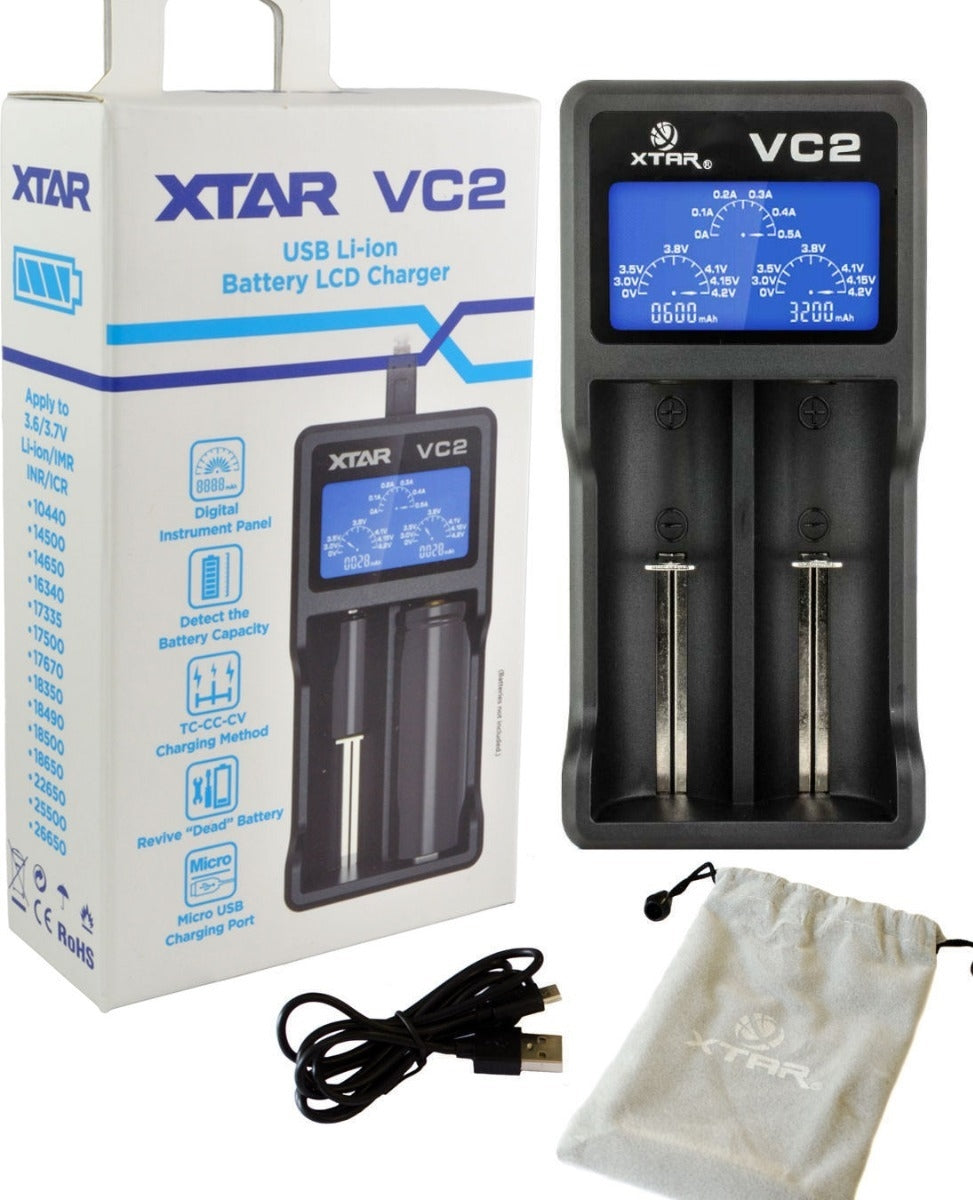


XTAR · 2-SLOT CHARGER · VC2
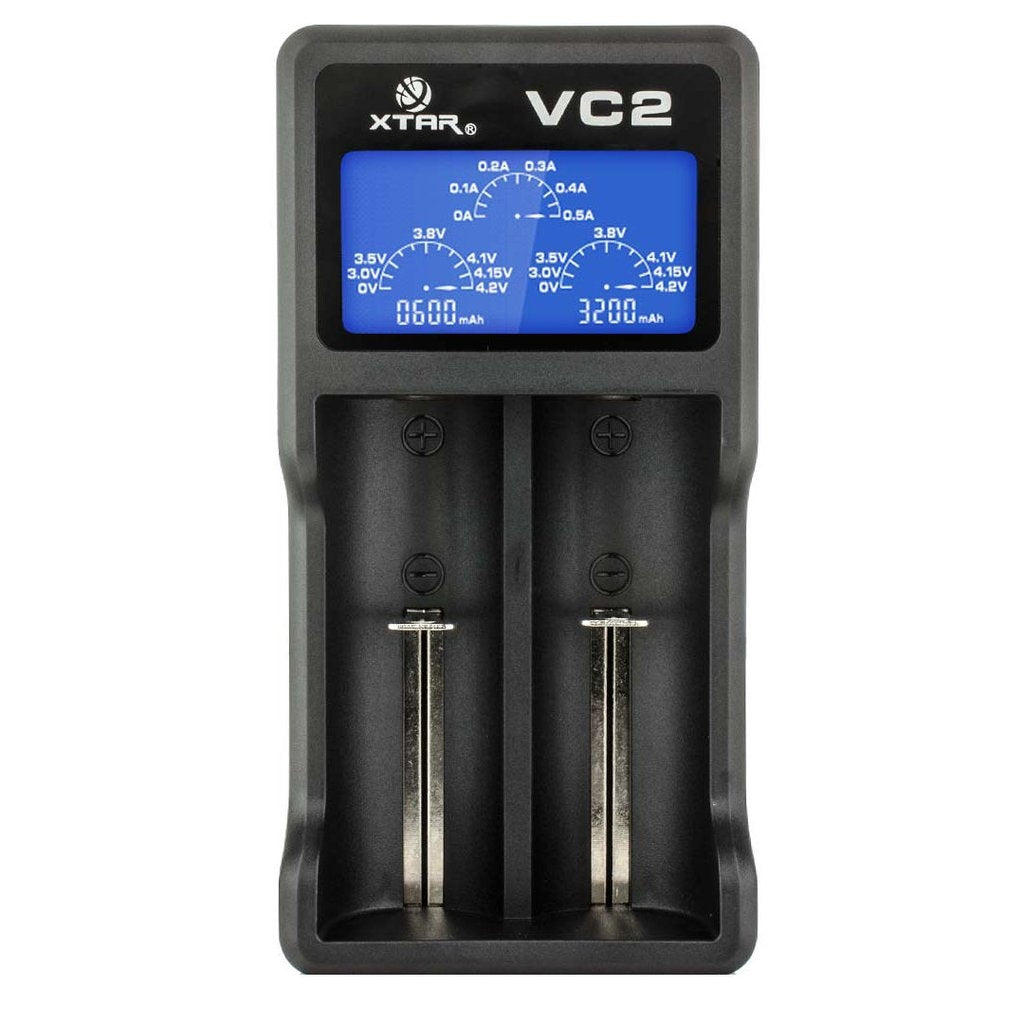
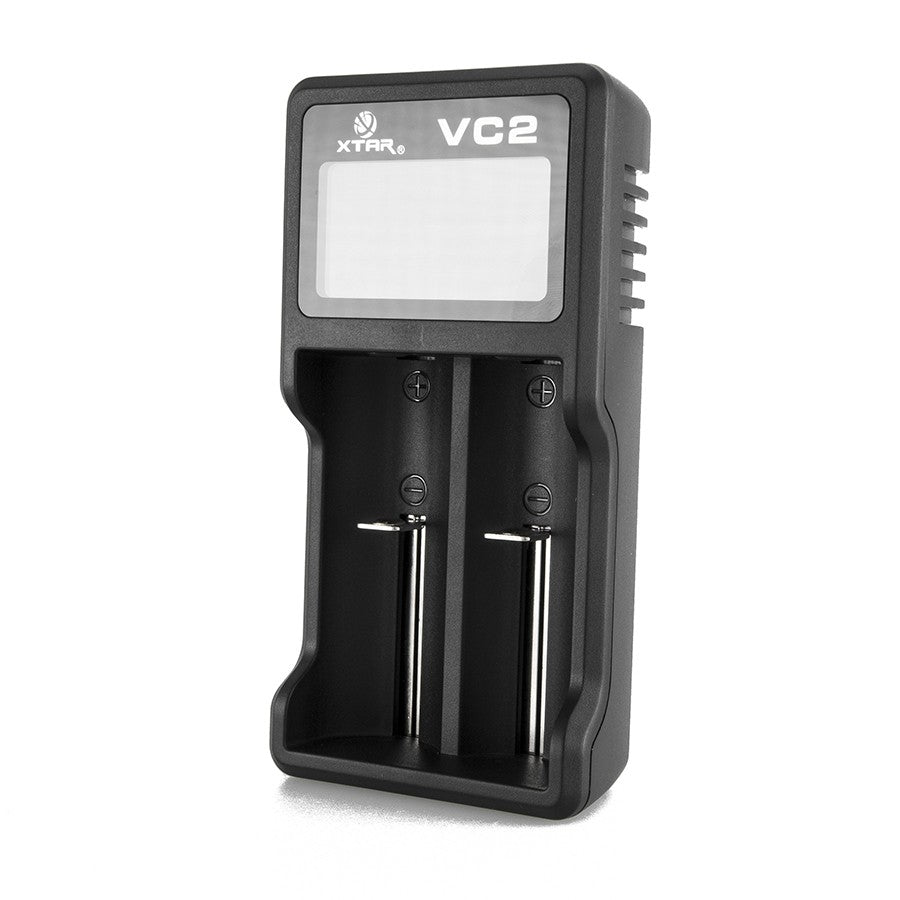
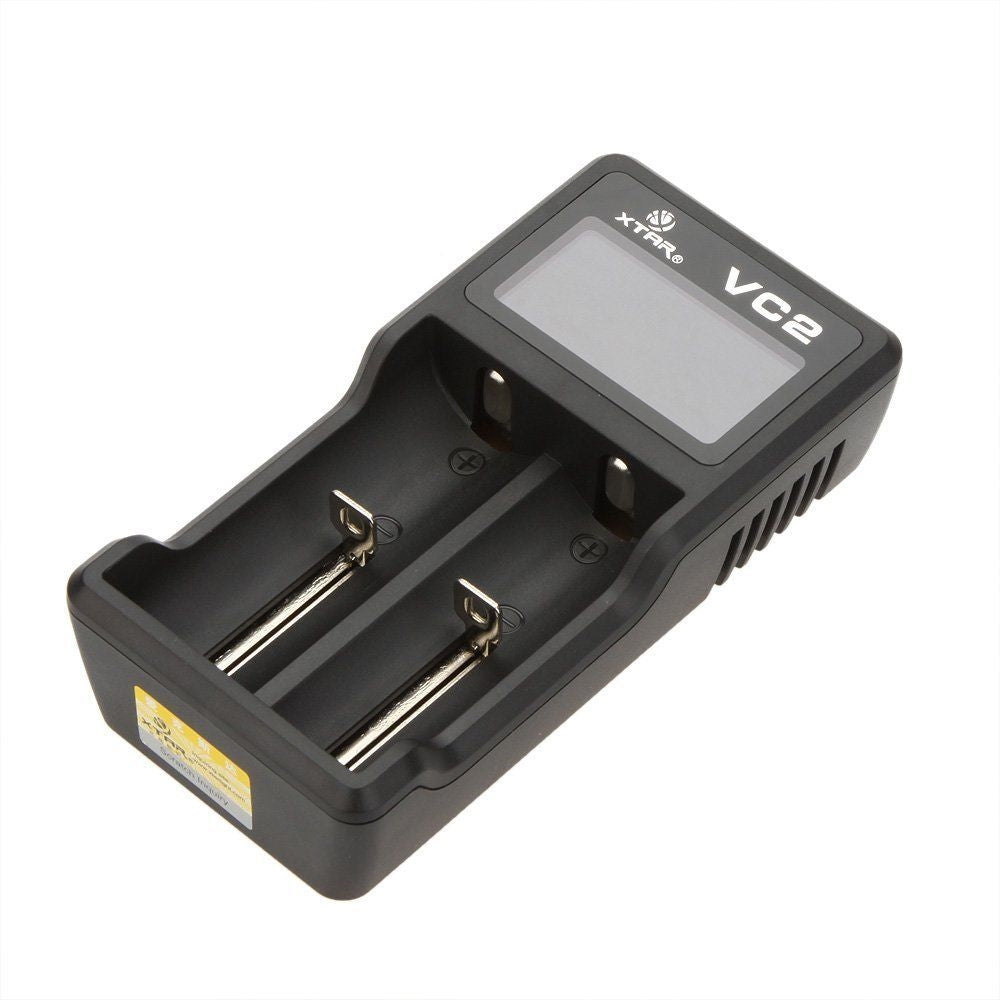
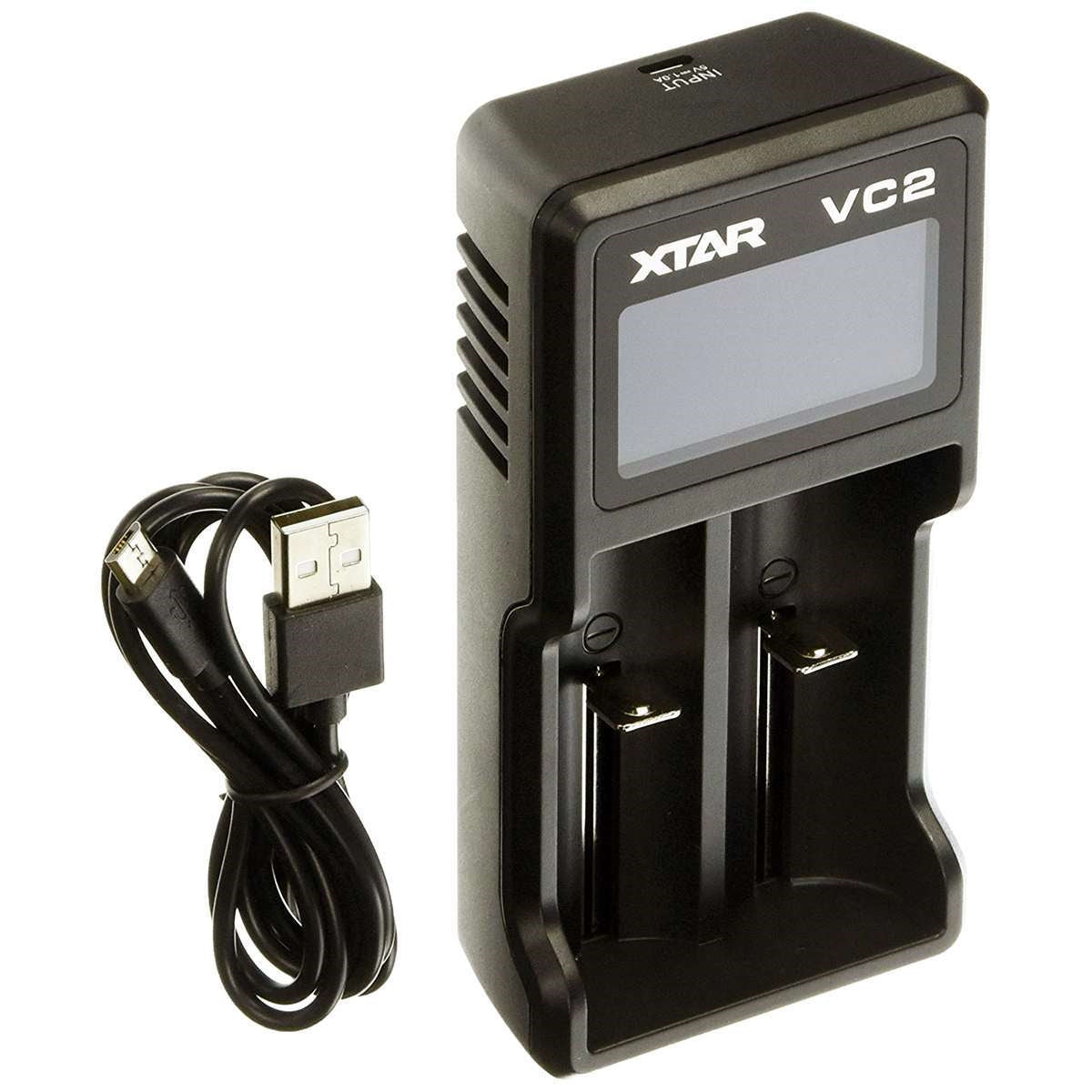
A two-slot USB charger for 3.6/3.7 V lithium-ion cells, with an LCD: 500 ± 50 mA maximum per slot, a charge that ends at 4.20 ± 0.05 V, and a 5.0 V 1.0 A micro-USB input [1][2]. Below: every rating XTAR prints with its condition, what the screen shows, which of our cells it suits, and charge times we calculated from the ratings, so you can check each number.
INPUT5.0 V1.0 A DC [1], micro-USB [2]
PER SLOT500 mA± 50 mA, max. constant current [1]
END OF CHARGE4.20 V± 0.05 V; ends at ≤ 80 mA [1]
SLOTS2two cells at once [2]
CELL TYPESLi-ion3.6/3.7 V Li-ion, IMR, INR, ICR; 10440 to 26650 [1]
MASS109 gnet weight [1][2]
XTAR lists only 3.6/3.7 V Li-ion, IMR, INR and ICR cells for the VC2 [1], and says it can’t charge protected 20700/21700 cells [1]. Don’t use it for Ni-MH, LiFePO4, 1.5 V lithium AA/AAA or alkaline cells.
01SPEC PLATE
Every rating, with its condition.
XTAR publishes the VC2’s ratings as a specification table on its VC2 page [1] and as a row in its charger comparison chart [2]; its download library has no manual for this model. The table’s ratings come first, copied as printed; then what XTAR’s feature panels and chart add, and our arithmetic. Each row names its source or shows its formula.
| SPECIFICATION | VALUE | CONDITION · SOURCE |
|---|---|---|
| RATED · MANUFACTURER copied from XTAR’s specification table [1] | ||
| MODEL | VC2 | as printed [1] |
| INPUT POWER | 5.0 V · 1.0 A | “DC 5.0V/1.0A” [1]; “DC 5V 1A”, micro-USB [2] |
| MAX. CONSTANT CURRENT | 500 mA | “500±50mA”, per slot [1]; “0.5A x 2” [2] |
| END-OF-CHARGE VOLTAGE | 4.20 V | “4.20±0.05V” [1][2] |
| END-OF-CHARGE CURRENT | ≤ 80 mA | “≤80mA” [1] |
| OPERATING TEMPERATURE | 0 to 40 °C | “0-40 ℃” [1] |
| SIZE | 131 × 66 × 33 mm | L × W × H [1][2] |
| NET WEIGHT | 109 g | [1][2] |
| ALSO PRINTED BY XTAR feature panels on [1] and the chart [2], as printed | ||
| SLOTS | 2 | “Two slots 0.5A charger with LCD display” [2] |
| CELL TYPES | 3.6/3.7 V | “3.6V/3.7V Li-ion / IMR / INR / ICR” [1] |
| SIZES | 17 | 10440 to 26650; the same list in [1] and [2], shown in section 04 |
| PROTECTED 20700/21700 | No | “Cannot charge protected 20700/ 21700 batteries.” [1] |
| CHARGE METHOD | TC-CC-CV | “Unique efficient charge method (TC-CC-CV) with 0.5Ax2” [1] |
| CURRENT CHOICE | 0.1–0.5 A | “Automatically recognize and adjust the current from 0.1A to 0.5A” [1]; no manual setting printed |
| RECOMMENDED SOURCE | 5 V · 1.0 A | “Recommend 5V/1.0A power source or above to maximize efficiency” [1] |
| CAPACITY READOUT | ± 5 % | tolerance printed beside “Battery Capacity Display” [1] |
| IN THE BOX | Charger, cable, manual | “Charger, USB cable, Manual” [1]; “VC2charger*1, Charging cable*1, Manual *1, Color paper box*1” [2] |
| CALCULATED arithmetic on [1], shown so you can check it | ||
| TOTAL CHARGE CURRENT | 1.0 A | 500 mA × 2 slots [1] |
| CHARGE POWER, BOTH SLOTS | 4.2 W | 4.20 V × 1.0 A at the end of constant current; input 5.0 V × 1.0 A = 5.0 W [1] |
| END-OF-CHARGE BAND | 4.15–4.25 V | 4.20 ± 0.05 V [1] |
| CURRENT BAND | 450–550 mA | 500 ± 50 mA [1] |
| + Source: [1] XTAR, VC2 product page, xtar.cc: its feature list, “VC2 Specification” table and image panels (compatibility, screen, safety, package contents, a charge graph), retrieved 2026-10-31 · XTAR VC2 page + Source: [2] XTAR, XTAR Charger Range Comparison Chart, the VC2 row; 3 pages, no version printed; listed in XTAR’s download library as last updated 2024-01-21 · XTAR download page | ||
RATED · [1]FIG 1.1
End-of-charge voltage
4.15 Vlowest4.20 Vrated4.25 Vhighest
Orange band: the end-of-charge voltage XTAR rates, 4.20 ± 0.05 V [1]; a charge can end anywhere inside it. Scale 4.10–4.30 V.
RATED · [1]FIG 1.2
Current per slot, and where a charge ends
Max. constant current 500 ± 50 mA, per slot [1]
Automatic range 0.1 to 0.5 A [1]
End of charge ≤ 80 mA [1]
Per-slot currents XTAR prints for the VC2, in mA [1]: the rated maximum with its ± 50 mA tolerance (orange, mark at 500), the 0.1–0.5 A range XTAR says it adjusts within by itself, and the current at which a charge ends. Scale 0–600 mA.
02 · CHARGE CURRENT
Up to 0.5 A in each slot.
XTAR rates the VC2 at 500 ± 50 mA maximum constant current in each of its two slots [1], so two cells take up to 1.0 A in all (our arithmetic). Its page adds: “Adapt to any 5V USB power. Automatically recognize and adjust the current from 0.1A to 0.5A.” [1] XTAR prints no way to choose the current.
ONE CELL0.5 Amaximum, “500±50mA” [1]
TWO CELLS0.5 Aeach, “0.5A x 2” [2]; 1.0 A in all, our arithmetic
PRINTED · [1][2]FIG 2.1
Current per slot, by slots in use
Each slotTotal of the slots in use
Data: “Max Constant current 500±50mA” [1] and “0.5A x 2” [2] · black: each slot; gray: both slots together, our arithmetic · scale 0–4 A · XTAR says the VC2 adjusts the current from 0.1 to 0.5 A by itself [1]
03CHARGE TIME
Hours at 0.5 A, by cell.
Hours = capacity ÷ current, as if the whole charge ran at that current. A real charge from empty takes longer, because the current tapers in the constant-voltage finish, and a cell that isn’t empty needs less. Capacities are each cell’s own printed figure [C].
HOURSmAh ÷ mA
at full current, from empty
PER SLOT500 mA
max. constant current [1]
3,000 mAh CELL6.0 h
3,000 ÷ 500, at 0.5 A
XTAR’S GRAPH4.5 h
“SONY VTC4 2100mAh-0.5A-4.5h” [1]
| CELL | FORMAT | CAPACITY AS PRINTED, mAh [C] | HOURS AT 0.5 A |
|---|---|---|---|
| Samsung 25R | 18650 | 2,500 minimum | 5.0 |
| Samsung 30Q | 18650 | 3,000 nominal | 6.0 |
| Sony/Murata VTC6 | 18650 | 3,120 nominal | 6.2 |
| Molicel P28A | 18650 | 2,800 typical | 5.6 |
| Samsung 35E | 18650 | 3,350 minimum | 6.7 |
| Molicel M35A | 18650 | 3,450 typical | 6.9 |
| EVE 33V | 18650 | 3,200 typical | 6.4 |
| Samsung 40T | 21700 | 4,000 minimum | 8.0 |
| Samsung 50E | 21700 | 4,900 minimum | 9.8 |
| Samsung 50S | 21700 | 5,000 typical | 10.0 |
| Molicel P50B | 21700 | 5,000 typical | 10.0 |
CALCULATED FROM [1][C]FIG 3.1
Hours at constant current, at 0.5 A
Hours = capacity ÷ current, from each cell’s printed capacity [C] and the VC2’s current [1]; scale 0–11 h. As if the whole charge ran at that current.
Arithmetic, not a measurement. XTAR’s charge graph for the VC2 [1] shows a 2,100 mAh Sony VTC4 charged at 0.5 A, labeled “SONY VTC4 2100mAh-0.5A-4.5h”; 2,100 ÷ 500 gives 4.2 h at constant current, and the graph’s current starts to fall near its 4.0 h mark. The graph’s time axis is unevenly labeled, so we quote it rather than redraw it. At 0.5 A all the cells listed are inside their printed charge limits, including the lower limits some print for the cold (section 04) [C].
04COMPATIBILITY
Li-ion only, 10440 to 26650.
XTAR lists seventeen 3.6/3.7 V lithium-ion sizes for the VC2, 10440 to 26650, the same in [1] and [2], and says it can’t charge protected 20700/21700 cells [1]. Below: the sizes, and 0.5 A against the charge limit printed for eleven of the cells we sell.
PRINTED · [1][2]FIG 4.1
Sizes XTAR lists
3.6/3.7 V LI-ION / IMR / INR / ICR
1044014500146501634017335175001767018350184901850018650187002070021700226502550026650
Sizes exactly as printed in [1] and [2], which list the same seventeen. Not protected 20700/21700 [1]. XTAR lists no Ni-MH, LiFePO4 or 1.5 V lithium sizes for the VC2.
DATA SHEETS · [1][C]FIG 4.2
Charge current against each cell’s printed limit
Samsung 25R 18650 · 4 A rated charge
Samsung 30Q 18650 · 4 A rated charge
Sony/Murata VTC6 18650 · 5.0 A continuous max. · 2 A from 0 to below 10 °C
Molicel P28A 18650 · 8.4 A max. at 23–45 °C (chart) · our chart reading: 2.8 A at 0–23 °C, 1.4 A at 0–10 °C in the specified region
Samsung 35E 18650 · 2.0 A, “not for cycle life”
Molicel M35A 18650 · 1.7 A max.
EVE 33V 18650 · 3.1 A at 15–50 °C · 0.62 A at 0–15 °C
Samsung 40T 21700 · 6 A rated charge
Samsung 50E 21700 · 4.9 A, “not for cycle life”
Samsung 50S 21700 · 6 A, continuous charge
Molicel P50B 21700 · 25 A, 70 °C cut-off
Bars: each cell’s printed charge limit [C], on a 0–6 A scale; limits above 6 A run to the edge, and every limit is written above its bar, with any lower limit the cell prints for the cold. Black mark: the VC2’s current [1]. No bar is orange: every cell’s highest printed limit, the bar, is at or above it. Three of the cells print a lower limit for the cold (data table); the VC2’s 0.5 A stays within them. Every verdict in fig 4.2 is for a cell from 0 to 40 °C; ten of the eleven cells print no charge range below 0 °C [C]. In the data table, each limit starts with the data sheet’s own row label; text in quotation marks is copied as printed, and notes after it are ours.
DATA TABLE · FIG 4.2
| CELL | FORMAT | CHARGE LIMIT AS PRINTED [C] | VC2 CURRENT ABOVE IT |
|---|---|---|---|
| Samsung 25R | 18650 | Rated charge: “CCCV, 4A, 4.20V, 100mA cut-off” (the spec prints no separate maximum charge current) | none |
| Samsung 30Q | 18650 | Rated charge: “CCCV, 4A, 4.20V, 100mA cut-off” (the spec prints no separate maximum charge current); pre-charge 0.1–0.5C at 1.0–3.0 V in its pack design guideline, at most 1.5 A (our arithmetic) | none |
| Sony/Murata VTC6 | 18650 | Continuous Maximum Charge Current: “5.0A” (“Continuous”); “2.00A” from 0 to below 10 °C cell surface, for a charge that ends at 4.25 V or less (its 4.00 A figure needs one that ends at 4.15 V) | none |
| Molicel P28A | 18650 | Maximum charging current: “8.4A” (“See Section 4.14”); its §4.14 chart reaches 8.4 A only from 23 to 45 °C, in its safe region (5.6 A in its specified region); 2.8 A at 0–23 °C in its §4.14 chart’s safe region, and above 10 °C in its specified region; 1.4 A at 0–10 °C in its chart’s specified region (the safe region stays at 2.8 A); the chart figures are our reading | none |
| Samsung 35E | 18650 | Max. Charge Current: “2,000mA (not for cycle life)”; pre-charge 0.1–0.5C at 1.0–3.0 V in its pack design guideline, at most 1.7 A (our arithmetic) | none |
| Molicel M35A | 18650 | Maximum charging current: “1.7 A” (“See Section 4.14”); its §4.14 chart, against cell surface temperature, stays at 1.7 A from 0 to 60 °C (our reading of the chart); Molicel’s older public data sheet prints 3.4 A, and this page uses the lower 1.7 A of Molicel’s newer specification | none |
| EVE 33V | 18650 | Operation Temperature (Cell Surface Temperature): “≤ 1.0C (3100mA)” at “Charge: 15 to 50 °C”; “≤ 0.2C (620mA)” at “Charge: 0 to 15 °C” | none |
| Samsung 40T | 21700 | Rated charge: “CCCV, 6A, 4.20 V, 100mA cut-off” (the spec prints no separate maximum charge current); pre-charge 0.1–0.5C at 1.0–3.0 V in its pack design guideline, at most 2 A (our arithmetic) | none |
| Samsung 50E | 21700 | Max. Charge Current: “4,900mA (not for cycle life)”; pre-charge 0.1–0.5C at 1.0–3.0 V in its pack design guideline, at most 2.45 A (our arithmetic) | none |
| Samsung 50S | 21700 | Max. charge current: “6A (continuous charge)”; pre-charge 0.1–0.5C at 1.0–3.0 V in its pack design guideline, at most 2.5 A (our arithmetic) | none |
| Molicel P50B | 21700 | Charge Current (70 °C cut-off), Maximum: “25 A” | none |
05DISPLAY
What the screen shows.
A “Tachometer-style” LCD shows, from top to bottom, the charging current, each cell’s voltage and the capacity charged in [1]. Its printed scales, and what its messages mean, in XTAR’s words.
PRINTED · [1]FIG 5.1
The voltage dial, as printed
Voltage dial, each slot marks printed around the dial [1]
End of charge 4.20 ± 0.05 V [1]
“Each interval of battery voltage display is about 10% of your battery capacity. Batteries are 100% full at 4.2V.” [1] Marks: the voltages printed around each slot’s dial in XTAR’s screen images, 3.0 to 4.2 V (0 V is also printed) [1]; they are unevenly spaced in volts. The current dial at the top is marked from 0 to 0.5 A [1]. Scale 2.9–4.3 V.
Screen messages
| SCREEN | WHEN | WHAT XTAR SAYS |
|---|---|---|
| FULL | end of charge | the charge is complete; the backlight “will flash when your batteries are fully charged and stop flashing after few times” [1] |
| null | after 10 min | “It is a bad battery or Ni-MH battery that can’t be charged.” [1] |
| Err | immediately | “When reverse polarity and short circuit happens.” [1] |
| mAh | while charging | “It shows the capacity that is being charged in to the batteries”; tolerance ± 5 % [1] |
Reading the mAh number
It counts what goes in during this charge, within ± 5 % [1]. XTAR says that if a cell starts at its discharge cut-off voltage and charges until the screen shows FULL, the number is the cell’s actual capacity [1]. From a part-charged cell, it shows only the top-up. XTAR lists no discharge or test mode for the VC2 [1][2].
06SAFETY
Protections, in XTAR’s words.
XTAR lists these for the VC2 [1]. It prints no test method for them, so they appear as XTAR’s claims, quoted.
What XTAR lists
- “Reverse polarity and short circuit protection.” The screen shows “Err” at once if either happens [1].
- “Temperature monitoring.” XTAR doesn’t say at what temperature it acts [1].
- “Flame retardant material.” [1]
- “Extra-low safe input voltage”: the VC2 runs on 5 V USB [1].
- “Accurate cut-off, efficient charging and never over charge batteries”: the charge ends at 4.20 ± 0.05 V and ≤ 80 mA [1].
- “0V Activation Function”: “Recharge a “damaged” (Low voltage) battery.” A cell it can’t charge shows “null” after 10 minutes [1].
Before you charge
- Charge on a hard, non-flammable surface, away from anything that burns, and stay within reach while it charges.
- Use only the cell types and sizes XTAR lists (section 04), inside each cell’s own charge limit [C].
- Keep the charger between 0 and 40 °C while it works [1].
- Let a cold cell warm up to room temperature before you charge it, and don’t charge any cell below 0 °C.
- Don’t charge a cell with a torn wrap until it is rewrapped. Recycle a cell that is dented or leaking.
- If a cell gets hot, smells or swells, unplug the charger and keep clear of it. Once it has cooled, move it onto a non-flammable surface and recycle it. If it smokes or catches fire, leave the room and call 911.
- If a lithium-ion cell has sat deeply discharged, check its voltage with a meter before you put it in: the charger starts reviving such cells on its own [1], and a cell can be damaged even if it takes a charge. Six of the eleven cells in section 04 should not be charged once they have fallen under 1.0 V: the Samsung 30Q, 40T, 50E and 50S specifications each print “Do not charge the battery under 1.0V voltage.” The Samsung 35E’s says the same, and the Sony/Murata VTC6’s forbids charging a cell at 1.0 V or less [C]. Recycle such a cell rather than reviving it.
07COMPARE
Where the VC2 sits.
The XTAR chargers in our store, each from its own XTAR manual, product page or chart [X]. The table quotes each one’s current as printed.
XTAR DOCUMENTS · [X]FIG 7.1
Highest current per slot, as printed
The highest per-slot current each charger’s XTAR manual, product page or chart prints [X], on a 0–3 A scale. Orange: the VC2. More current per slot shortens a charge; use it only where the cell’s printed limit allows it, which for some cells is lower in the cold.
| CHARGER | SLOTS | CURRENT AS PRINTED | MOST AT ONCE* | INPUT | CELL TYPES | DISPLAY |
|---|---|---|---|---|---|---|
| XTAR VC8 | 8 | 3Ax1 / 2Ax2 / 1Ax4 / 0.5Ax8 / 0.25A x 8 | 4 A | QC3.0 (5 V⎓2 A / 9 V⎓2 A), Type-C (manual); QC3.0 (5 V⎓3 A/9 V⎓2 A) on XTAR’s VC8 page | 3.6 V/3.7 V Li-ion/IMR/INR/ICR; 1.2 V Ni-MH/Ni-CD | LCD |
| XTAR SC2 | 2 | 3Ax1 / 2Ax2 | 4 A | QC3.0 (9 V⎓2 A/5 V⎓2 A), Type-C | 3.6/3.7 V Li-ion IMR/INR/ICR | LED indicator |
| XTAR DRAGON VP4L PLUS | 4 | 2A×2 (CH1&CH4) / 1A×4 / 0.5A×4 | 4 A | DC 12 V 3 A | 3.6 V/3.7 V Li-ion/IMR/INR/ICR; 1.2 V Ni-MH/Ni-CD; 11.1 V 3S Battery Pack | LCD |
| XTAR FC2 | 2 | 2A x 1 / 1A x 2 / 0.5A x 2 | 2 A | DC 5 V 2 A, Type-C | 3.6 V/3.7 V Li-ion/IMR/INR/ICR; 1.2 V Ni-MH | LED indicator |
| XTAR SC1 | 1 | 2A×1 | 2 A | 5 V 2.1 A, Type-C | 3.6/3.7 V rechargeable 18650/18700/20700/21700/22650/26650 Li-ion batteries | LED indicator |
| XTAR VC4 | 4 | 1A×2 (CH1 & CH4) / 0.5A×4 | 2 A | DC 5 V 2.1 A | 3.6 V/3.7 V Li-ion/IMR/INR/ICR; 1.2 V Ni-MH/Ni-CD | LCD |
| XTAR VC2 | 2 | 0.5A x 2 | 1 A | DC 5.0 V/1.0 A, Micro USB | 3.6 V/3.7 V Li-ion / IMR / INR / ICR | LCD |
| XTAR MC1 | 1 | 0.5A x 1 | 0.5 A | DC 5 V 0.5 A, Type-C | 3.6 V/3.7 V Li-ion/IMR/INR/ICR | LED indicator |
Current is copied as printed in each charger’s source [X], largest first; input and cell types are condensed from it. * Most at once: the largest current × slots among the rows XTAR prints, our arithmetic. Links go to each charger in our store.
08USE IT RIGHT
Charge inside the cell’s limit.
What the VC2 is for, and how to use it inside XTAR’s ratings and your cell’s limits.
- XTAR lists 3.6/3.7 V Li-ion, IMR, INR and ICR cells in seventeen sizes [1], and says the VC2 can’t charge protected 20700/21700 cells [1]. Don’t use it for Ni-MH, LiFePO4, 1.5 V lithium AA/AAA or alkaline cells.
- Power it from a 5 V USB source; XTAR recommends 5 V 1.0 A or more [1], and says the VC2 adjusts the current from 0.1 to 0.5 A by itself [1].
- 0.5 A is inside the printed charge limit of each of the eleven cells in fig 4.2, including the lower limits the Sony/Murata VTC6, Molicel P28A and EVE 33V print for the cold [C]. For any other cell, small ones such as 10440, 14500 and 16340 included, check its own printed limit, including any cold limit, before you charge it: the VC2 sets its own current, up to 0.5 A, and XTAR describes no way to choose it [1].
- Use the charger between 0 and 40 °C [1]. Never charge a cell colder than 0 °C: ten of the eleven cells in section 04 print 0 °C as their lowest charge temperature [C], and a cell brought in from the cold stays colder than the room for a while.
- Take cells out once the screen shows FULL, and don’t leave the charger running unattended.
- If the screen shows “null” after 10 minutes, XTAR says: “It is a bad battery or Ni-MH battery that can’t be charged.” [1] If it’s a lithium-ion cell, stop using it and recycle it.
Questions? Call 1-800-547-3050 or text 1-833-419-2192 to ask a person.
Documents
XTAR posts no VC2 manual; its VC2 page [1] and charger chart [2] are the sources for this page, linked as published by XTAR.
Ships from Stockbridge, GA. Most in-stock orders ship within 1 business day.
09QUESTIONS
Questions, answered.
Short answers. Where an answer comes from a document, it carries its source; the rest is standard handling practice. Anything else: call 1-800-547-3050 or text 1-833-419-2192.
Can the VC2 charge 21700 cells?
Yes, unprotected 20700 and 21700 cells are on XTAR’s list [1][2]. XTAR says it can’t charge protected 20700/21700 cells [1].
Can it charge AA or AAA batteries?
Not Ni-MH, alkaline or 1.5 V lithium AA/AAA. XTAR lists only 3.6/3.7 V lithium-ion cells for the VC2, including the 14500 and 10440 sizes [1][2]; a Ni-MH cell shows “null” after 10 minutes [1]. For Ni-MH AA/AAA, choose a charger whose cell types in section 07 include 1.2V Ni-MH.
How long does a charge take?
About capacity ÷ current, plus a slower finish. At 0.5 A, a 3,000 mAh cell needs 6.0 h from empty by our arithmetic (section 03). XTAR’s charge graph shows a 2,100 mAh Sony VTC4 charged at 0.5 A in 4.5 h [1].
Can I use a phone charger, a power bank or a laptop port?
XTAR says the VC2 is “Compatible with all 5V USB power including USB wall adaptors, cell phone chargers, solar panel, PC USB, power banks, etc.” and recommends 5 V 1.0 A or more [1]. No wall adapter comes in the box: “Charger, USB cable, Manual” [1].
What does the mAh number on the screen mean?
The capacity put in during this charge, within ± 5 % [1]. XTAR says it shows the cell’s actual capacity when the cell starts from its discharge cut-off voltage and charges until the screen shows FULL [1]; otherwise it shows only the top-up.
Does it stop when the cell is full?
Yes. XTAR rates the end of charge at 4.20 ± 0.05 V, once the current is down to ≤ 80 mA [1], and the screen shows FULL while the backlight flashes a few times [1]. Take cells out once they’re full.
What does 0 V activation do?
XTAR says the VC2 can “Recharge a “damaged” (Low voltage) battery” [1]; if a cell can’t be charged, the screen shows “null” after 10 minutes [1]. A cell that sat at very low voltage may be damaged even if it takes a charge. Six of the eleven cells in section 04 should not be charged once they have fallen under 1.0 V: the Samsung 30Q, 40T, 50E and 50S specifications each print “Do not charge the battery under 1.0V voltage.” The Samsung 35E’s says the same, and the Sony/Murata VTC6’s forbids charging a cell at 1.0 V or less [C]. Recycle such a cell rather than reviving it.
Can it test internal resistance or run a capacity test?
It has no internal-resistance reading, and XTAR lists no discharge or test mode for it [1][2]. Its mAh count gives a cell’s capacity only when the cell starts from its discharge cut-off voltage, as XTAR describes (section 05) [1]. For a full capacity test, see the XTAR VC8.
Is the VC2 the same as the VC2S, VC2SL or VC2 Plus?
No. XTAR’s download library has separate manuals for the VC2 Plus, VC2S and VC2SL. This page covers the VC2 only.
10SOURCES
Sources and method.
Where every number on this page comes from.
- + Source: [1] XTAR, VC2 product page, xtar.cc: its feature list, “VC2 Specification” table and image panels (compatibility, screen, safety, package contents, a charge graph), retrieved 2026-10-31 · XTAR VC2 page
- + Source: [2] XTAR, XTAR Charger Range Comparison Chart, the VC2 row; 3 pages, no version printed; listed in XTAR’s download library as last updated 2024-01-21 · XTAR download page
- + Source: [C] Each cell’s manufacturer data sheet or specification, as transcribed and second-read for the cell pages in our store (the cell names link to them): its capacity (typical or nominal where printed, else the minimum) and its charge limit, with the printed wording and conditions, including any lower limit it prints for the cold, any pre-charge range it prints for a run-down cell, and any cell voltage below which it says not to charge.
- + Source: [X] XTAR VC8: XTAR VC8 User Manual, Multi-Language V3 (file dated 2020-08-11), Specification table (“3Ax1 / 2Ax2 / 1Ax4 / 0.5Ax8”, “QC3.0 (5V⎓2A / 9V⎓2A)”); XTAR VC8 product page, Specification table (“QC3.0 (5V⎓3A/9V⎓2A)”) and Product Comparison Table (“0.25A x 8”) (retrieved 2026-10-31) · source
- + Source: [X] XTAR SC2: XTAR Official Store (xtardirect.com) SC2 page, Specifications table (“2Ax2 / 3Ax1 Max”, “QC3.0 (9V⎓2A/5V⎓2A)”); XTAR Charger Range Comparison Chart, SC2 row (“3.6/3.7V Li-ion”, “IMR/INR/ICR”); no SC2 manual is posted by XTAR (retrieved 2026-10-31) · source
- + Source: [X] XTAR DRAGON VP4L PLUS: XTAR DRAGON VP4L Plus user manual, V6 (2023), Specification table (“0.5A×4 / 1A×4 / 2A×2 (CH1&CH4)”, “DC 12V 3A”) (retrieved 2026-10-31) · source
- + Source: [X] XTAR FC2: XTAR FC2-C User Manual, V6 2023, Specification table (“4.2V 2A x 1 / 1A x 2 / 0.5A x 2 or 1.45V 2A x 1 / 1A x 2 / 0.5A x 2”, “DC 5V 2A”) (retrieved 2026-10-31) · source
- + Source: [X] XTAR SC1: XTAR SC1 (Type-C) User Manual, V7 (file dated 2024-01-06), Specification table (“Constant Current 2A×1”, “Input 5V 2.1A”) and “Apply to” (retrieved 2026-10-31) · source
- + Source: [X] XTAR VC4: XTAR VC4 User Manual, V2 (file dated 2018-05-10), Specification table (“0.5A×4 / 1A×2 (CH1 & CH4)”, “DC 5V 2.1A”) (retrieved 2026-10-31) · source
- + Source: [X] XTAR VC2: XTAR VC2 product page, “VC2 Specification” table (“Max Constant current 500±50mA”, “Input Power DC 5.0V/1.0A”); XTAR Charger Range Comparison Chart, VC2 row (“DC 5V 1A Micro USB”, “0.5A x 2”) (retrieved 2026-10-31) · source
- + Source: [X] XTAR MC1: XTAR MC1 (Type-C) user manual, Version 6 2023, Specification table (“DC 5V 0.5A”, “0.5A x 1”); title “Type-C Li-ion Battery Charger” (retrieved 2026-10-31) · source
- + Method: every charger figure on this page is XTAR’s, read from [1] and [2] (and, in section 07, from the documents listed under [X]) and checked against them by a second reading, or arithmetic on XTAR’s figures with the formula shown. Arithmetic is rounded half up. XTAR’s download library has no VC2 manual; it lists the VC2 Plus, VC2S, VC2L, VC2SL and VC2 Turbo. The VC2 page prints one charge graph, for a Sony VTC4 at 0.5 A; its time axis is unevenly labeled, so we quote the printed label and don’t redraw the curve.
- + Not shown from [1]: certification marks and the warranty term; we don’t hold the certificates.
- + Not shown: measurements of our own units. We will add Measured rows only once our test procedure is published, with sample size, instrument and date.
Customer Reviews
Overall rating: 4.8 / 5 from 83 reviews.
Great product works exactly as described and very easy to use.
Super fast charges.
Arrived quickly. The unit works great.
I like the "Fuel Gauge" meter. It works well, I verified the charged voltage with my Fluke multimeter.
Good

Good

Everything works as intended. The display is accurate and helpful. The only bad thing i can say about this charger is the charging time. But as this price range and safety measures, this is is 5/5.
I was surprised to find that it had to have separate power supply but I had a couple so it was OK.
Works as it is attended

Quick shipping great charger one of the best I have ever had it is a slow charge but the batteries get fully charged and seem to last longer great display works better than my nite core and was 3 times cheaper

This is my fav charger by far. It tells you how far down your batteries are when you first plug them in. Never have to worry if the charger is working or not. Is but it again!
Works great, display is more intuitive than my old nitecore.
works great thanks
Great charger.

Love this new charger. Shows the charger for each battery though the charge process. I like it shows the charge capacity for each battery. Charges very fast.
Thanks
Works great. Thank you!
I love this charger, works great!
Initial impression is very good. It's slow, which is what I wanted. Great display. Zero complaints.
Have only used it once, but it charged the batteries
Excellent as always. Great company.
This is a great charger and well worth the price.

It works, I have one golisi 18650 battery dead, it started charging in like 4 or 5 minutes, good product and reasonable price!
Charged 2 batteries in an hour plus. Have not reinstalled them to see how long they will continue to hold the charge. Delivery took longer than expected. Also had a phishing email saying I had a $2.00 charge before item could be delivered. Did not fall for it but I was concerned since it took so long to be delivered.
Great product, great pricing and great service. Thanks
Great charger, and have an awesome function that let me know when it is full.
Only used once, but worked as advertised.
I like how it shows you what volts your charging at to make sure your not over doing it. Also the easy display screen so you can see the results as they happen
Pleased with this charger.
Great battery charger! Always great service from 18650BatteryStore!
Slow load at half an amp but that should be due to the variety of batteries it can charge, finding it convenient and safe! I just found that the readings are reporting around .2-.3 volts higher than my multimeter. Besides that it's a solid pick for the price
Works great and it’s very bright
Absolutely perfect for a great price. Why get anything without a digital readout for $10 when this is out. It is idiot proof too. No settings or knowledge needed.
Had a great experience with this company. They fixed my problem with the battery and got me the correct charger, shipping was Fast!
The XTAR VC2 works very well. It's much more advanced than the single battery charger that came with my flashlight and generic 18650 battery.
Great recommendation from 18650batterystore, which advised that not all new pre-charged solar rechargables are fully charged. Set the new battery into the charger for 24 hours, as advised, and our solar lights are once again shining brightly at night. The extra $3 for the model with metering (to include mAh) is worth it. Longevity to be determined ... but pleased with the results so far.

Perfect charger
Arrived on time. Charged new batteries without problem Charger cut off when battery full.
Prompt shipping. Tested function on generic cell and was impressed with charger function, feel and display. One use says nothing of durability, but vendor asked for 1st impression. Vendors performance and specialization left me inclined to add to my list of reliable sources.