

It’s good
Ships from Stockbridge, GA · Most in-stock orders ship within 1 business day · Call 1-800-547-3050
Wholesale and bulk pricingMost in-stock orders ship within 1 business dayCall 1-800-547-3050Wholesale and bulk pricing
Call or text a person
Call 1-800-547-3050Text 1-833-419-2192support@18650batterystore.comMonday to Friday, 9 AM to 5 PM Eastern
Other sizes
Other sizes: see allCell sizes
Household sizes
Which size do I have?
The number is the size. An 18350 is 18 mm across and 35 mm long; a 26650 is 26 mm across and 65 mm long.
18650 sizing explainedCan't find your size? Call 1-800-547-3050
Learn
Learn: overview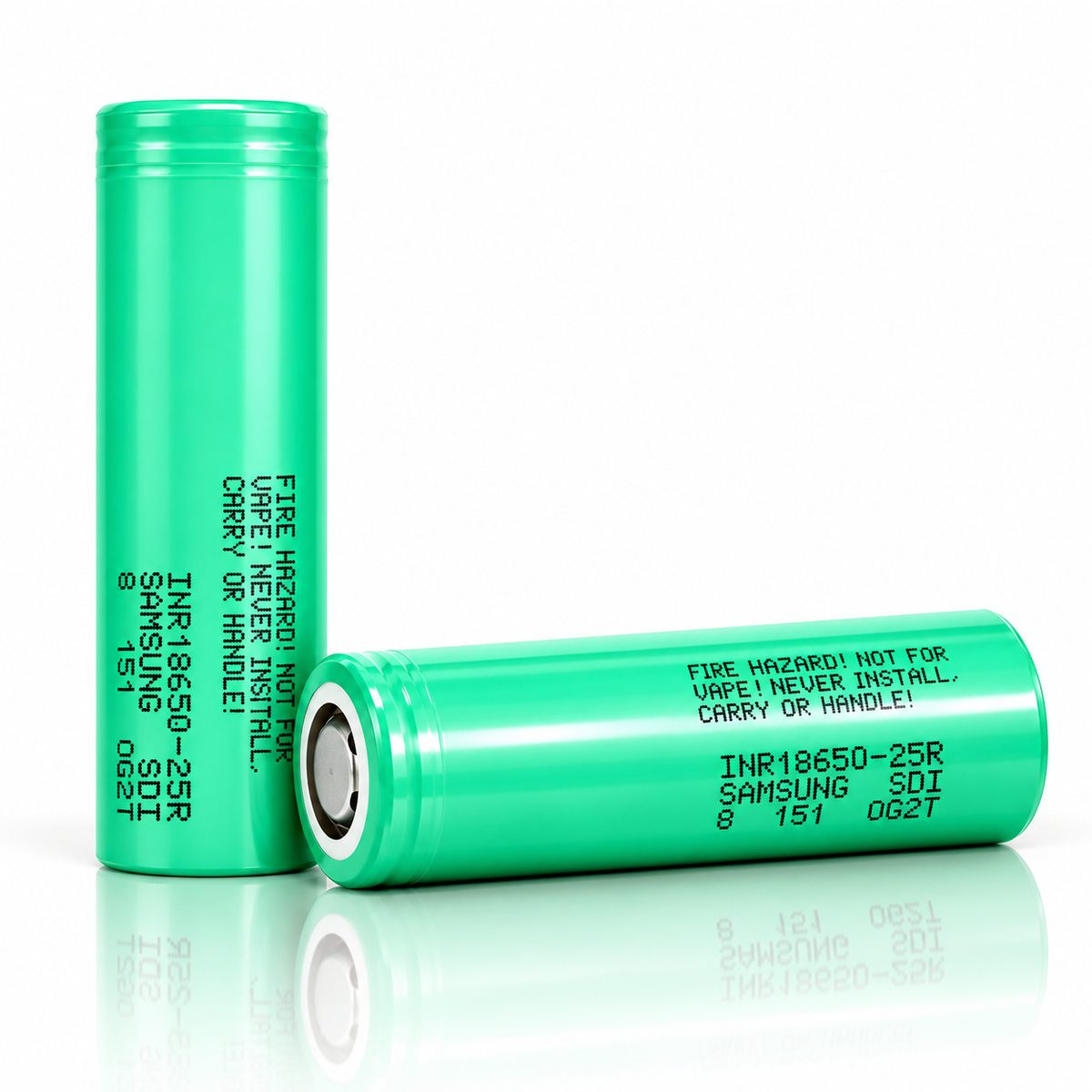


[1] Specification of Product, SDI Model INR18650-25R, Version No. 1.0, on file since 2026-10-19
An 18650 power cell rated 2,500 mAh minimum and 20 A maximum continuous discharge at room temperature [1]. Below: every rating with its condition, Samsung’s own curves digitized, and what we calculated from them, so you can check each number.
A bare cell: a component for protected packs and devices built for it. Not for vaping. Charge on a lithium-ion (Li-ion) charger that stops at 4.20 V.
01SPEC PLATE
Samsung’s current specification [1] first, copied as printed. Then figures we read from Samsung’s 2013 presentation [2], the typical figures it prints, our arithmetic, and facts from the safety data sheet (SDS) [3] and UN38.3 report [4]. Each row names its source or shows its formula.
| SPECIFICATION | VALUE | CONDITION · SOURCE |
|---|---|---|
| RATED · MANUFACTURERcopied from specification [1] | ||
| MODEL CODE | INR18650-25R | as printed [1] |
| CAPACITY, STANDARD | 2,500 mAh | minimum; 0.2C (500 mA) to 2.5 V after standard charge, 23 ± 3 °C [1] |
| CAPACITY, RATED | 2,450 mAh | minimum; 10 A to 2.5 V after rated charge, 23 ± 3 °C [1] |
| CAPACITY, TYPICAL | — | Not stated by manufacturer [1] |
| NOMINAL VOLTAGE | 3.6 V | [1] |
| CHARGE VOLTAGE | 4.20 V | CC-CV (constant current, then constant voltage) [1] |
| DISCHARGE CUT-OFF | 2.5 V | end of discharge [1] |
| STANDARD CHARGE | 1.25 A | 0.5C, CC-CV to 4.20 V, 125 mA cut-off; 180 min [1] |
| RATED CHARGE | 4 A | CC-CV to 4.20 V, 100 mA cut-off; 62 min; no charge current is labelled maximum [1] |
| MAX. CONTINUOUS DISCHARGE | 20 A | at room temperature (23 ± 3 °C) [1] |
| DISCHARGE OVER-TEMPERATURE PROTECTION | 70 °C | at most, at the hottest cell surface in the pack [1] |
| CHARGE TEMPERATURE | 0 to 45 °C | ambient [1] |
| DISCHARGE TEMPERATURE | −20 to 60 °C | ambient [1] |
| AC IMPEDANCE | ≤ 18 mΩ | initial, AC 1 kHz, after standard charge [1] |
| CYCLE LIFE | ≥ 1,500 mAh | after 250 cycles: 4 A charge, 20 A discharge, 23 ± 3 °C; 60 % of standard capacity [1] |
| RECOVERY AFTER STORAGE | ≥ 1,960 mAh | 30 days at 60 °C from rated charge, then 10 A to 2.5 V; 80 % of rated capacity [1] |
| STORAGE TEMPERATURE | 0 to 23 °C | up to 1 year; 0–45 °C up to 3 months; 0–60 °C up to 1 month [1] |
| AS SHIPPED | 3.43–3.58 V | ex-factory voltage; about 30 % charge [1] |
| DIAMETER | 18.40 mm | maximum, table 3.12; the outline drawing prints 18.47 mm maximum with tube [1] |
| HEIGHT | 65.00 mm | maximum [1] |
| MASS | 45.0 g | maximum [1] |
| TERMINAL · PROTECTION | Flat top · none | as sold: bare cell, no protection circuit; terminal style not stated in [1] |
| + Source: [1] Samsung SDI, Specification of Product, Model INR18650-25R, Version No. 1.0, Date of Application 2016/04/15 (as printed); on file 2026-10-19; not posted, as the document is marked confidential. Call or text to ask about it | ||
| SPECIFICATION | VALUE | CONDITION · SOURCE |
|---|---|---|
| READ FROM THE 2013 PRESENTATION’S CHARTSdigitized from [2], about ±0.5 % of each axis | ||
| CAPACITY AT 10 A | 2,561 mAh | to 2.5 V, 23 °C ambient [2] |
| CAPACITY AT 20 A | 2,524 mAh | to 2.5 V, 23 °C ambient [2] |
| CELL TEMPERATURE, END OF 20 A | 96 °C | one cell, 23 °C ambient; cooling not stated [2] |
| 20 A CAPACITY BEFORE 70 °C | 1,314 mAh | where the 20 A temperature trace crosses the 70 °C limit in [1] [2] |
| CAPACITY AT −20 °C | 2,030 mAh | 10 A to 2.5 V; 2,408 mAh to the chart’s 1.5 V cut-off [2] |
| CAPACITY AFTER 250 CYCLES | 1,756 mAh | 4 A charge, 20 A discharge, 23 °C ambient; [1] rates ≥ 1,500 [2] |
| PRINTED IN THE 2013 PRESENTATIONtypical figures, not ratings [2] | ||
| CAPACITY, TYPICAL (2013) | 2,560 mAh | at 0.2C; 2,539 at 10 A; printed as 2.560 and 2.539 in a row labelled mAh [2] |
| AC IMPEDANCE, TYPICAL | 13.20 mΩ | ± 2 mΩ, AC 1 kHz [2] |
| DC IMPEDANCE, TYPICAL | 22.15 mΩ | ± 2 mΩ, DC from 10 A to 1 A; ≤ 30 mΩ specified in [2] |
| MASS, TYPICAL | 43.8 g | [2] |
| ENERGY AT 2.5 A · 20 A | 9.02 · 8.25 Wh | data labels on the energy chart, CC to 2.5 V, 23 °C [2] |
| CALCULATEDarithmetic on [1] and [2], shown so you can check it | ||
| 1C | 2.5 A | the current that delivers the standard capacity in one hour: 2,500 mAh [1] ÷ 1 h; [2] uses the same 1C |
| CONTINUOUS AS C-RATE | 8C | 20 A [1] ÷ 2.5 A |
| RATED CHARGE AS C-RATE | 1.6C | 4 A [1] ÷ 2.5 A |
| AVERAGE POWER AT 20 A | 65 W | 20 A × 3.27 V average printed in [2] |
| RUNTIME AT 20 A | 7.6 min | 2,524 mAh ÷ 20 A, from [2] |
| FROM THE SAFETY DATA SHEET (SDS) AND UN38.3 TRANSPORT TEST REPORTcopied as printed from [3] and [4] | ||
| CHEMISTRY | Li-ion | [1] says lithium-ion only; SDS section 3 lists a lithium cobalt oxide cathode (20–50 %) and graphite anode [3]; [2] says NCA |
| ENERGY RATING | 9.20 Wh | Wh rating, SDS section 1 [3]; the UN38.3 report prints 9 Wh [4] |
| TRANSPORT | UN3480 · Class 9 | “Lithium Ion Batteries”; UN3481 when packed with or contained in equipment [3] |
| UN38.3 | MT0080405 · Rev. 04 | T1–T6 and T8 passed (T8 run at 20 A for 8 min); T7 not applicable to cells; Samsung SDI Safety Center, 2013-02-05 [4] |
| SAFETY DATA SHEET | Revision no. 01 | 2018-01-01; lists INR18650-25R by name [3] |
| STORAGE · SDS | ≈20 °C | at about 20–60 % of capacity (open-circuit 3.6–3.9 V) [3] |
| + Source: [1] Samsung SDI, Specification of Product, Model INR18650-25R, Version No. 1.0, Date of Application 2016/04/15 (as printed); on file 2026-10-19; not posted, as the document is marked confidential. Call or text to ask about it + Source: [2] Samsung SDI Energy Business Division, “Introduction of INR18650-25R” (presentation), Oct. 2013, no version printed; source of every chart on this page. It predates [1]; where they differ, the ratings on this page follow [1] + Source: [3] Samsung SDI, Safety Data Sheet, Model INR18650-25R, Revision no. 01, 2018-01-01; on file 2026-10-20 · SDS PDF + Source: [4] Samsung SDI Safety Center, Test report, UN Manual of Tests and Criteria Part III Subsection 38.3 (2011, Rev. 5, Amend. 1), INR18650-25R, Document No. MT0080405, Revision 04, 2013-02-05; on file 2026-10-20 · UN38.3 report PDF | ||
Black marks: rated voltages [1]. Orange band: where the middle 80 % of capacity is delivered at 2.5 A, 3.28–3.98 V, read from the 1C curve digitized from [2].
Currents as rated in [1], each with its condition. C-rates calculated against the 2,500 mAh standard capacity. [1] labels no charge current as a maximum, and lists no pulse rating.
Ambient operating ranges as rated in [1]. Tick: the spec asks for discharge over-temperature protection set no higher than 70 °C at the hottest cell surface in the pack [1].
Storage temperature by duration, as rated in [1]. The longer the storage, the cooler: up to 23 °C for a year. [1] says capacity recovers to more than 80 % if the cell is kept as shipped, at about 30 % charge.
Discharge capacity at each current, as a percent of the 2,450 mAh rated capacity at 10 A, after rated charge, to 2.5 V [1]. mAh calculated from those percents.
Relative capacity at 10 A to 2.5 V after rated charge, as a percent of the 2,450 mAh rated capacity at 23 °C [1]. The current spec lists no figure below 23 °C; section 05 has the 2013 cold-discharge curves.
Samsung’s 1C curve and its rated maximum, digitized. At 2.5 A the cell delivers about 2,503 mAh to 2.5 V. At 20 A it delivers about 2,524 mAh, with the voltage 0.32 V lower after 1,300 mAh delivered.
Data: digitized from [2] Discharge characteristics · 2.5 A (1C) and 20 A · charge CC-CV 4 A to 4.2 V (100 mA) · discharge CC to 2.5 V · 23 °C ambient · two traces per current as printed; we plot the upper one and tabulate both · data tables under figs 3.1 and 3.2
03BY CURRENT
Six discharge currents from Samsung’s 2013 presentation, 2.5 to 25 A; 25 A is above the 20 A continuous rating in [1]. The energy and average voltage are Samsung’s own printed figures; the rest is arithmetic on the curves, with the formula under each. Curves that run within a few hundredths of a volt of each other carry a key instead of labels at the line.
Data: digitized from [2] Discharge characteristics · charge CC-CV 4 A to 4.2 V (100 mA) · discharge CC to 2.5 V · 23 °C ambient · two traces per current as printed; we plot the upper one and tabulate both
| TRACE | V AT 0 mAh | 500 | 1,000 | 1,500 | 2,000 | 2,400 | END mAh |
|---|---|---|---|---|---|---|---|
| 2.5 A · 1C · upper | 4.11 | 3.89 | 3.69 | 3.53 | 3.40 | 3.03 | 2,503 |
| 2.5 A · 1C · lower | 4.11 | 3.89 | 3.69 | 3.53 | 3.40 | 3.02 | 2,493 |
| 5 A · 2C · upper | 4.08 | 3.82 | 3.63 | 3.46 | 3.34 | 2.99 | 2,519 |
| 5 A · 2C · lower | 4.08 | 3.82 | 3.63 | 3.46 | 3.34 | 2.98 | 2,519 |
| 10 A · 4C · upper | 3.99 | 3.71 | 3.53 | 3.37 | 3.26 | 2.95 | 2,561 |
| 10 A · 4C · lower | 3.99 | 3.71 | 3.53 | 3.37 | 3.26 | 2.95 | 2,561 |
Data: digitized from [2] Discharge characteristics · charge CC-CV 4 A to 4.2 V (100 mA) · discharge CC to 2.5 V · 23 °C ambient · two traces per current as printed; we plot the upper one and tabulate both · 25 A is above the 20 A rating [1]
| TRACE | V AT 0 mAh | 500 | 1,000 | 1,500 | 2,000 | 2,400 | END mAh |
|---|---|---|---|---|---|---|---|
| 15 A · 6C · upper | 3.89 | 3.61 | 3.44 | 3.29 | 3.18 | 2.90 | 2,554 |
| 15 A · 6C · lower | 3.89 | 3.61 | 3.44 | 3.29 | 3.18 | 2.88 | 2,548 |
| 20 A · 8C · upper | 3.95 | 3.50 | 3.35 | 3.22 | 3.10 | 2.81 | 2,524 |
| 20 A · 8C · lower | 3.95 | 3.49 | 3.34 | 3.21 | 3.10 | 2.79 | 2,524 |
| 25 A · 10C · upper | 4.18 | 3.36 | 3.25 | 3.14 | 3.02 | 2.68 | 2,472 |
| 25 A · 10C · lower | 4.18 | 3.35 | 3.24 | 3.13 | 3.02 | 2.67 | 2,472 |
End of each digitized curve in [2], at 2.5 V; upper trace. The second trace ends within 10 mAh. Rated for comparison: ≥ 2,450 mAh at 10 A [1]. 25 A is above the 20 A continuous rating.
Energy to 2.5 V at each current, copied from the data labels on the energy chart in [2]. Our own integration of the digitized curves agrees within 0.04 Wh. At 5 A the table on the same slide prints 8.95 Wh against the chart label’s 8.92. SDS energy rating for comparison: 9.20 Wh [3].
Average voltage to 2.5 V at each current, copied from the data labels in [2]. The line joins the printed points.
| CURRENT | AVERAGE V | ENERGY Wh |
|---|---|---|
| 2.5 A · 1C | 3.61 | 9.02 |
| 5 A · 2C | 3.54 | 8.92 |
| 10 A · 4C | 3.44 | 8.79 |
| 15 A · 6C | 3.35 | 8.55 |
| 20 A · 8C | 3.27 | 8.25 |
| 25 A · 10C | 3.18 | 7.84 |
Power = current × the average voltage printed in [2], over the whole discharge to 2.5 V; the start runs higher, the end lower. 25 A is above the 20 A continuous rating [1].
Runtime = capacity delivered ÷ current, from the curves in [2]: one full CC-CV charge at 4 A, 23 °C ambient. A device whose average draw is below its peak current runs longer than the figure at that peak.
Cell voltage after the same capacity delivered, read from each curve in [2]. At 1,300 mAh the 20 A curve sits 0.32 V below the 2.5 A curve: 0.32 V ÷ 17.5 A ≈ 18 mΩ (17–22 mΩ across the three depths). Effective resistance = (V at 2.5 A − V at 20 A) ÷ 17.5 A at the same capacity; arithmetic, not a rating. [2] prints a typical DC impedance of 22.15 mΩ.
| DEPTH | 2.5 A | 5 A | 10 A | 15 A | 20 A | 25 A | mΩ, 2.5 → 20 A |
|---|---|---|---|---|---|---|---|
| 500 mAh | 3.89 | 3.82 | 3.71 | 3.61 | 3.50 | 3.36 | 22 |
| 1,300 mAh | 3.59 | 3.52 | 3.43 | 3.34 | 3.27 | 3.18 | 18 |
| 2,100 mAh | 3.37 | 3.31 | 3.22 | 3.15 | 3.07 | 2.97 | 17 |
Two estimates of heat generated inside one cell, averaged over the discharge. Orange: current × the average voltage gap to the 2.5 A curve, read from [2]. Gray: current² × the 22.15 mΩ typical DC impedance printed in [2]. Section 04 shows what that heat does to the cell’s temperature.
04HEAT
The same 2013 test logged cell temperature. One cell at 23 °C ambient reached about 96 °C by the end of a 20 A discharge. [1] asks for pack protection at no more than 70 °C at the cell surface, so in a pack built to the spec a full 20 A discharge ends early, at about 1,314 mAh in this test.
Data: digitized from [2] Discharge characteristics, cell-temperature traces · charge CC-CV 4 A to 4.2 V (100 mA) · discharge CC to 2.5 V · 23 °C ambient · two traces per current as printed; we plot the upper one and tabulate both
| TRACE | °C AT 0 mAh | 500 | 1,000 | 1,500 | 2,000 | 2,400 | END °C |
|---|---|---|---|---|---|---|---|
| 2.5 A · 1C · upper | 25 | 27 | 28 | 28 | 29 | 30 | 32 |
| 2.5 A · 1C · lower | 25 | 26 | 27 | 27 | 28 | 30 | 31 |
| 5 A · 2C · upper | 24 | 30 | 34 | 36 | 38 | 40 | 42 |
| 5 A · 2C · lower | 24 | 29 | 33 | 34 | 37 | 39 | 41 |
| 10 A · 4C · upper | 25 | 36 | 44 | 50 | 54 | 58 | 60 |
| 10 A · 4C · lower | 25 | 35 | 43 | 49 | 54 | 58 | 60 |
Data: digitized from [2] Discharge characteristics, cell-temperature traces · charge CC-CV 4 A to 4.2 V (100 mA) · discharge CC to 2.5 V · 23 °C ambient · two traces per current as printed; we plot the upper one and tabulate both · dotted line: 70 °C, the most [1] allows at the cell surface before protection ends a discharge
| TRACE | °C AT 0 mAh | 500 | 1,000 | 1,500 | 2,000 | 2,400 | END °C |
|---|---|---|---|---|---|---|---|
| 15 A · 6C · upper | 24 | 41 | 53 | 62 | 70 | 76 | 79 |
| 15 A · 6C · lower | 24 | 39 | 52 | 61 | 69 | 75 | 78 |
| 20 A · 8C · upper | 26 | 44 | 61 | 74 | 84 | 93 | 96 |
| 20 A · 8C · lower | 25 | 43 | 60 | 72 | 83 | 91 | 94 |
| 25 A · 10C · upper | 27 | 49 | 71 | 86 | 98 | 107 | 110 |
| 25 A · 10C · lower | 27 | 47 | 66 | 82 | 92 | 101 | 104 |
Cell temperature at the end of each discharge, upper trace, read from [2]. One cell at 23 °C ambient; the presentation doesn’t describe cooling or mounting. Orange: above the 70 °C cell-surface limit in [1].
Capacity delivered before the cell-temperature trace in [2] reaches 70 °C, the most [1] allows at the cell surface. A pack protected as [1] asks would end the discharge there. Gray: the trace never reaches 70 °C, so the full capacity to 2.5 V is shown.
05COLD
Samsung’s 2013 low-temperature test: charged at the test temperature, then discharged at 10 A to 1.5 V, below the 2.5 V cut-off in [1]. The current spec rates discharge from −20 °C ambient [1].
Data: digitized from [2] Low temperature performance (10 A) · charge 4 A to 4.2 V (100 mA), 3 h rest at the test temperature · discharge 10 A to 1.5 V at the test temperature · two cells per temperature; we plot cell 1 and tabulate both · dotted line: the 2.5 V cut-off in [1]
| TRACE | V AT 0 mAh | 500 | 1,000 | 1,500 | 2,000 | mAh TO 2.5 V | mAh TO 1.5 V |
|---|---|---|---|---|---|---|---|
| 0 °C · cell 1 | 3.75 | 3.52 | 3.36 | 3.17 | 2.96 | 2,206 | 2,324 |
| 0 °C · cell 2 | 3.75 | 3.50 | 3.33 | 3.14 | 2.89 | 2,160 | 2,297 |
| −10 °C · cell 1 | 3.60 | 3.45 | 3.30 | 3.09 | 2.81 | 2,113 | 2,400 |
| −10 °C · cell 2 | 3.60 | 3.42 | 3.27 | 3.09 | 2.79 | 2,097 | 2,387 |
Data: digitized from [2] Low temperature performance (10 A) · charge 4 A to 4.2 V (100 mA), 3 h rest at the test temperature · discharge 10 A to 1.5 V at the test temperature · two cells per temperature; we plot cell 1 and tabulate both · dotted line: the 2.5 V cut-off in [1]
| TRACE | V AT 0 mAh | 500 | 1,000 | 1,500 | 2,000 | mAh TO 2.5 V | mAh TO 1.5 V |
|---|---|---|---|---|---|---|---|
| −15 °C · cell 1 | 3.50 | 3.37 | 3.23 | 3.04 | 2.73 | 2,082 | 2,414 |
| −15 °C · cell 2 | 3.48 | 3.39 | 3.25 | 3.06 | 2.78 | 2,104 | 2,423 |
| −20 °C · cell 1 | 3.37 | 3.32 | 3.19 | 3.00 | 2.60 | 2,030 | 2,408 |
| −20 °C · cell 2 | 3.37 | 3.32 | 3.16 | 2.96 | 2.50 | 2,001 | 2,388 |
Capacity at 10 A, read from the curves in [2]. The cold tests run to 1.5 V, below the 2.5 V cut-off in [1]; the extra capacity below 2.5 V is not usable within the spec. To 2.5 V, capacity falls as it gets colder; to 1.5 V the colder tests deliver slightly more, as printed. [2] doesn’t say why; self-heating at 10 A is one possible reason.
06CHARGING
The specification rates two charges, both CC-CV to 4.20 V: a 1.25 A standard charge and a 4 A rated charge [1]. It labels neither as a maximum, and charges only between 0 and 45 °C ambient.
Charging time for each charge, CC-CV to 4.20 V at room temperature, as rated in [1]. Neither document charts a charge profile, so there is no charge curve on this page.
07CYCLE LIFE
[1] rates at least 1,500 mAh after 250 cycles of 4 A charge and 20 A discharge. Samsung’s 2013 test of the same program, and a second test at 30 A that goes beyond the rating, digitized.
Data: digitized from [2] Cycle life, 20 A cycle · charge 4 A to 4.2 V (100 mA), 10 min rest · discharge 20 A to 2.5 V, 30 min rest · 23 °C ambient · axis starts at 1,400 mAh · dotted line: the ≥ 1,500 mAh cycle-life rating in [1]
| CYCLE | 1 | 50 | 100 | 150 | 200 | 250 |
|---|---|---|---|---|---|---|
| Capacity, mAh | 2,555 | 2,265 | 2,095 | 1,971 | 1,861 | 1,756 |
| Energy, Wh | 8.34 | 7.31 | 6.69 | 6.23 | 5.81 | 5.42 |
Capacity at each cycle count in the 20 A test, read from [2], against the ≥ 1,500 mAh rating after 250 cycles in [1]. A chart reading of one test, not a warranty.
Data: digitized from [2] Cycle life, 20 A cycle, energy trace · same test as figure 7.1 · axis starts at 5 Wh. Energy falls faster than capacity because the average voltage falls as well.
Data: digitized from [2] Cycle life, 30 A cycle (70 °C T-cut) · discharge 30 A to 2.5 V, stopped at 70 °C and resumed below 50 °C · 23 °C ambient. 30 A is above the 20 A continuous rating in [1]; shown because Samsung published it, not as a rating.
08IMPEDANCE
Two histograms from the 2013 presentation: how AC and DC internal resistance were spread across the cells Samsung measured. [1] rates AC impedance at ≤ 18 mΩ (1 kHz) and states no DC figure.
Data: digitized from the [2] AC-IR histogram · printed on the chart: N = 256 cells, mean 13.20 mΩ, standard deviation 0.3972 mΩ. A manufacturer sample from 2013, not our lot; cells you receive may differ.
Data: digitized from the [2] DC-IR histogram · printed on the chart: N = 30 cells, mean 22.15 mΩ, standard deviation 0.1676 mΩ. A manufacturer sample from 2013, not our lot; cells you receive may differ.
09COMPARE
Nine other 18650 cells, each from its own data sheet. A higher discharge rating usually costs capacity. The conditions behind each rating differ, so the table quotes each sheet’s wording.
Each cell’s figures copied from its own data sheet [1][5]. Bars start at zero: minimum capacity on a 0–3,500 mAh scale, discharge on 0–40 A. The condition sits beside each current. The 25R’s 2,500 mAh is its 0.2C standard minimum; its 10 A rated minimum is 2,450 mAh [1]. Pulse and other non-continuous figures are left out.
| CELL | TYPICAL OR NOMINAL mAh | MINIMUM mAh | DISCHARGE RATING AS PRINTED | CHARGE RATING AS PRINTED | MASS g |
|---|---|---|---|---|---|
| Molicel P28B INR-18650-P28B |
2,800 typical | 2,650 | “Discharge Current, Continuous: 40 A (80°C cut-off)” | “8.4 A (70°C cut-off)” | 48 max |
|
Molicel P28A INR-18650-P28A |
2,800 typical | 2,700 | “Maximum discharging current: 35A (with 80 °C temp. cut)” | “8.4A, see Section 4.14” | 48 max |
|
Molicel P26A INR-18650-P26A |
2,600 typical | 2,500 | “Maximum discharging current: 35A” (no condition printed) | “6A” | 48 max |
|
Sony/Murata VTC6 US18650VTC6 |
3,120 nominal | 3,000 | “Continuous Maximum Discharge Current: 30A (With 80 deg temperature cut)” | “Continuous Maximum Charge Current: 5.0A” | 46.6 typical |
|
Samsung 30Q INR18650-30Q6 |
3,000 nominal | 2,950 | “Max. continuous discharge: 15A (Without temperature cut) / 30A (With 80℃ temperature cut)” | “Rated charge: CCCV, 4A, 4.20V, 100mA cut-off” | 48 max |
|
Molicel P30B INR-18650-P30B |
3,000 typical | 2,900 | “Discharge Current, Continuous: 30 A (80°C cut-off)” | “9 A (60°C cut-off)” | 47 max |
| Samsung 25R INR18650-25R |
not printed | 2,500 | “Max. continuous discharge: 20A (@ RT)” | “Rated charge: CCCV, 4A, 4.20V, 100mA cut-off” | 45 max |
| LG HG2 18650HG2 |
3,000 nominal | Not stated by manufacturer | “Max. Discharge Current, For continuous discharge: 20000mA” | “Max. Charge Current: 4000mA” | 48 max |
|
Molicel M35A INR-18650-M35A |
3,450 typical | 3,350 | “Maximum discharging current: 10 A” (no condition printed) | “1.7 A, see Section 4.14” | 48 max |
|
Samsung 35E INR18650-35E |
not printed | 3,350 | “Max. Discharge Current: 8,000mA (for continuous discharge)” (non-continuous figure not shown) | “2,000mA (not for cycle life)” | 50 max |
Text in quotation marks is copied as printed from each manufacturer data sheet [1][5], newest version in our library, checked by a second reading; notes in parentheses are ours. Links go to the bare-cell listing in our store.
10PACK MATH
How the single-cell ratings scale in series (S) and parallel (P). Illustrative arithmetic, not a pack rating.
charge voltage, 4.20 V [1]
nominal voltage [1]
Ah, standard minimum at 0.2C; 2.45 × P at 10 A [1]
A: the 20 A single-cell rating at room temperature [1], times P*
| CONFIG | CELLS | V MAX | V NOMINAL | Ah MINIMUM | Wh MINIMUM | CONTINUOUS A* | CELL MASS g, MAX |
|---|---|---|---|---|---|---|---|
| 1S1P | 1 | 4.2 | 3.6 | 2.5 | 9.0 | 20 | 45 |
| 2S1P | 2 | 8.4 | 7.2 | 2.5 | 18.0 | 20 | 90 |
| 3S1P | 3 | 12.6 | 10.8 | 2.5 | 27.0 | 20 | 135 |
| 4S1P | 4 | 16.8 | 14.4 | 2.5 | 36.0 | 20 | 180 |
| 5S2P | 10 | 21.0 | 18.0 | 5.0 | 90.0 | 40 | 450 |
| 6S1P | 6 | 25.2 | 21.6 | 2.5 | 54.0 | 20 | 270 |
| 7S3P | 21 | 29.4 | 25.2 | 7.5 | 189.0 | 60 | 945 |
| 10S3P | 30 | 42.0 | 36.0 | 7.5 | 270.0 | 60 | 1,350 |
| 10S4P | 40 | 42.0 | 36.0 | 10.0 | 360.0 | 80 | 1,800 |
| 13S4P | 52 | 54.6 | 46.8 | 10.0 | 468.0 | 80 | 2,340 |
| 14S5P | 70 | 58.8 | 50.4 | 12.5 | 630.0 | 100 | 3,150 |
20 A × P: the single-cell rating at room temperature [1] times the parallel count. A ceiling before derating, not a pack rating.
* 20 A × P multiplies the single-cell rating (20 A at room temperature [1]) by the number of cells in parallel. Wh = 3.6 V × 2.5 Ah × S × P, from the minimum standard capacity. In Samsung’s own test one cell at 20 A reached about 96 °C by the end of discharge [2], and [1] asks for pack protection at 70 °C cell surface: derate, size the BMS, fusing and interconnects for the derated current, and use matched cells of one model and lot. Mass counts cells only. The UN38.3 report [4] covers the bare cell; a pack you build needs its own UN38.3 testing before it ships as UN3480.
11SIZE AND FIT
Drawn at its rated maximum beside nominal outlines of three common formats. The spec’s outline drawing prints 18.47 mm maximum with the tube, slightly more than its own table; check tight holders against the larger figure.
All outlines drawn to the same scale. The 25R at its table maximum [1]; the other outlines are nominal format sizes, for scale only.
| DIMENSION | VALUE | CONDITION |
|---|---|---|
| Diameter | 18.40 mm | maximum, table 3.12 [1] |
| Diameter, drawing | 18.47 mm | maximum with tube, Fig. 1 [1] |
| Height | 65.00 mm | maximum [1] |
| Mass | 45.0 g | maximum [1]; 43.8 g typical [2] |
| Terminal | Flat top | as sold, bare cell |
| Volume | 17.3 cm³ | π × (18.40 ÷ 2)² × 65.00 mm³, the table maximum |
Check that your holder or device takes a flat-top cell up to 65.00 mm long. Spot-weld nickel strip for packs; don’t solder to the cell.
12USE IT RIGHT
What this cell is, and how to use it within its ratings.
Questions? Call 1-800-547-3050 or text 1-833-419-2192 to ask a person.
The specification [1] and the 2013 presentation [2] are on file but not posted: Samsung marks both confidential. Each posted document is linked as published by its author; versions are listed as printed.
Ships from Stockbridge, GA. Most in-stock orders ship within 1 business day.
13QUESTIONS
Short answers. Where an answer comes from a document, it carries its source; the rest is standard handling practice. Anything else: call 1-800-547-3050 or text 1-833-419-2192.
No. It is a bare flat-top cell with no protection circuit. Use it only in packs with a battery management system (BMS) or in devices built for unprotected cells.
It is the specification’s maximum continuous discharge, rated at room temperature, 23 ± 3 °C [1]. The same spec asks for pack protection that ends discharge by 70 °C at the cell surface. In Samsung’s 2013 test, one cell discharged at 20 A reached about 96 °C by the end [2], so a protected pack would stop near 1,314 mAh. In a pack, plan for less than 20 A per cell.
Samsung’s 2013 presentation prints a momentary pulse figure, and some listings repeat it as if it were a rating. We don’t list pulse figures. The current specification rates 20 A maximum continuous at room temperature [1], so 20 A is the discharge figure we publish.
The current specification prints minimums only: 2,500 mAh at 0.2C and 2,450 mAh at 10 A [1]. Samsung’s 2013 presentation prints typical figures of about 2,560 mAh at 0.2C and 2,539 mAh at 10 A [2]. In its discharge chart the cell delivered about 2,561 mAh at 10 A.
The spec rates a 4 A charge (62 min) and a 1.25 A standard charge (180 min), both CC-CV to 4.20 V, between 0 and 45 °C ambient [1]. It doesn’t label any current as a maximum, so we don’t suggest charging faster than 4 A.
A lithium-ion charger with a CC-CV profile (constant current, then constant voltage) that stops at 4.20 V. Not a NiMH, LiFePO4 or lead-acid charger.
Runtime ≈ capacity ÷ current. From Samsung’s curves: about 1 h 00 min at 2.5 A, 15 min at 10 A and 7.6 min at 20 A, from full at 23 °C ambient (figure 3.7). In a pack with 70 °C protection, a 20 A discharge may stop sooner.
In Samsung’s 2013 test at 10 A, the cell delivered about 2,206 mAh to 2.5 V at 0 °C and about 2,030 mAh at −20 °C, against about 2,561 mAh at 23 °C [2]. The spec rates discharge from −20 °C and charging only from 0 °C ambient [1].
The spec rates at least 1,500 mAh left after 250 cycles of 4 A charge and 20 A discharge [1]. In Samsung’s 2013 test of that program the cell had about 1,756 mAh at cycle 250 [2]. Neither document gives an end-of-life figure. Heat, current, depth of discharge and storage all change the result.
No. It is a bare cell: a component for protected packs and devices built for it, not for vaping.
Don’t solder directly to the cell: the heat can damage the seal and internal parts. Spot-weld nickel strip, or use a holder.
No, not in the same pack. Use cells of the same model and lot, at the same state of charge. In series, the weakest cell reaches 2.5 V first and limits the whole pack, and mismatched cells drift further apart with every cycle.
In a case, away from metal objects, somewhere dry and cool. The spec allows 0–23 °C for up to a year [1]; the SDS suggests about 20 °C at 20–60 % charge, about 3.6–3.9 V [3]. Check the voltage every few months.
14SOURCES
Where every number on this page comes from.
Overall rating: 4.9 / 5 from 2602 reviews.
It’s good

Always great products from 1865batterystore! Amazing incoming quality and cells tested within wishing 1% of each other. Another happy customer!

Was able to revive this dormant battery pack on an Inboard M1 longboard! Great shipping, batteries were in protected cases. Charged to spec, every single one just like they said. Fantastic communication from a company in a world where customer service is disappearing. Will be back very soon to order more and won't be going any where else from now on!

Excelente

My electric lawnmower battery had a couple dead cells so I replaced them. After I replaced them and balanced the pack everything worked perfectly!

The battery works great. Charges in the vape well. But had an old charger to charge the battery and it didn't work. Oh well ordered a new one.

I used your battery for my robotics project https://youtube.com/@saltpeppercode?si=W0qaqkti--jwUElF

Perfection. Both of these batteries will be going in a 2022 All-Clad handheld blender which has lost its way to power.

Working perfectly in my Dreamcast with modified controller PCB.

I have the smaller vape and the big vape. The big one uses the batteries i bought.

Sustainable for the charges, very stable.my old battery is new again.

Wonderful batteries ! Not expensive and charge pretty fast!

These guys take the transport of these cells very seriously; I highly recommend them.

Very good

Good quality! Recommended

Good 👍

I buy these every year thay last a long time I'm always keep them charged very reliable batteries thank you 😊

So far so good. Good buy.

The battery arrived when it was supposed to with no delay. No complaints from me. Thank you!

Incoming voltages are always within 1% of one another. Cells are always well packaged and my customers are never disappointed with my builds!

18650BatteryStore's quality lives up to expectation! I will definitely buy more again.. not sponsored...

Replaced a cell group in my 52v e-bike battery. Matched ah etc. Dropped them in and connected everything back up again and saved a bunch of money vs buying a whole new pack. Did some test rides and everything was back up to spec. Happy camper.

I used the Samsung batteries to refurbish a Kobalt 40V battery! The samsung's hold a good charge!!

Amazing and eternally grateful

Batteries work great! And I love that they included a free case! Thanks!

Great vape batteries long lasting great price and fast shipping

I was looking for this exact battery for a long time used it for my Vaultek rs500i safe works well just like an oem part no issues super happy with it and packaged well ( bought 2 batteries)

They're good batteries. They accommodate my military-grade laser pointer very well.

Good 👍

Ok truth haven’t tried them yet bought for backups but the 25r’s have been around for years and everyone like Mooch always speaks highly of them. Also my Samsung NCR20700B and a’s 20700 are indestructible so I expect great results. BTW 18650 is a great place to buy. Fast, reliable and best value.

Love how long these last

They work good and hold a good charge works wonderful for vapes

It's so good to actually have headlights that actually stay lit and don't go dim within the hour. There are so many options out there and the work poorly seems like. I have been very pleased with these batteries.

Worked great!!

Batteries were delivered quickly and were useful to build a dewalt 20v and 18v battery. Batteries were excellent and provided a strong tool battery.

Never install, carry, or handle written on the side… tf you think I’m going to do with these? Bury them in the backyard. Batteries all appear to be proper mah but according to the battery you just have to look at them while they’re in a case from a 100 feet away. Don’t beg me for a review the day after they arrive unless you want a stupid fucking response.

GOOD 👍

Always quick fast and easy thank you as always

I run a test for all the receiving batteries turn out they are all above 2500 mAH few even above 2600 mAH. Happy with seller for these batteries and extra thanks for the flashlight gift

Great price. Arrived fast. Charged to spec. A+ batteries from an A+ store!