
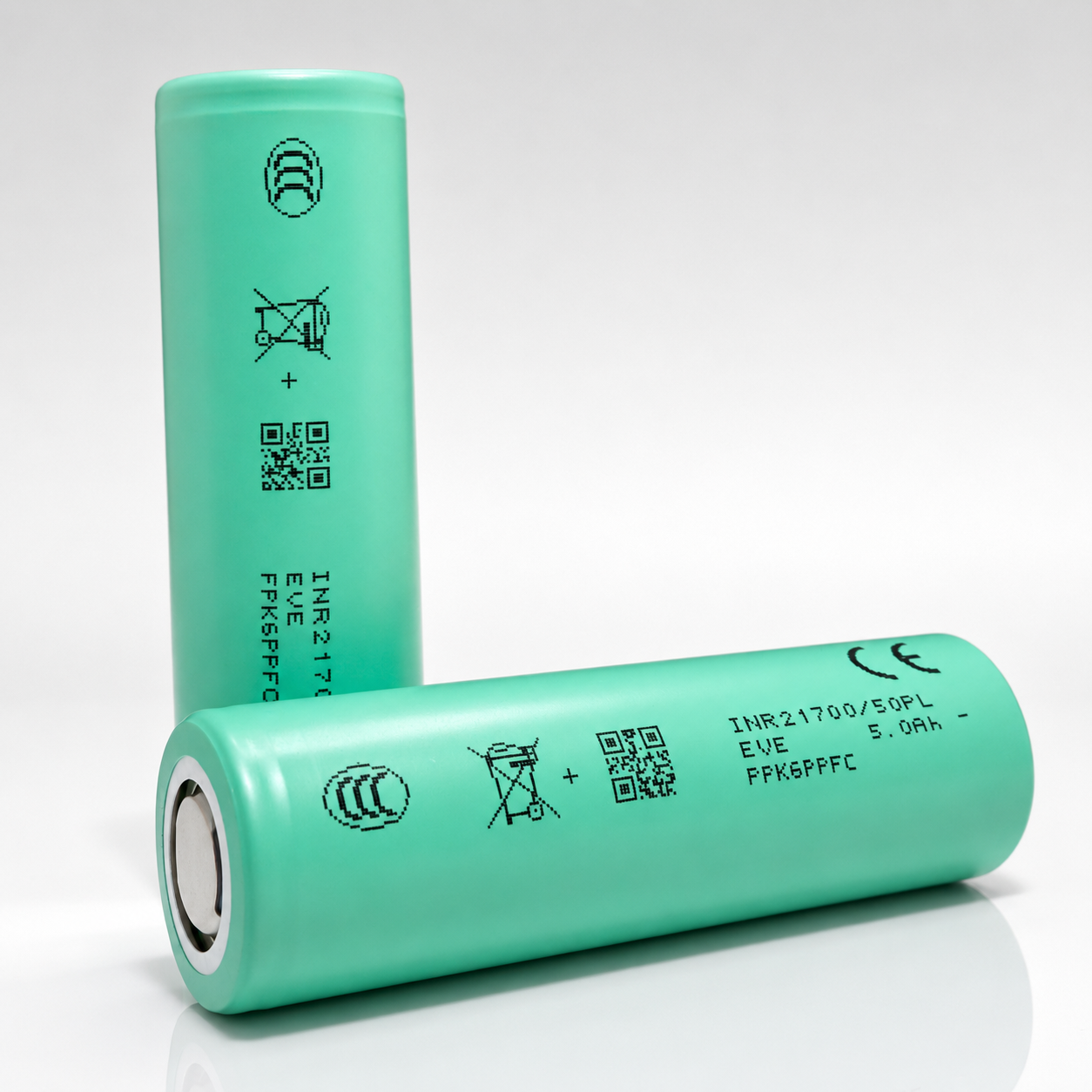
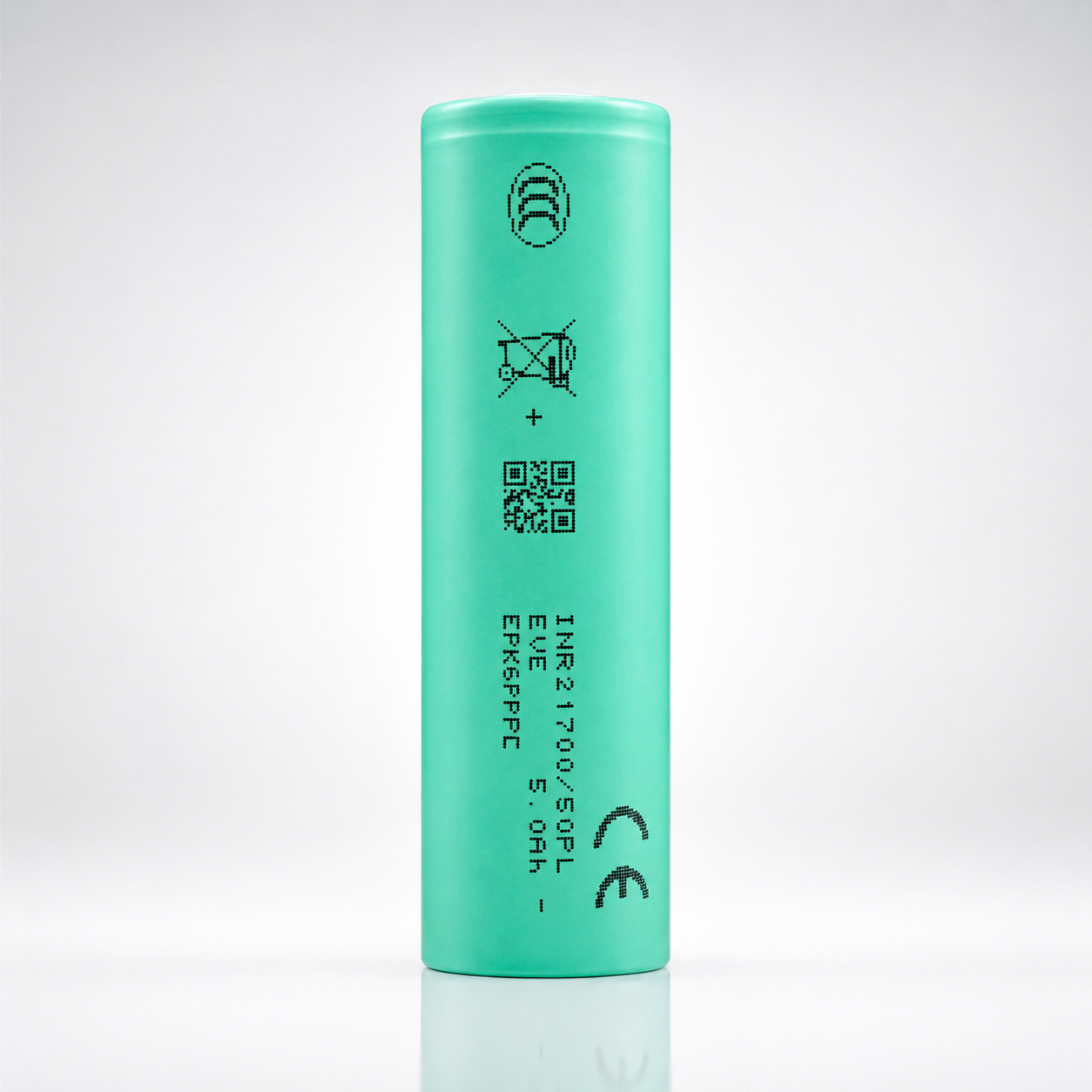
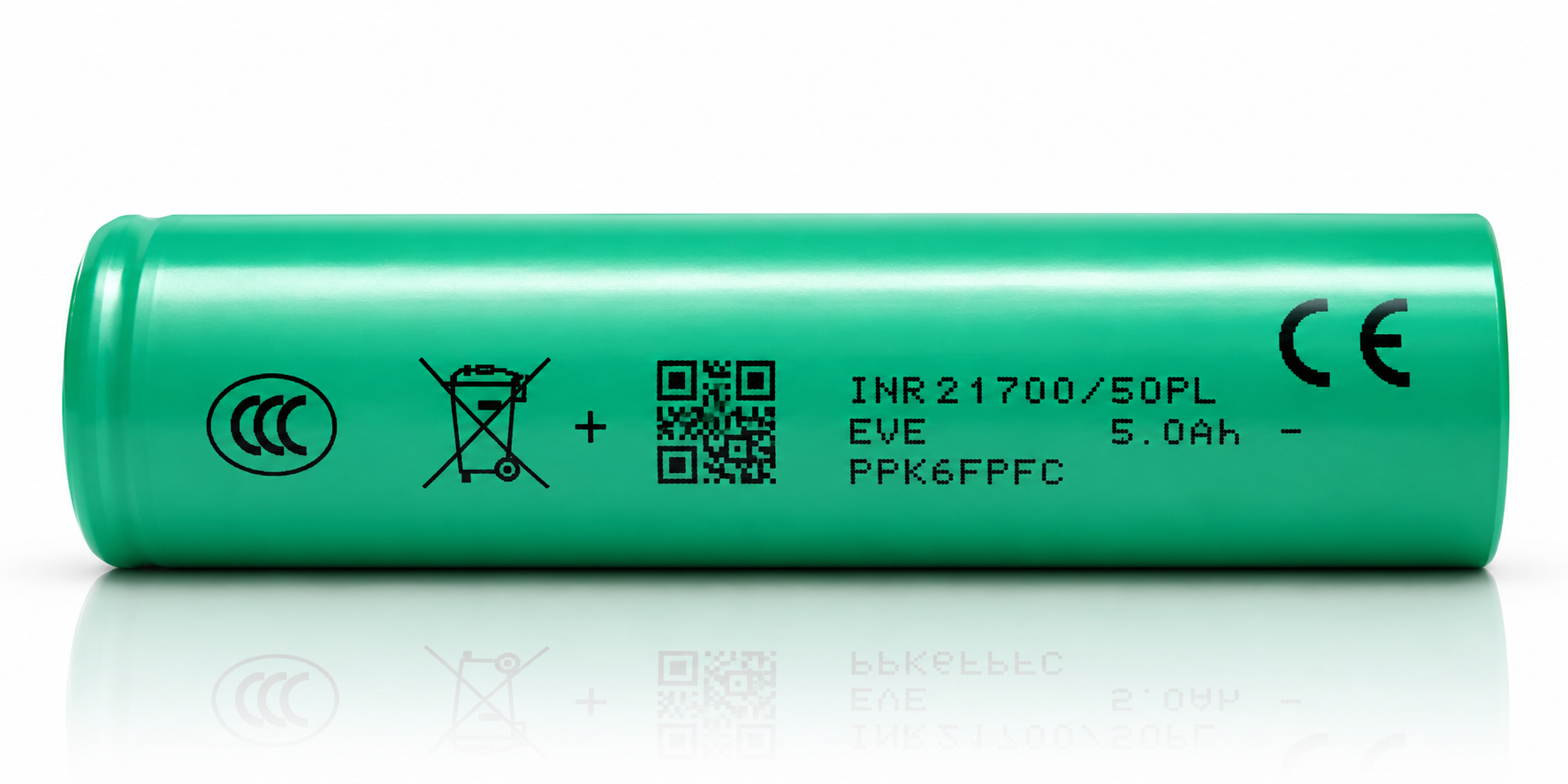


KEY SPECS · EVE ENERGY INR21700/50PL
SOURCE [1]- SIZE
- Ø21.15 × 70.15 mm
- nominal ±0.10 / ±0.15 · with tube
- CAPACITY
- Not stated by manufacturer typ.
- 5,000 mAh min.
- 0.2C to 2.50 V
- CURRENT
- Not stated by manufacturer
- continuous discharge
- TEMPERATURE
- −20 to 60 °C
- discharge · ambient
- charge 0 to 45 °C · ambient
A 21700 lithium-ion cell from EVE: 5,000 mAh minimum (“Minimum 5000mAh”, at a 1 A (0.2C) discharge to 2.50 V) [1] §3.1. Its one discharge maximum is 50 A (10C), printed as “Maximum Discharge” with two cut-off temperatures, 75 °C recommended and 80 °C maximum (“TRecommended:75℃ cut-off”, “Tmax:80℃ cut-off”) [1] §3.6. EVE prints no typical capacity and calls no current continuous. It marks its specification confidential and proprietary, so this description quotes it rather than linking it (section 12 below). Below: the printed figures, each with its condition, what we calculated from them, and what the safety data sheet (SDS) and the UN38.3 test documents record, so you can check each number.
SDS [3]: Issue Date 2025-10-21; validity printed “2025-10-21 ~2025-12-31”; printed validity ended 2025-12-31. The specification and the UN38.3 test documents are on file; this description quotes them but doesn’t link them (section 12 below). The library holds data sheets where the manufacturer publishes one.
A bare cell: a component for protected packs and devices built for it. Not for vaping. Charge on a lithium-ion (Li-ion) charger that stops at 4.20 V.
01SPEC PLATE
Every printed figure, with its condition.
EVE’s data sheet for the 50PL is titled PRODUCT SPECIFICATION [1]; this page calls it the specification. Its cover is dated September 2025, and its revision history runs to revision C, dated 2025-09-02 (printed “2025.9.02”). We also hold the November 2024 version it supersedes [2]; section 08 below compares the two. The plate gives [1]’s figures first, copied as printed; then the percentages its tables print, our arithmetic, and facts from the safety data sheet (SDS) [3] and the UN38.3 test summary [4]. Each row names its source or shows its formula.
| SPECIFICATION | VALUE | CONDITION · SOURCE |
|---|---|---|
| PRINTED · MANUFACTURER copied from specification [1] | ||
| MODEL | INR21700/50PL | as printed on every page, on the cover (“Model(型号): INR21700/50PL”) and in §2.2 “Model name” [1]; its warranty clause (§12) also prints “EVE INR21700-50PL”, with a hyphen; we list the cell as EVE 50PL |
| CAPACITY, TYPICAL | Not stated | Not stated by manufacturer: [1] prints no typical, nominal or rated capacity |
| CAPACITY, MINIMUM | 5,000 mAh | “Minimum 5000mAh”; “Charge: 2.5A(0.5C), 4.20V, CCCV 0.1A cut-off”; “Discharge:1A(0.2C), 2.50V cut-off”; no temperature printed in §3.1, and [1] sets 25 ± 2 °C for its tests unless otherwise specified (§6.1) [1] §3.1 |
| CAPACITY, MINIMUM, §8.1 | 5,000 mAh | “Standard Discharge Capacity≥ 5000mAh”, “with discharge current of 1A (0.2C) and 2.50V cut-off at 25°C after the standard charge”; “Referring IEC61960 Standard.”; the same discharge as §3.1 [1] §8.1 |
| 1C | 5.0 A | “*1C=5.0A”: a C-rate is the current as a multiple of 5.0 A, so 0.5C = 2.5 A, the Standard Charge, and 10C = 50 A, the §3.6 Maximum Discharge with its cut-off temperatures; every C-rate in [1] is printed beside its current [1] §3.1 |
| NOMINAL VOLTAGE | 3.60 V | “3.60V”; no condition printed [1] §3.2 |
| CHARGE VOLTAGE | 4.20 V | “4.20±0.05V”, “CCCV” (CC-CV: constant current, then constant voltage), in the Standard and Maximum Charge rows; range “4.20~2.50V” [1] §3.3, §3.4, §3.7 |
| DISCHARGE CUT-OFF | 2.50 V | “2.50V cut-off” [1] §3.1, §3.5, §3.6 |
| STANDARD CHARGE | 2.5 A | “CCCV, 2.5A(0.5C), 4.20±0.05V, 0.1A cut-off”; defined “at 25°C for capacity” (§7.1); no charge time printed [1] §3.3 |
| MAXIMUM CHARGE | 10 A | “CCCV, 10A(2.0C), 4.20±0.05V, 0.1A cut-off”; defined “at 25°C” (§7.2, which prints the current “10.0A (2.0C)”); no temperature band and no charge time printed with it [1] §3.4 |
| STANDARD DISCHARGE | 1 A | “1A(0.2C), 2.50V cut-off” [1] §3.5 |
| MAXIMUM DISCHARGE | 50 A | “50A(10C), 2.50V cut-off”, with “TRecommended:75℃ cut-off” and “Tmax:80℃ cut-off” beside it; [1] doesn’t say where that temperature is read; it calls no current continuous and prints no pulse figure [1] §3.6 |
| TEMPERATURE MEASUREMENT | K-type, 30–34 mm | “The temperature monitoring system (K-type thermocouple) is recommended to be placed in the middle of the cell (30mm~34mm up from the bottom of the cell), and the accuracy of the temperature monitoring system should be within ±2°C.” A separate guide clause; [1] doesn’t tie it to §3.6 [1] §14.8.7 |
| OPERATION TEMPERATURE | Two sub-rows | “3.10. Operation Temperature (Cell Surface Temperature)”: “Ambient Temperature” “Charge: 0 to 45 °C” “Discharge: -20 to 60℃”; then, with no heading of its own, “Charge Temperature: 0 to 60°C” “(recommended recharge release <45°C)” “Discharge Temperature: -20 to 80°C” “(recommended re-discharge release <60°C)”; [1] doesn’t say which basis the second sub-row has [1] §3.10 |
| AC IMPEDANCE | ≤ 5 mΩ | “Initial Internal Impedance ≤ 5mΩ”, “at AC 1kHz at shipping SOC” [1] §8.2 |
| CYCLE LIFE | ≥ 60 % of Ci | “Capacity ≥60% Ci” after 400 cycles: “Charge: 10A(2C), 4.20V, 0.1A cut-off.” “Discharge:40A(8.0C) discharge, 2.50V or 80°C cut-off.” “Rest Time: 10min after charge and 30min after discharge.” Ci is “the first discharge capacity of cycle life test at 25±2℃”; [1] doesn’t give it in mAh [1] §8.5 |
| STORAGE TEMPERATURE | −20 to 25 °C | for “1 year”; “-20~45°C” for “3 months”, “-20~60°C” for “1 month”; “(At Shipping SOC)”; Remark: recovery “more than 90% of standard discharge capacity (=5000mAh)” [1] §3.11 |
| RECOVERY AFTER 30 DAYS AT 60 °C | ≥ 90 % | “Recovery Capacity ≥ 90% of Standard Discharge” (as printed; its Chinese line, “恢复容量≥90%(标准放电容量的90%)”, says 90 % of the standard discharge capacity); “After storage for 30days at 60℃.”; §8.6 defines Recovery Capacity as “The capacity of standard discharge of three times cycles after fully standard charged storage at condition as follows.” No mAh is printed here [1] |
| AS SHIPPED | 3.450–3.600 V | “The cell should be shipped in 3.450V to 3.600V charging voltage range.” No state of charge printed [1] §11 |
| LONG STORAGE | 3.50–3.80 V | for “3 months or more”: “it is strongly recommended that the cell is performed one cycle”; “the voltage of the cell is recommended from 3.50V to 3.80V”; “low-temperature (normally 0~25°C), dry and no corrosive gas” [1] §15.1 |
| DIAMETER | 21.15 mm | “Diameter: 21.15±0.10mm”, under “3.9. Cell Dimensions(w/ tube)”; Fig. 1: “with tube” [1] §3.9 |
| HEIGHT | 70.15 mm | “Height: 70.15±0.15mm”, under the same label; Fig. 1: “with tube” [1] §3.9 |
| MASS | 72.0 g | “72.0g Max” [1] §3.8 |
| TERMINAL | Not stated | Not stated by manufacturer: [1] states no top style |
| + Source: [1] EVE Energy Co., Ltd., “PRODUCT SPECIFICATION”, INR21700/50PL, Spec. No. PBRI-INR21700/50PL-D06-01, “September 2025”, revision C (as printed); marked confidential and proprietary; on file, not linked from this description (section 14 below) | ||
| SPECIFICATION | VALUE | CONDITION · SOURCE |
|---|---|---|
| PRINTED IN THE SPECIFICATION’S TABLES percent of “the 10A discharge capacity at 25°C”, as printed; no mAh is printed for it, so none is calculated [1] | ||
| CAPACITY AT 40 A (8.0C) | ≥ 95 % | “≥95” of “the 10A discharge capacity at 25°C”, which [1] doesn’t give in mAh; “2.50V cut-off after the standard charge at 25°C” [1] §8.3 |
| CAPACITY AT 30 A (6.0C) | ≥ 95 % | “≥95”; same reference and conditions [1] §8.3 |
| CAPACITY AT 1 A (0.2C) | ≥ 100 % | “≥100”; same reference and conditions [1] §8.3 |
| CAPACITY AT −20 °C, 12.5 A | ≥ 60 % | “≥60”, “after 3 hours storage at the test environment”, then “with discharge constant current 12.5A (2.5C) and 2.50V cut-off after the standard charge at 25°C”; percent of “the 10A discharge capacity at 25°C”, as the note under §8.4 prints it, though §8.4 discharges at 12.5 A [1] §8.4 |
| CAPACITY AT −10 °C, 12.5 A | ≥ 75 % | “≥75”; same conditions [1] §8.4 |
| CAPACITY AT 0 °C, 12.5 A | ≥ 80 % | “≥80”; same conditions [1] §8.4 |
| CAPACITY AT 60 °C, 12.5 A | ≥ 90 % | “≥90”; same conditions [1] §8.4 |
| CALCULATED arithmetic on [1], shown so you can check it | ||
| ENERGY, CHECK | 18.00 Wh | 3.60 V nominal [1] §3.2 × 5.000 Ah, the §3.1 minimum [1]; equals the 18 Wh printed in the SDS [3] and the UN38.3 summary [4]; [1] prints no Wh |
| RECOVERY AFTER §3.11 STORAGE | > 4,500 mAh | more than 90 % × 5,000 mAh, the index “(=5000mAh)” printed in the §3.11 Remark [1] |
| DIAMETER, LIMITS | 21.05–21.25 mm | 21.15 ± 0.10 mm [1] §3.9 |
| HEIGHT, LIMITS | 70.00–70.30 mm | 70.15 ± 0.15 mm [1] §3.9 |
| VOLUME | 24.6 cm³ | π × (21.15 mm ÷ 2)² × 70.15 mm ≈ 24,646 mm³, at the printed size [1] §3.9 |
| DOCUMENTED · WHAT WE HOLD the documents on file for this cell, copied as printed | ||
| SPECIFICATION | September 2025 | PRODUCT SPECIFICATION, Spec. No. PBRI-INR21700/50PL-D06-01, “September 2025”; revision C, dated 2025-09-02 (printed “2025.9.02”), the latest in its revision history; marked confidential and proprietary on every page, so this description doesn’t link it [1] |
| EARLIER VERSION | November 2024 | “Version No. 版本 A”, “November, 2024”, the same Spec. No.; superseded by [1]; marked confidential like [1]; compared in section 08 below only, not linked [2] |
| CHEMISTRY | Li-ion | “Lithium-ion rechargeable cell”; no cathode material printed [1] §2.1. The SDS lists “Cobalt lithium manganese nickel oxide /钴锂锰镍氧化物”, LiNixCoyMnzO2, CAS 182442-95-1, “35.05%” in its “Weigh 含量” column [3] Section 3 |
| ENERGY | 18 Wh | “3.60V, 5000mAh, 18Wh”, under “Parameter 参数”, no condition printed [3] Section 1; “5.0Ah 18Wh” under “容量/能量 Capacity/energy” [4]; [1] prints no Wh |
| TRANSPORT | UN 3480 | by air, “IATA-DGR 66th Edition (Effective 1 January-31 December 2025)”: “Class 9” under “Packing Instruction 965, section IB”; packed with or inside equipment, UN 3481, “Not restricted” under “Packing Instruction 966, section II” and “Packing Instruction 967, section II”; by sea and road, “Not restricted”, “Packing as per sp188” [3] Section 14 |
| SAFETY DATA SHEET | YWA2F9D07 |
Guangzhou MCM Certification & Testing Co., Ltd.; Issue Date 2025-10-21; validity printed “2025-10-21 ~2025-12-31”: printed validity ended 2025-12-31 [3] |
| UN38.3 | 812500600 |
Test Summary from Shanghai Institute of Chemical Industry Testing Co., Ltd., issued 2025-10-30; T.1–T.6 and T.8 “合格 Passed”, T.7 “/” [4]; the lab’s full report No. 1125090659 [5]; section 07 below |
| + Source: [1] EVE Energy Co., Ltd., “PRODUCT SPECIFICATION”, INR21700/50PL, Spec. No. PBRI-INR21700/50PL-D06-01, “September 2025”, revision C (as printed); marked confidential and proprietary; on file, not linked from this description (section 14 below) + Source: [2] EVE Energy Co., Ltd., “PRODUCT SPECIFICATION”, Spec. No. PBRI-INR21700/50PL-D06-01, “Version No. 版本 A”, “November, 2024”; superseded by [1]; marked confidential and proprietary; on file, not linked from this description (section 14 below) + Source: [3] Guangzhou MCM Certification & Testing Co., Ltd., “MATERIAL SAFETY DATA SHEET”, Report No. YWA2F9D07SDS01; no version printed; Issue Date 2025-10-21, validity printed “2025-10-21 ~2025-12-31”: printed validity ended 2025-12-31 · SDS PDF + Source: [4] Shanghai Institute of Chemical Industry Testing Co., Ltd., “UN38.3 Test Summary” 812500600880710; no version printed; issued 2025-10-30; on file, not linked from this description; full report No. 1125090659, 2025-10-29 [5], on file | ||
Voltage window
Black marks: the voltages [1] prints, “2.50V cut-off” (§3.1, §3.5, §3.6), “3.60V” nominal (§3.2) and “4.20±0.05V” charge (§3.3, §3.4); range “4.20~2.50V” (§3.7). Orange band: “The cell should be shipped in 3.450V to 3.600V charging voltage range.” [1] §11; its top equals the 3.60 V nominal voltage. For storage of 3 months or more, [1] §15.1 recommends 3.50 to 3.80 V (fig 6.3).
Currents, as printed
The current rows of [1] §3 (§3.3 to §3.6), each with its printed condition; C-rates as printed, on “*1C=5.0A”. [1] calls none of them continuous and prints no pulse figure. Orange: the §3.6 “Maximum Discharge”, its only maximum discharge figure, which carries two cut-off temperatures; [1] doesn’t say where that temperature is read (fig 4.2).
Operation temperature, as printed
One row of [1], quoted whole, in °C. Its label reads “3.10. Operation Temperature (Cell Surface Temperature)”; the first sub-row (black) is headed “Ambient Temperature”, the second (gray) has no heading of its own, and [1] doesn’t say which basis the second has. We label neither sub-row beyond its printed words. Marks: the second sub-row’s release temperatures, and the §3.6 cut-off temperatures.
Storage temperature, by duration
“3.11. Storage Temperature (At Shipping SOC)”, by duration; orange: the 1-year range. Below the table, [1] prints “Remark: The Recovery capacity is more than 90% of standard discharge capacity (=5000mAh) after storage at the condition of 3.11.” That is more than 4,500 mAh: 90 % × 5,000 mAh, our arithmetic. [1] says cells ship at 3.450 to 3.600 V (§11) and prints no percentage for “Shipping SOC”.
Capacity, as each document prints it
Bars start at zero. Orange: the §3.1 minimum, the capacity this page leads with. [1] and [3] print 5,000 mAh and [4] prints 5.0 Ah, the same quantity, and only [1] says what kind of figure it is: a minimum. §3.1: “Minimum 5000mAh”, “Charge: 2.5A(0.5C), 4.20V, CCCV 0.1A cut-off”, “Discharge:1A(0.2C), 2.50V cut-off”. §8.1: “Standard Discharge Capacity≥ 5000mAh”, “with discharge current of 1A (0.2C) and 2.50V cut-off at 25°C after the standard charge”; the two clauses agree. The SDS prints “3.60V, 5000mAh, 18Wh” [3] and the UN38.3 summary “5.0Ah 18Wh” [4], with no label and no condition (5.0 Ah is 5,000 mAh). None of the three prints a typical, nominal or rated capacity; the November 2024 version printed other capacity figures (section 08 below).
Energy, as printed and checked
Bars start at zero. [1] prints no energy figure. The SDS [3] and the UN38.3 summary [4] each print 18 Wh, with no label and no condition. Gray: our check, 3.60 V nominal (§3.2) × 5.000 Ah, the §3.1 minimum capacity: 18.00 Wh, the same figure. The SDS’s printed validity ended 2025-12-31; we hold no newer one.
At least 95 % of its 10 A capacity at 40 A.
[1] §8.3 prints the capacity at four currents, from 1 A (0.2C) to 40 A (8.0C), as a percent of “the 10A discharge capacity at 25°C”, which it doesn’t give in mAh. At 30 and 40 A it prints “≥95”. Above 40 A it prints no capacity: its “Maximum Discharge” of 50 A, with “TRecommended:75℃ cut-off” and “Tmax:80℃ cut-off” [1] §3.6, has no capacity, runtime or cycle figure beside it.
Data: [1] §8.3, Discharge Rate Capabilities · “2.50V cut-off after the standard charge at 25°C” · percent of “the 10A discharge capacity at 25°C”, labels as printed, a lower bound (“≥”) except at 10 A · points only: EVE prints no curve between them · the vertical line marks the §3.6 “Maximum Discharge”, 50 A, with “TRecommended:75℃ cut-off” and “Tmax:80℃ cut-off” · axis starts at 60 % · data table under fig 3.1
03BY CURRENT
Capacity, by current.
[1] §8.3 prints the capacity at 1, 10, 30 and 40 A as a percent of “the 10A discharge capacity at 25°C”. It prints no mAh for that reference, so this page gives the percentages only and calculates no runtime from them. Its 50 A “Maximum Discharge”, with “TRecommended:75℃ cut-off” and “Tmax:80℃ cut-off” [1] §3.6, has no capacity figure.
Capacity, by discharge current
Capacity to 2.50 V after the standard charge at 25 °C, printed in [1] §8.3 as a percent of the capacity at 10 A. Its note reads “Note: Relative capacity is divided by the 10A discharge capacity at 25°C.” [1] gives that 10 A capacity no mAh figure, so none is calculated. Bars start at zero and show the printed figure, a lower bound (“≥”) except at 10 A; [1] prints the percent sign once, in the row heading “Relative Capacity 相对容量(%)”. Orange: 40 A, the largest current with a printed capacity; none is printed at 50 A (§3.6 “Maximum Discharge”, “50A(10C), 2.50V cut-off”, with “TRecommended:75℃ cut-off” and “Tmax:80℃ cut-off”).
DATA TABLE · FIG 3.1 · AS PRINTED
| CURRENT, A | RATE, C | RELATIVE CAPACITY, % |
|---|---|---|
| 1 | 0.2 | ≥100 |
| 10 | 2.0 | 100 |
| 30 | 6.0 | ≥95 |
| 40 | 8.0 | ≥95 |
| 50, §3.6 | 10 | not printed |
Discharge currents in the specification
Where each discharge current in [1] sits, on one 0–60 A scale; currents and C-rates as printed. §3.5 “Standard Discharge”, the same 1 A discharge as the §3.1 and §8.1 capacity, and §3.6 “Maximum Discharge” are current rows of the §3 table; the other three rows are test conditions (§8.3, §8.4, §8.5). [1] prints a capacity for currents from 1 to 40 A (fig 3.1) and none at 50 A, and calls no current continuous.
What 50 A means
- In plain terms: 50 A is the most current [1] lists, and it lists it only as “Maximum Discharge”, “50A(10C), 2.50V cut-off”, with two cut-off temperatures beside it, “TRecommended:75℃ cut-off” and “Tmax:80℃ cut-off” [1] §3.6. Read as printed: cut the discharge off at 75 °C (recommended), and never above 80 °C (maximum). [1] gives no duration for 50 A and no maximum without those cut-offs, and its §13 Note 3 says that for special requirements, the current included, “it is necessary to confirm in writing in advance with the EVE”.
- [1] doesn’t say where the cut-off temperature is read. Its guide separately recommends that “The temperature monitoring system (K-type thermocouple)” be placed “in the middle of the cell (30mm~34mm up from the bottom of the cell)”, accurate “within ±2°C” [1] §14.8.7. It doesn’t tie that clause to §3.6.
- No current in [1] is called continuous, and no pulse figure is printed. Its guide says “The cell shall be discharged continuously at less than maximum discharging current specified in the specification.” and that a higher current “shall be confirmed with EVE” [1] §14.3.1. That sets a ceiling, not a continuous rating.
- 40 A is the largest current with a printed capacity: “≥95” (percent) of the 10 A capacity at 25 °C [1] §8.3. The 400-cycle figure also discharges at 40 A, to “2.50V or 80°C cut-off” [1] §8.5. [1] prints no capacity and no cycle figure at the 50 A maximum.
04TEMPERATURE
Capacity in the cold and the heat.
One table in [1] §8.4: capacity at −20, −10, 0, 25 and 60 °C, each after a standard charge at 25 °C and 3 hours at the test temperature, with a 12.5 A (2.5C) discharge to 2.50 V, as a percent of “the 10A discharge capacity at 25°C”, as its note prints it; its own 25 °C column prints “100”. At −20 °C it prints “≥60”. [1] prints no charge-temperature table.
Capacity, by discharge temperature
Capacity at each temperature, printed in [1] §8.4: “after 3 hours storage at the test environment”, then “with discharge constant current 12.5A (2.5C) and 2.50V cut-off after the standard charge at 25°C”. Its note: “Note: Relative capacity is divided by the 10A discharge capacity at 25°C.” That is the note §8.3 prints, word for word, though §8.4 discharges at 12.5 A and its own 25 °C column prints “100”; [1] gives that reference no mAh figure, so none is calculated. Bars start at zero and show the printed figure, a lower bound (“≥”) except at 25 °C. Orange: below 0 °C. −20 °C, the coldest point printed, is the bottom of both discharge ranges in §3.10.
DATA TABLE · FIG 4.1 · AS PRINTED
| TEMPERATURE, °C | RELATIVE CAPACITY, % |
|---|---|
| -20 | ≥60 |
| -10 | ≥75 |
| 0 | ≥80 |
| 25 | 100 |
| 60 | ≥90 |
Discharge temperatures and cut-offs
Discharge temperatures in [1], on one −20 to 90 °C scale. Black: the §3.10 sub-row headed “Ambient Temperature”; gray: the unheaded second sub-row, with its release mark at 60 °C. Marks: the §3.6 cut-off temperatures, the 80 °C cut-off of the §8.5 cycle test, and the §8.4 test points. [1] doesn’t say where the §3.6 and §8.5 temperatures are read; §14.8.7, a separate clause, recommends a K-type thermocouple 30 to 34 mm up from the bottom of the cell.
What the table leaves out
- No capacity above 60 °C, though the second sub-row of §3.10 prints “Discharge Temperature: -20 to 80°C” with “(recommended re-discharge release <60°C)” [1].
- No capacity at a high current in the cold: §8.4 uses a 12.5 A discharge only [1].
- No charge-temperature table: [1] prints no capacity after a charge at any temperature but 25 °C.
- Its operating temperatures are one row, printed “3.10. Operation Temperature (Cell Surface Temperature)”; the first sub-row is headed “Ambient Temperature” and the second has no heading. [1] doesn’t say which basis the second has (fig 1.3).
05CHARGING
Charging: 2.5 A standard, 10 A maximum.
The specification prints a “Standard Charge” of “CCCV, 2.5A(0.5C), 4.20±0.05V, 0.1A cut-off” and a “Maximum Charge” of “CCCV, 10A(2.0C), 4.20±0.05V, 0.1A cut-off”; §7.1 and §7.2 define both at 25 °C [1]. It prints no charge time. Its 400-cycle figure charges at 10 A (2C), the maximum current, and both §3.10 charge ranges start at 0 °C.
Charge currents, as printed
Charge currents as [1] prints them: “CCCV, 2.5A(0.5C), 4.20±0.05V, 0.1A cut-off” (§3.3), “Charge: 10A(2C), 4.20V, 0.1A cut-off.” (§8.5) and “CCCV, 10A(2.0C), 4.20±0.05V, 0.1A cut-off” (§3.4); C-rates as printed. Orange: the “Maximum Charge”; gray: the 400-cycle test, which charges at the same 10 A. [1] prints no charge time for any of them. Its overcharge test, 15.0 A (3C) at 4.6 V (§10.1), is an abuse condition, not a limit (section 07 below).
Charge temperature, as printed
Where [1] allows charging, in °C. Black: “Charge: 0 to 45 °C” in the §3.10 sub-row headed “Ambient Temperature”; gray: “Charge Temperature: 0 to 60°C” in the unheaded second sub-row, with its “(recommended recharge release <45°C)” marked. Both start at 0 °C: below 0 °C, don’t charge. [1] prints no capacity after a charge at any temperature but 25 °C.
Before you charge
- Use a lithium-ion charger with a CC-CV profile that stops at 4.20 V: [1] prints “4.20±0.05V”, “CCCV”, with a 0.1 A cut-off [1] §3.3, §3.4.
- 2.5 A (0.5C) is the “Standard Charge” and 10 A (2.0C) the “Maximum Charge”, both defined at 25 °C [1] §3.3, §3.4, §7.1, §7.2. [1]’s guide says “Charging current shall be less than maximum charge current specified in the specification.” [1] §14.2.1. The 400-cycle figure charges at 10 A (2C) [1] §8.5.
- Charge within §3.10: “Charge: 0 to 45 °C” under “Ambient Temperature”, and “Charge Temperature: 0 to 60°C” with “(recommended recharge release <45°C)” in the unheaded second sub-row [1]. Both ranges include 0 to 45 °C. Below 0 °C, don’t charge.
- [1] prints no charge time, no pre-charge level and no minimum voltage for starting a charge. Its guide asks for a device that stops discharge at the cut-off voltage, and a charger that detects the voltage of the “cell box” (the battery pack, in its Chinese line) to determine recharging procedures [1] §14.3.3.
- In a pack, a BMS (battery management system) should end charge at 4.20 V per cell; [1] asks for a device to monitor “each voltage of cell block” and a warning system for over temperature, over voltage and over current [1] §14.6.6.
Figs 5.1 and 5.2 plot values [1] prints as text; EVE draws no chart of them. [1] prints the charge temperatures in two sub-rows of §3.10, quoted whole in fig 1.3; we label neither beyond its printed words.
06CYCLE LIFE AND STORAGE
What it keeps after cycling, and recovers after storage.
[1] specifies a “Recovery Capacity” of at least 90 % of the standard discharge capacity after 30 days at 60 °C from full charge (§8.6, printed “Recovery Capacity ≥ 90% of Standard Discharge”). That is the capacity on standard discharge cycles after the storage, not the charge left in the cell, and [1] prints no self-discharge figure. After 400 cycles of “Charge: 10A(2C), 4.20V, 0.1A cut-off.”, “Discharge:40A(8.0C) discharge, 2.50V or 80°C cut-off.” and “Rest Time: 10min after charge and 30min after discharge.” it specifies “Capacity ≥60% Ci” (§8.5), where Ci is the test’s own first discharge capacity, which [1] doesn’t give in mAh. It prints no cycle-life curve. Its storage clauses, in §3.11, §14.4 and §15.1, are each worded differently (fig 6.2).
Capacity after storage and cycling
Capacity after storage and cycling as [1] prints it, in mAh where [1] gives one. New: “Minimum 5000mAh” at a 1 A (0.2C) discharge (§3.1) and “≥ 5000mAh” at the same current, 25 °C (§8.1). After 30 days at 60 °C from full charge: “Recovery Capacity ≥ 90% of Standard Discharge” (§8.6, defined on the plate), with no mAh printed, so there is no bar. Gray: after the §3.11 storage, “more than 90%” of the “(=5000mAh)” index, more than 4,500 mAh by our arithmetic. After the 400-cycle test (40 A discharge to “2.50V or 80°C cut-off”; full conditions in the section intro): “Capacity ≥60% Ci”. Ci, the test’s first discharge capacity at 25 ± 2 °C, isn’t printed in mAh, so there is no bar. A specification, not a warranty, and not a curve: [1] prints no capacity between cycle 1 and 400.
Storage temperature, every statement
[1]’s storage statements, each in its own words, on one −20 to 80 °C scale. Orange: the 1-year range in §3.11. Gray: §15.1’s advice for 3 months or more, which also recommends one cycle and a cell voltage of 3.50 to 3.80 V (fig 6.3). The §8.6 mark is a 30-day test at 60 °C, not storage advice. §14.4.1 asks for storage “within a range of temperatures specified in the specification”.
Storage voltage, as printed
Storage voltage as [1] prints it, on a 3.4–4.0 V scale. The shipping range (§11) and the long-storage range (§15.1) overlap from 3.50 to 3.60 V. [1] prints no state of charge for either. §14.4.2 asks for long-term storage “at lower voltage within a range specified in this specification”. Separately, the SDS [3] says to “charge the battery every 6 months to the amount specified by the manufacture, even if the battery is not used” (Section 7, Storage 4); it gives no voltage, and its printed validity ended 2025-12-31.
07TRANSPORT TESTS
What the UN38.3 documents record.
UN38.3 is the set of transport tests, in section 38.3 of the UN Manual of Tests and Criteria, that a lithium cell must pass before it can be shipped. The UN38.3 Test Summary [4], No. 812500600880710, comes from Shanghai Institute of Chemical Industry Testing Co., Ltd., a testing company separate from the EVE companies it names as consignor and manufacturer. For the INR21700/50PL it prints “合格 Passed” for T.1–T.6 and T.8, and “/” for T.7 and for 38.3.3 (f) and (g). It was issued 2025-10-30 and summarizes the lab’s test report No. 1125090659 [5], which we also hold: tests from 2025-09-30 to 2025-10-28 on 40 samples in all (our tally), with the per-sample figures in figs 7.1–7.3. A manufacturer sample, not our lot.
Highest temperature, by abuse test
Highest external temperature of each sample, printed in [5] under “样品表面最高温度 Max. External Temperature /℃”: one tick per sample; the orange bar spans the lowest to the highest. T.5 external short circuit: the 10 samples of T.1–T.4, fully charged, 5 marked “1CYC” and 5 “25CYC” (one and 25 cycles): 99.1–116.7 °C. T.6 impact: 10 other samples at “50% Capacity”: 22.4–41.2 °C. [5] prints no temperature limit and no test settings (short-circuit resistance, impact mass), only the UN Manual section it follows. It marks every sample “O”: in T.5, “No Disassembly,No Fire & No Rupture”; in T.6, “No Disassembly & No Fire”. Sample counts are our tallies of the printed rows. A manufacturer sample, not our lot.
DATA TABLE · FIG 7.1
| TEST | SAMPLE STATE, AS PRINTED | MAX °C, EACH SAMPLE, AS PRINTED |
|---|---|---|
| T.5 | 1CYC Fully charged | 99.1, 108.7, 103.9, 108.5, 107.5 |
| T.5 | 25CYC Fully charged | 108.3, 104.1, 107.6, 109.2, 116.7 |
| T.6 | 1CYC 50% Capacity | 22.4, 41.2, 27.5, 23.0, 31.1 |
| T.6 | 25CYC 50% Capacity | 22.7, 28.4, 22.9, 24.9, 25.0 |
Voltage kept through T.1–T.4
Open-circuit voltage (OCV) after each test as a percent of the voltage before it, printed in [5] as “剩余电压 Residual OCV /%”: one tick per printed value. The same 10 fully charged samples ran T.1 to T.4 in turn; each test’s “Before” readings are the previous test’s “After” readings. OCV before T.1: 4.15–4.17 V; after T.4: 4.09–4.10 V. Mass loss is printed as “质量损失 Mass Loss /%”; in T.2, samples 008 and 010 weighed slightly more after the test (66.5847 to 66.5859 g and 66.4211 to 66.4218 g), printed as “0.00”. [5] prints no pass threshold for either. The scale starts at 97 %.
Mass of the samples in the report
The lab’s weighings of the 10 samples before T.1, printed in [5] Appendix 1: 66.3277–66.6120 g (mean 66.484 g, our arithmetic), all below [1]’s “72.0g Max” (§3.8), which is off this scale. The line: the summary [4] prints “0.0667” under “质量(kg) Mass”, that is 66.7 g, and doesn’t say how it was obtained. The axis starts at 66.2 g. A manufacturer sample, not our lot; we haven’t weighed our own stock.
DATA TABLE · FIG 7.3
| SAMPLE | BEFORE T.1, g | AFTER T.4, g |
|---|---|---|
| 001 | 66.3277 | 66.3207 |
| 002 | 66.6120 | 66.6045 |
| 003 | 66.5251 | 66.5169 |
| 004 | 66.5005 | 66.4922 |
| 005 | 66.4051 | 66.3987 |
| 006 | 66.5861 | 66.5785 |
| 007 | 66.3423 | 66.3267 |
| 008 | 66.5910 | 66.5830 |
| 009 | 66.5229 | 66.5181 |
| 010 | 66.4266 | 66.4182 |
| TEST, AS PRINTED [4] | RESULT, AS PRINTED |
|---|---|
| T.1 高度模拟 Altitude simulation | 合格 Passed |
| T.2 温度测试 Thermal test | 合格 Passed |
| T.3 振动测试 Vibration | 合格 Passed |
| T.4 冲击测试 Shock | 合格 Passed |
| T.5 外部短路 External short circuit | 合格 Passed |
| T.6 撞击 Impact | 合格 Passed |
| T.7 过度充电 Overcharge | / |
| T.8 强制放电 Forced discharge | 合格 Passed |
| 38.3.3 (f) | / |
| 38.3.3 (g) | / |
| ITEM | AS PRINTED [4] |
|---|---|
| Summary | 812500600880710, issued 2025-10-30 |
| Test report | No. 1125090659, 2025-10-29 [5] (on file, not on our store: our note) |
| Test standard | UNITED NATIONS Manual of Tests and Criteria 38.3, ST/SG/AC.10/11/Rev.8 |
| Test lab | Shanghai Institute of Chemical Industry Testing Co., Ltd. (上海化工院检测有限公司) |
| Consignor | EVE Energy Co., Ltd. |
| Manufacturer | Chengdu EVE Energy Co., Ltd. |
| Type | INR21700/50PL |
| Brand | EVE |
| Nominal voltage (V) | 3.6 |
| Capacity/energy | 5.0Ah 18Wh |
| Mass (kg) | 0.0667 |
| Li content (g) | / |
| Appearance | 绿色圆柱型塑料薄膜外壳 green cylinder plastics film shell |
| Remark | / |
The summary’s conclusion, as printed: “The tested samples meet the requirements of test items of the UNITED NATIONS Manual of Tests and CriteriaST/SG/AC.10/11/Rev.8 38.3”. The report gives its test environment as “Ambient temperature:20℃-25℃”. This description cites these documents but links none of them: [4] prints a telephone number for the manufacturer that we haven’t confirmed as a company line, and [5] is not on our store. A re-issued summary, No. 812500800185794 (2025-11-17) [6], repeats the same results with a different brand field and different label photographs.
Safety tests the specification lists
| TEST | METHOD, CONDENSED FROM [1] | PASS CRITERION, AS PRINTED | METHOD REFERENCE, AS PRINTED | SECTION |
|---|---|---|---|---|
| 9.1. Free Fall Test | Each fully charged cell dropped 3 times from 1.0 m onto a concrete floor, in random orientations; 1 h of rest, then a visual inspection | “No fire, no explosion.” | “Free fall test is according to the IEC62133 standard.” | [1] §9.1 |
| 9.2. Vibration Test | For the X and Y axes of the cylindrical cell: 7 Hz → 200 Hz → 7 Hz in 15 min, repeated 12 times, 3 h in total; 1 g from 7 to 18 Hz, then 1.6 mm amplitude, at most 8 g, to 200 Hz | “No fire, no explosion, no leakage, with less than 10% of OCV drop.” | “Vibration test is according to the UN38.3 standard.” | [1] §9.2 |
| 10.1. Overcharge Test | Fully discharged (standard discharge) cell charged at 4.6 V and 15.0 A (3C) for 7 h | “No fire, no explosion.” | “Overcharge test is according to the UL1642 standards.” | [1] §10.1 |
| 10.2. External Short-circuit Test | Fully charged (standard charge) cell shorted through an 80 ± 20 mΩ load at 55 ± 5 °C, for 24 h or until the surface temperature has fallen by 20 % of its maximum rise, whichever is sooner | “No fire, no explosion.” | “External short-circuit test is according to the IEC62133 standard.” | [1] §10.2 |
| 10.3. Forced Discharge Test | Discharged cell reverse-charged at 5.0 A (1C) for 90 min | “No fire, no explosion.” | “Forced discharge test is according to the IEC62133 standard.” | [1] §10.3 |
| 10.4. Heating Test | Standard-charged cell heated at 5 °C per minute to 130 °C, then held 10 min in an oven | “No fire, no explosion.” | “Heating test is according to the UL1642 standard.” | [1] §10.4 |
| 10.5. Low Pressure Test | Fully charged (standard charge) cell stored at 11.6 kPa or less for at least 6 h at ambient temperature | “No fire, no explosion and no leakage with less than 10% of OCV drop.” | “Low pressure test is according to the UN38.3 standards.” | [1] §10.5 |
EVE’s own test methods and pass criteria, from “9. Mechanical Characteristics” (§9.1, §9.2) and “10. Safety” (§10.1–§10.5) of [1]: methods condensed in our words, without adding or dropping a figure; criteria and method references quoted as printed. [1] reports no results, and the standards it names are the methods its tests follow, not certificates. Their voltages and currents, such as 4.6 V and 15.0 A (3C) in the overcharge test, are abuse conditions, not limits. The UN38.3 results above are a different set of tests, from [4] and [5]; [1]’s own vibration and low-pressure methods name UN38.3, but [1] prints no results for them. OCV: open-circuit voltage.
08WHAT CHANGED
The November 2024 version and the September 2025 specification, side by side.
[2] is the earlier version of the same specification, Spec. No. PBRI-INR21700/50PL-D06-01, “Version No. 版本 A”, dated “November, 2024”. [1], dated “September 2025”, keeps [2]’s revision A in its revision history and adds B, a template update, and C, the cycle-life clause. In short, [1] raises the minimum capacity from 4,800 to 5,000 mAh and prints no nominal capacity; lowers the “Maximum Discharge” from 125 A (25C) to 50 A (10C), with the same two cut-off temperatures; changes the “Initial Internal Impedance” criterion from “≤ 7mΩ” to “≤ 5mΩ”; adds the 400-cycle clause and the §3.11 storage remark; drops the pulse figure and the without-tube dimensions; and moves the recommended thermocouple position. [1] doesn’t say why these changed. Every figure on this page for this cell follows [1].
| ITEM | NOVEMBER 2024, VERSION A [2] | SEPTEMBER 2025, REVISION C [1] |
|---|---|---|
| Date and version | dated “November, 2024”; “Version No. 版本 A” on every page; revision history: “A 2024.11.29 First Edition 新版发行” | dated “September 2025”; “Version No. 版本 B” on the cover, revision-history and “Catalogue” pages, “Version No. 版本 A” on the numbered pages; revision history adds “B 2025.8.19 Update Template 模板更新” and “C 2025.9.02 Update Cycle Life 新增循环项目” |
| Standard Discharge Capacity, §3.1 | “Minimum 4800mAh Nominal 5000mAh” | “Minimum 5000mAh”; no nominal capacity printed |
| Capacity criterion, §8.1 | “Standard Discharge Capacity≥ 4800mAh” | “Standard Discharge Capacity≥ 5000mAh” |
| Maximum Discharge, §3.6 | “125A(25C), 2.50V cut-off”, with “TRecommended:75℃ cut-off” and “Tmax:80℃ cut-off” | “50A(10C), 2.50V cut-off”, with the same two cut-off temperatures |
| Pulse Discharge, §3.7 | a “Pulse Discharge” figure with a 2-second duration; left out here: we publish no pulse figures, and [1] removed it | none printed |
| Initial Internal Impedance, §8.2 | “Initial Internal Impedance ≤ 7mΩ” | “Initial Internal Impedance ≤ 5mΩ” |
| Cycle Life, §8.5 | none printed | adds “Capacity ≥60% Ci” after 400 cycles at a 40 A (8.0C) discharge to “2.50V or 80°C cut-off” |
| Storage remark, §3.11 | none printed | adds “Remark: The Recovery capacity is more than 90% of standard discharge capacity (=5000mAh) after storage at the condition of 3.11.” |
| Dimensions without tube | “3.10. Cell Dimensions (w/o tube)”, its second §3.10: “Height: 70.04±0.15mm”, “Diameter: 21.00±0.10mm” | none printed; only “3.9. Cell Dimensions(w/ tube)”, unchanged |
| Fig. 1 outline labels | “With out tube”, “70.04±0.15”, “21.00±0.10” | “with tube”, “70.15±0.15”, “21.15±0.10” |
| Thermocouple position, guide | “(35mm up from the bottom of the cell)”, §14.7.7 | “(30mm~34mm up from the bottom of the cell)”, §14.8.7 |
| Connecting the cell, guide | “The cell should not be soldered directly with other cells.”, §14.5.1 | reworded: “the cell should be connected with solder which shall be welded on the connector (eg. cell cap or bottom)”, §14.6.1, whose Chinese line names weld tabs (焊片); §14.8.8 still says “Do not make the direct soldering onto a cell.” |
| Precautions, §13 Note 3 | asked customers to “discuss the equipment design, its system and protection circuit of Lithium-ion cell with EVE in advance” | asks that special requirements, the current included, be confirmed in writing: “it is necessary to confirm in writing in advance with the EVE”; otherwise EVE “will not be liable” for resulting cell failures or accidents |
| Warranty, §12 | not quoted here: written to EVE’s direct customer | reworded; not quoted here, for the same reason |
Text in quotation marks is copied as printed in [2] and [1]; the rest is our summary. Unchanged between them, as printed: the §3.2 nominal voltage, the §3.3 Standard Charge, §3.4 Maximum Charge and §3.5 Standard Discharge rows, the voltage range, cell weight, with-tube dimensions, operation temperatures and storage temperatures (§3.7 to §3.11 in [1], §3.8 to §3.12 in [2]), the §7 charge definitions, the §8.3 rate and §8.4 temperature tables with their English note, the 30-day storage test, the free-fall, vibration, overcharge, external short-circuit, forced-discharge, heating and low-pressure tests, the ex-factory voltage and the long-storage advice. Smaller changes: [1]’s Chinese note under §8.4 reads 不同温度 (different temperatures) where [2]’s reads 不同电流 (different currents); its §14.8.8 adds “Do not use the cell fall off on the ground”; and its connector-handling clause (§14.7.2; §14.6.2 in [2]) corrects “welled” to “welded”. Both versions are marked “-EVE Energy CO., LTD Confidential and Proprietary-”, so this description quotes both and links neither.
09COMPARE
Where the 50PL sits.
Sixteen other 21700 cells, each from its own data sheet or specification. The 50PL’s 50 A is printed as a “Maximum Discharge” with two cut-off temperatures [1] §3.6, not as a continuous figure. Every other discharge figure in the chart is printed as continuous, except the EVE 40PL’s, also a “Maximum Discharge” with a temperature cut-off, and the Molicel M65A’s, whose sheet prints no rating type. So the 50PL’s bar doesn’t compare like for like: the Samsung 45T’s 50 A beside it is continuous “With 80℃ temperature cut”, and 35 A without; above it, the Tenpower 60XG and the Molicel P50B print 60 A continuous with temperature cut-offs of 75 and 80 °C. Three sheets print a higher minimum capacity than the 50PL’s 5,000 mAh at a 1 A discharge [1] §3.1: the Samsung 58E and the Tenpower 60XG, both drafts, and the Molicel M65A, preliminary R&D data; the others print less, and the LG M50LT prints no mAh figure. The conditions behind each figure differ, so the table quotes each sheet’s wording.
Minimum capacity and discharge, side by side
- EVE 40PL INR21700/40PL4,000 mAh minimum · no typical printed70 A maximum, not continuous · with temperature cut-off, 75 °C recommended, 80 °C max.
- Tenpower 60XG INR21700-60XG5,900 mAh minimum · 6,000 nominal60 A continuous · 75 °C temp. cut-off; 40 A without
- Molicel P50B INR-21700-P50B4,850 mAh minimum · 5,000 typical60 A continuous · 80 °C cut-off
- EVE 50PL INR21700/50PL5,000 mAh minimum · no typical printed50 A “Maximum Discharge”, not called continuous · cut-offs 75 °C recommended, 80 °C max.
- Samsung 45T CC4503F1014,400 mAh minimum · 4,500 typical50 A continuous · 80 °C temp. cut; 35 A without
- Samsung 50S INR21700-50S4,800 mAh rated minimum at 10 A · 5,000 typical45 A continuous · 80 °C temp. cut; 25 A without
- Molicel P45B INR-21700-P45B4,350 mAh minimum · 4,500 typical45 A max. continuous · no condition printed
- Samsung 40T INR21700-40T4,000 mAh minimum · no typical printed45 A continuous · 80 °C temp. cut; 35 A without
- Molicel P42A INR-21700-P42A4,000 mAh minimum · 4,200 typical45 A continuous · no condition printed
- Sony/Murata VTC6A US21700VTC6A4,000 mAh minimum · 4,160 nominal40 A continuous max. · 80 °C temp. cut
- Molicel M65A 21700-M65A6,400 mAh minimum · 6,500 ± 70 at 0.2C; no typical label25.6 A rating type not printed · 90 °C cut-off; preliminary
- EVE 50E INR21700/50E4,900 mAh minimum · 5,000 nominal15 A max. continuous · no condition printed
- Molicel M50A INR-21700-M50A4,800 mAh minimum · 5,000 typical15 A continuous · no condition printed
- Samsung 50G INR21700-50G (Ver. B)4,900 mAh minimum · no typical printed14.7 A for continuous discharge · −20 to 30 °C; 9.8 A at 31 to 60 °C
- LG M50LT INR21700M50LTMinimum not stated by manufacturer · no mAh capacity printed14.4 A max. continuous · 10 to 25 °C; 7.2 A at 25 to 55 °C, 2.4 A at −20 to 10 °C
- Samsung 58E CC5493F101 (Ver. A)5,330 mAh minimum · no typical printed10.66 A 2C for continuous discharge · 10.66 A = 2 × 5,330 mA, our arithmetic
- Samsung 50E INR21700-50E4,900 mAh minimum · no typical printed9.8 A for continuous discharge · no condition printed
Each cell’s figures copied from its own data sheet or specification [1][7]. Bars start at zero: minimum capacity on a 0–7,000 mAh scale, discharge on 0–70 A. The condition sits beside each current; where a sheet prints two continuous figures, the bar shows the higher and the condition names the other. Orange: the EVE 50PL. Its 50 A and the EVE 40PL’s 70 A are printed as a “Maximum Discharge” with temperature cut-offs, not as continuous; the Molicel M65A’s sheet prints no rating type; the others are printed as continuous. The 50S’s 4,800 mAh is its rated minimum at 10 A; the 58E’s 10.66 A is our arithmetic, 2 × 5,330 mA. Pulse figures, and the non-continuous figures some sheets print beside a continuous one, are left out; the two EVE maximums are shown because each is the only maximum discharge current its specification prints.
| CELL | TYPICAL OR NOMINAL mAh | MINIMUM mAh | DISCHARGE AS PRINTED | CHARGE AS PRINTED | MASS g |
|---|---|---|---|---|---|
|
EVE 40PL INR21700/40PL |
not printed | 4,000 | “Maximum Discharge”: “70A(17.5C), 2.50V”, “With Temperature Cut-off”, “TRecommended: 75℃”, “TMax: 80℃” (printed as a maximum, not as continuous) | “Maximum Charge: 8.0A(2.0C), 4.20±0.05V, CCCV 0.1A cut-off” | 67.0 max |
|
Tenpower 60XG INR21700-60XG |
6,000 nominal | 5,900 | “Max. continuous discharge current: 40A (without temperature cut off) / 60A(with 75℃ temperature cut-off)” | “Max. charging current: 16A” (no condition printed) | 76.0 max |
|
Molicel P50B INR-21700-P50B |
5,000 typical | 4,850 | “Discharge Current, Continuous: 60 A (80°C cut-off)” | “Charge Current, Maximum: 25 A (70°C cut-off)” | 71 max |
| EVE 50PL INR21700/50PL |
not printed | 5,000 | “Maximum Discharge” “50A(10C), 2.50V cut-off”, with “TRecommended:75℃ cut-off” and “Tmax:80℃ cut-off” [1] §3.6 (no current is called continuous; no pulse figure printed) | “Maximum Charge” “CCCV, 10A(2.0C), 4.20±0.05V, 0.1A cut-off”; “Standard Charge” “CCCV, 2.5A(0.5C), 4.20±0.05V, 0.1A cut-off” [1] §3.3, §3.4 | 72.0 “72.0g Max” |
|
Samsung 45T CC4503F101 |
4,500 typical | 4,400 | “Max. continuous discharge (Surface temperature): 35A(Without temperature cut) / 50A(With 80℃ temperature cut)” | “Max. charge current: 9A (for step charge) / 6A (continuous charge)” | 72.0 max |
|
Samsung 50S INR21700-50S |
5,000 typical | 4,800 rated minimum at 10 A | “Max. continuous discharge (Surface temperature): 25A(Without temperature cut) / 45A(With 80℃ temperature cut)” | “Max. charge current: 6A (continuous charge)” | 72.0 max |
|
Molicel P45B INR-21700-P45B |
4,500 typical | 4,350 | “Maximum continuous discharging current: 45A” (no condition printed; remark: “Cycle life is reduced at high rates.”) | “Maximum continuous charging current: 9A” (remark: “High rate charge cycle will decay fast.”) | 70 max |
|
Samsung 40T INR21700-40T |
not printed | 4,000 | “Max. continuous discharge (Surface temperature): 35A(Without temperature cut) / 45A(With 80℃ temperature cut)” | “Rated charge: CCCV, 6A, 4.20 V, 100mA cut-off” (this spec prints no separate Max. charge current item) | 70 max |
|
Molicel P42A INR-21700-P42A |
4,200 typical | 4,000 | “Discharge Current, Continuous: 45 A” (no condition printed) | not printed on the Version 1.7 sheet (“Charge Current, Standard: 4.2 A”); Doc # INR21700P42A-01 Rev. 0.2: “Maximum charging current: 8.4A, See Section 4.14” | 70 max |
| Sony/Murata VTC6A US21700VTC6A |
4,160 nominal | 4,000 | “Continuous Maximum Discharging Current: 40A (With 80deg.C temperature cut)” | “Maximum Charging Current: 6A (Continuous)” | not printed placeholder “xx ±1.5g” |
| Molicel M65A 21700-M65A |
6,500 “Capacity (0.2C): 6500 mAh ± 70 mAh”; no typical or nominal label printed | 6,400 | “Discharge current: 25.6A (90℃cut-off)” (the word continuous is not printed; preliminary R&D data) | “Charge current: 6.5A (Standard) / 6.5A (Max)” | 72.5 ± 1.5, as printed |
|
EVE 50E INR21700/50E |
5,000 nominal | 4,900 | “Max Continuous Discharge current”: 15,000 mA (no condition printed) | “Max. Continuous Charge current: 2500 mA” (§5.9); “≤5000mA” in its charging-temperature row, 15 to 50 °C (§5.12); “Charge rates greater than 5000mA are not recommended.” (§12.2.1 b) | 69.0 ± 2.0, as printed; no maximum printed |
| Molicel M50A INR-21700-M50A |
5,000 typical | 4,800 | “Discharge Current, Continuous: 15 A” (no condition printed) | not printed on the V3 data sheet (“Charge Current, Standard: 2.5 A”); Doc # INR21700M50A-01 Rev. 0.1: “Maximum charging current: 5.0A” | 70 max |
| Samsung 50G INR21700-50G (Ver. B) |
not printed | 4,900 | “Max. Discharge Current (*²): 3C (14,700mA, for continuous discharge @ -20℃~30℃) / 2C (9,800mA, for continuous discharge @ 31℃~60℃)” | “Max. Charge Current: 4,900mA (not for cycle life)” | 71 max |
| LG M50LT INR21700M50LT |
not printed no mAh capacity printed; energy 18.2 Wh nominal, 17.6 Wh minimum | Not stated by manufacturer | “Max. Discharge Current (complete full charge)²⁾: -20 ~ 10℃ 0.5C (2,400mA) / 10 ~ 25℃ 3.0C(14,400mA) / 25 ~ 55℃ 1.5C(7,200mA)” (the sheet’s note 2 calls these the maximum continuous currents) | “Max. Charge Current (complete full charge)²⁾: 0 ~ 25℃ 0.3C (1,440mA) / 25 ~ 45℃ 0.7C (3,360mA)” | 68.2 ± 1.0, with tube and washer |
|
Samsung 58E CC5493F101 (Ver. A) |
not printed | 5,330 | “Max. Discharge Current (*²): 2C (for continuous discharge)” (the sheet prints 1C = 5,330 mA, so 10.66 A is our arithmetic; non-continuous figure not shown) | “Max. Charge Current: 1C (not for cycle life)”; “*1C=5,330 mA” | 74 max |
|
Samsung 50E INR21700-50E |
not printed | 4,900 | “Max. Discharge Current: 9,800mA (for continuous discharge)” (non-continuous figure not shown) | “Max. Charge Current: 4,900mA (not for cycle life)” | 69.5 max |
Text in quotation marks is copied as printed from each manufacturer data sheet or specification [1][7], newest version in our files, checked by a second reading; notes in parentheses are ours. The [7] sheets are quoted, not linked: several are marked draft, tentative, preliminary or confidential, as Sources notes beside each version. Cell names link to our bare-cell listing where we list the cell.
10PACK MATH
From one cell to a pack.
How the single-cell figures scale in series (S) and parallel (P). Illustrative arithmetic, not a pack rating.
charge voltage, “4.20±0.05V” [1] §3.3, §3.4
nominal voltage, “3.60V” [1] §3.2
Ah, “Minimum 5000mAh”, 1 A (0.2C) discharge to 2.50 V [1] §3.1
A: the §3.6 “Maximum Discharge”, 75 °C recommended and 80 °C max. cut-off, times P*; not continuous
| CONFIG | CELLS | V MAX | V NOMINAL | Ah MINIMUM | Wh, 18 × S × P | MAXIMUM A, 50 × P, §3.6 CUT-OFFS* | CELL MASS g, MAX |
|---|---|---|---|---|---|---|---|
| 1S1P | 1 | 4.20 | 3.60 | 5.0 | 18 | 50 | 72.0 |
| 2S1P | 2 | 8.40 | 7.20 | 5.0 | 36 | 50 | 144.0 |
| 3S1P | 3 | 12.60 | 10.80 | 5.0 | 54 | 50 | 216.0 |
| 4S1P | 4 | 16.80 | 14.40 | 5.0 | 72 | 50 | 288.0 |
| 2S2P | 4 | 8.40 | 7.20 | 10.0 | 72 | 100 | 288.0 |
| 3S2P | 6 | 12.60 | 10.80 | 10.0 | 108 | 100 | 432.0 |
| 4S2P | 8 | 16.80 | 14.40 | 10.0 | 144 | 100 | 576.0 |
| 7S3P | 21 | 29.40 | 25.20 | 15.0 | 378 | 150 | 1,512.0 |
| 10S3P | 30 | 42.00 | 36.00 | 15.0 | 540 | 150 | 2,160.0 |
| 10S4P | 40 | 42.00 | 36.00 | 20.0 | 720 | 200 | 2,880.0 |
| 13S4P | 52 | 54.60 | 46.80 | 20.0 | 936 | 200 | 3,744.0 |
| 14S5P | 70 | 58.80 | 50.40 | 25.0 | 1,260 | 250 | 5,040.0 |
Maximum-current ceiling, by parallel count
50 A × P: the single-cell §3.6 “Maximum Discharge”, “50A(10C), 2.50V cut-off” with “TRecommended:75℃ cut-off” and “Tmax:80℃ cut-off” [1], times the parallel count; our arithmetic. A ceiling before derating, not a pack rating and not a continuous current.
* 50 A × P: the single-cell 50 A “Maximum Discharge”, printed only with its two cut-off temperatures [1] §3.6, times the number of cells in parallel. [1] calls no current continuous and asks for continuous discharge at less than the maximum (“The cell shall be discharged continuously at less than maximum discharging current specified in the specification.” §14.3.1), so treat each figure as a ceiling, not a working current: cells in a pack run hotter and reach a cut-off temperature sooner. Derate for heat, and size the BMS, fusing and interconnects for the derated current. Wh = 18 Wh × S × P: 18 Wh per cell is printed in the SDS [3] and the UN38.3 summary [4] (3.60 V × 5.000 Ah, our check); [1] prints no Wh. Ah at the §3.1 minimum; mass counts cells only, at the §3.8 “72.0g Max”. [1] forbids mixing cell types or makers (§14.8.5) and recommends more than 1 mm between cells (§14.6.2), a pack current “under 10uA at sleep mode”, a device to monitor “each voltage of cell block”, and a warning system for over temperature, over voltage and over current (§14.6.6); we also advise matched cells of one model and lot. The UN38.3 summary [4] covers the INR21700/50PL cell, not your pack: a pack you build needs its own UN38.3 testing before it ships.
11SIZE AND FIT
Ø21.15 × 70.15 mm, as printed.
Drawn at its printed size beside 18650 and 21700 format outlines, at one scale. [1] §3.9 prints “Diameter: 21.15±0.10mm” and “Height: 70.15±0.15mm” under “3.9. Cell Dimensions(w/ tube)”; its Fig. 1 also prints “with tube”. Check tight holders against the upper limits of those tolerances, 21.25 and 70.30 mm (our arithmetic).
Drawn to scale
All outlines drawn to the same scale. The 50PL at its printed size, with tube [1] §3.9, Fig. 1; the other outlines are 18650 and 21700 format sizes, Ø18 × 65 mm and Ø21 × 70 mm, for scale only. [1] states no top style, so none is drawn.
| DIMENSION | VALUE | CONDITION |
|---|---|---|
| Diameter | 21.15 mm | “Diameter: 21.15±0.10mm” [1] §3.9, “3.9. Cell Dimensions(w/ tube)”; Fig. 1: “with tube” |
| Height | 70.15 mm | “Height: 70.15±0.15mm” [1] §3.9; Fig. 1: “with tube” |
| Diameter limits | 21.05–21.25 mm | 21.15 ± 0.10 mm, our arithmetic |
| Height limits | 70.00–70.30 mm | 70.15 ± 0.15 mm, our arithmetic |
| Mass | 72.0 g | “72.0g Max” [1] §3.8 |
| Terminal | Not stated | Not stated by manufacturer: [1] states no top style |
| Volume | 24.6 cm³ | π × (21.15 mm ÷ 2)² × 70.15 mm ≈ 24,646 mm³, at the printed size [1] §3.9 |
Check that your holder or device takes a cell 70.30 mm long and 21.25 mm across, the upper limits of the printed tolerances [1] §3.9. [1] doesn’t state the top style. For packs, weld nickel strip or leads to the terminals; don’t solder to the cell [1] §14.7.2, §14.8.8.
12USE IT RIGHT
Keep it inside its printed limits.
What this cell is, and how to use it within the figures its specification prints.
- This is a bare cell: a component for protected packs and devices built for it. It is not a standalone consumer battery and not for vaping.
- [1] doesn’t state the top style: check that your device takes a cell 70.30 mm long and 21.25 mm across, the upper limits of its printed tolerances, with tube [1] §3.9.
- Charge on a lithium-ion (Li-ion) charger that stops at 4.20 V. End discharge at 2.50 V [1].
- Stay inside the printed figures [1]: never above the 50 A “Maximum Discharge”, and keep continuous discharge below it (§14.3.1). [1] prints that 50 A only with “TRecommended:75℃ cut-off” and “Tmax:80℃ cut-off” (§3.6) and gives no continuous figure, so a design that runs near 50 A needs a temperature cut-off: 75 °C recommended, 80 °C at most (§3.6). Charge at the 2.5 A “Standard Charge” (§3.3), below the 10 A “Maximum Charge” (§3.4, §14.2.1), and only within the §3.10 charge ranges, which start at 0 °C and both include 0 to 45 °C.
- Don’t use or leave cells in the blazing sun or in a car heated by sunshine. Don’t expose a cell to heat above 100 °C, take it apart or burn it [1] §14.8.8.
- Keep cells away from children [1] §14.8.8. Look over each cell before you use it. Don’t use one with a torn wrap (sleeve damage), can distortion or an electrolyte smell [1] §14.7.1, or one that has been dropped (“Do not use the cell fall off on the ground”, §14.8.8). Carry cells in a case, never loose.
- For packs: one type of cell from one maker [1] §14.8.5, more than 1 mm between cells [1] §14.6.2, a BMS that watches each cell group’s voltage, and warnings for over temperature, over voltage and over current [1] §14.6.6. We also advise matched cells of one model and lot, and fusing sized for the pack.
Questions? Call 1-800-547-3050 or text 1-833-419-2192 to ask a person.
Documents
Linked, unaltered, as posted on our store: the safety data sheet [3], Report No. YWA2F9D07SDS01 from Guangzhou MCM Certification & Testing Co., Ltd., Issue Date 2025-10-21. Its validity is printed “2025-10-21 ~2025-12-31”, so its printed validity ended 2025-12-31; we hold no newer SDS. Quoted in this description, not linked from it: the specification [1] and the November 2024 version it supersedes [2], because EVE prints “-EVE Energy CO., LTD Confidential and Proprietary-” on every page (section 14 below quotes the footer of [1]); the UN38.3 test summary [4], because it prints a telephone number for the manufacturer that we haven’t confirmed as a company line; and the lab’s full test report [5] and the re-issued summary [6], which aren’t on our store. Call or text with questions about any of them.
Ships from Stockbridge, GA. Most in-stock orders ship within 1 business day.
13QUESTIONS
Questions, answered.
Answers to common questions. Where an answer comes from a document, it carries its source; the rest is standard handling practice. Anything else: call 1-800-547-3050 or text 1-833-419-2192.
Is the 50PL a protected cell?
We sell it as a bare cell: a component for protected packs and devices built for it. [1] states no protection status for the cell; it puts protection in the pack and the system: “An appropriate circuitry should be employed to protect accidental short-circuiting.” [1] §14.8.2, and the battery pack or system “should have warning system such as over temperature, over voltage, over current, and so on” [1] §14.6.6.
Is it a 5,000 mAh cell?
Yes, as a minimum. [1] §3.1 prints “Minimum 5000mAh”, after “Charge: 2.5A(0.5C), 4.20V, CCCV 0.1A cut-off” and with “Discharge:1A(0.2C), 2.50V cut-off”. §8.1 prints “Standard Discharge Capacity≥ 5000mAh”, “with discharge current of 1A (0.2C) and 2.50V cut-off at 25°C after the standard charge”. The two clauses agree. [1] prints no typical or nominal capacity, so a typical figure is not stated by manufacturer. The SDS prints “3.60V, 5000mAh, 18Wh” [3] and the UN38.3 summary “5.0Ah 18Wh” [4], neither with a label or a condition. The November 2024 version of the specification printed different capacity figures; section 08 above compares them.
Is 50 A a continuous rating?
No. [1] prints 50 A once, as “Maximum Discharge”: “50A(10C), 2.50V cut-off”, with “TRecommended:75℃ cut-off” and “Tmax:80℃ cut-off” beside it [1] §3.6: cut such a discharge off at 75 °C (recommended), and never above 80 °C (maximum); [1] doesn’t say where that temperature is read (next question). It calls no current continuous and prints no duration for the 50 A figure, no figure without the cut-offs and no pulse figure. Its guide asks for continuous discharge “at less than maximum discharging current” [1] §14.3.1. That is a ceiling, not a continuous rating. [1] prints no capacity at 50 A. The largest current with a printed capacity is 40 A: “≥95” (percent) of the 10 A capacity at 25 °C [1] §8.3, a specified minimum, not a test result. The 400-cycle figure also discharges at 40 A [1] §8.5. This page has no 50 A data from our own lot.
Where is the cut-off temperature read?
[1] doesn’t say. §3.6 prints “TRecommended:75℃ cut-off” and “Tmax:80℃ cut-off” with no location. Its guide separately says: “The temperature monitoring system (K-type thermocouple) is recommended to be placed in the middle of the cell (30mm~34mm up from the bottom of the cell), and the accuracy of the temperature monitoring system should be within ±2°C.” [1] §14.8.7. It doesn’t say whether that clause applies to §3.6. The §8.5 cycle test also ends its 40 A discharge at “2.50V or 80°C cut-off”.
How fast can I charge it?
The “Standard Charge” is “CCCV, 2.5A(0.5C), 4.20±0.05V, 0.1A cut-off”, and the “Maximum Charge” is “CCCV, 10A(2.0C), 4.20±0.05V, 0.1A cut-off” [1] §3.3, §3.4; §7.1 and §7.2 define both at 25 °C. [1] prints no charge time, and ties neither current to a temperature band of its own. The 400-cycle figure charges at 10 A (2C) [1] §8.5, and [1]’s guide says “Charging current shall be less than maximum charge current specified in the specification.” [1] §14.2.1. Charge only within the §3.10 charge ranges (fig 5.2): both start at 0 °C, and both include 0 to 45 °C.
What charger should I use?
A lithium-ion charger with a CC-CV profile (constant current, then constant voltage) that stops at 4.20 V. Not a NiMH, LiFePO4 or lead-acid charger.
How long will it run at my current?
Runtime ≈ capacity ÷ current. [1] prints a capacity in mAh at one current only: at least 5,000 mAh at a 1 A (0.2C) discharge to 2.50 V, after a standard charge, at 25 °C (§3.1, §8.1). That is at least 5 h at a steady 1 A, by our arithmetic; a device that stops above 2.50 V, or a colder cell, gets less. For a steady draw of 1 A or less, divide 5,000 mAh by your current in mA for a first estimate in hours. At 10, 30 and 40 A, [1] prints capacity only as a percent of the 10 A capacity at 25 °C, which it doesn’t give in mAh, so we can’t calculate a runtime there; at 30 and 40 A it prints “≥95” (fig 3.1). For your own current, call 1-800-547-3050 or text 1-833-419-2192.
How does cold affect it?
[1] §8.4 prints, after 3 hours at each temperature and a 12.5 A (2.5C) discharge to 2.50 V: “≥60” at −20 °C, “≥75” at −10 °C and “≥80” at 0 °C, in percent of “the 10A discharge capacity at 25°C”, as its note prints it (fig 4.1). Both §3.10 discharge ranges go down to −20 °C. Don’t charge below 0 °C: both §3.10 charge ranges start there.
How many cycles will it last?
EVE prints one cycle figure: “Capacity ≥60% Ci” after 400 cycles [1] §8.5, where Ci is “the first discharge capacity of cycle life test at 25±2℃”, which [1] doesn’t give in mAh. It is a high-current test: “Charge: 10A(2C), 4.20V, 0.1A cut-off.” “Discharge:40A(8.0C) discharge, 2.50V or 80°C cut-off.” “Rest Time: 10min after charge and 30min after discharge.” [1] gives no figure for gentler use or other temperatures, and doesn’t say how many cycles the cell lasts in your device.
What chemistry is it?
Lithium-ion: [1] calls it a “Lithium-ion rechargeable cell” (§2.1) and names no cathode material. The SDS lists “Cobalt lithium manganese nickel oxide /钴锂锰镍氧化物”, LiNixCoyMnzO2, CAS 182442-95-1, at “35.05%”, and “Graphite /石墨” at “15.98%”, in its “Weigh 含量” column [3] Section 3. We don’t infer a cathode from the “INR” in the model name.
Which version are these figures from?
From [1], EVE’s PRODUCT SPECIFICATION for the INR21700/50PL, Spec. No. PBRI-INR21700/50PL-D06-01, dated “September 2025” on its cover; its revision history runs to revision C, dated 2025-09-02 (printed “2025.9.02”), “Update Cycle Life”. Its page headers print “Version No. 版本 B” on the cover, revision-history and “Catalogue” pages and “Version No. 版本 A” on its numbered pages; [1] doesn’t reconcile the two, so we cite it by date and revision. We also hold the November 2024 version it supersedes [2]; section 08 above compares them. Every figure on this page for this cell follows [1].
Is there an SDS or a UN38.3 test report?
Both are on file. The safety data sheet (SDS) [3], Report No. YWA2F9D07SDS01 from Guangzhou MCM Certification & Testing Co., Ltd., is linked in section 12 above: Issue Date 2025-10-21, validity printed “2025-10-21 ~2025-12-31”; its printed validity ended 2025-12-31, and we hold no newer SDS. The UN38.3 Test Summary [4], No. 812500600880710, issued 2025-10-30 by Shanghai Institute of Chemical Industry Testing Co., Ltd., and the lab’s full report No. 1125090659 [5] are cited in section 07 above; this description doesn’t link them: [4] prints a telephone number for the manufacturer that we haven’t confirmed as a company line, and [5] isn’t on our store. Call or text with questions about either. [1] also says its vibration test is “according to the UN38.3 standard” (§9.2) and its low-pressure test “according to the UN38.3 standards” (§10.5): those are EVE’s test methods, with no results printed, not a test report.
How does it ship?
The SDS [3] lists the cell, by air, as “UN 3480_LITHIUM ION BATTERIES”, “Class 9”, under “Packing Instruction 965, section IB”; packed with or inside equipment, as UN 3481, “Not restricted” under “Packing Instruction 966, section II” and “Packing Instruction 967, section II”; by sea and by road, “Not restricted”, “Packing as per sp188” [3] Section 14. It cites the “IATA-DGR 66th Edition (Effective 1 January-31 December 2025)”, the “IMO IMDG Code (Edition 42-24)” and “ADR-2025”, and its own printed validity ended 2025-12-31: check the current rules before you ship cells yourself. The UN38.3 summary [4] covers the INR21700/50PL cell; a pack built from these cells needs its own UN38.3 testing.
Can I use it in a vape or e-cigarette?
No. It is a bare cell: a component for protected packs and devices built for it, not for vaping. [1], [3] and [4] say nothing about vaping; this is our policy.
Can I solder to it?
No. [1] says “Do not make the direct soldering onto a cell.” [1] §14.8.8, and “Excessive force on the cells’ terminal should be avoided when external strip connector is welded.” [1] §14.7.2. Its §14.6.1 is unclear in English, “the cell should be connected with solder which shall be welded on the connector (eg. cell cap or bottom)”; its Chinese line names weld tabs (焊片). Weld nickel strip or leads to the terminals, or use a holder.
Can I mix 50PL cells with other cells?
No, not in the same pack. [1] says “Different types of cell, or same types but different cell manufacturer shall not be used” [1] §14.8.5, and “Do not use Lithium-ion cell in mixture.” [1] §14.8.8. We also advise cells of one model and lot, at the same state of charge. In series, the weakest cell reaches 2.50 V first and limits the whole pack.
How should I store spare cells?
In a case, away from metal objects (“Do not handle or store with metallic like necklaces, coins or hairpins, etc.” [1] §14.8.8), somewhere dry and cool. [1] §3.11 prints storage ranges “(At Shipping SOC)”: “-20~25°C” for “1 year”, “-20~45°C” for “3 months” and “-20~60°C” for “1 month”, with recovery of “more than 90% of standard discharge capacity (=5000mAh)”. For 3 months or more, §15.1 recommends “one cycle” (it doesn’t say when), a cell voltage “from 3.50V to 3.80V”, and a “low-temperature (normally 0~25°C), dry” place with “no corrosive gas”. Separately, the SDS says to “charge the battery every 6 months to the amount specified by the manufacture, even if the battery is not used” [3] Section 7. Check the voltage every few months.
14SOURCES
Sources and method.
Where every number on this page comes from.
- + Source: [1] EVE Energy Co., Ltd., “PRODUCT SPECIFICATION” (Chinese title “产品交付规格书”: product delivery specification), Model INR21700/50PL, Spec. No. PBRI-INR21700/50PL-D06-01, dated “September 2025” on its cover; its revision history runs to revision C, dated 2025-09-02 (printed “2025.9.02”, “Update Cycle Life”), and its page headers print “Version No. 版本 B” on the cover, revision-history and “Catalogue” pages and “Version No. 版本 A” on its numbered pages (as printed); 21 pages; no validity date printed. Every page is marked “-EVE Energy CO., LTD Confidential and Proprietary-”, and its body pages carry the footer “亿纬保密信息,未经允许不得扩散” (EVE confidential information, not to be distributed without permission; our translation), so this description quotes and cites it but doesn’t link it. Call or text with questions about it.
- + Source: [2] EVE Energy Co., Ltd., “PRODUCT SPECIFICATION”, Spec. No. PBRI-INR21700/50PL-D06-01, “Version No. 版本 A” on every page, dated “November, 2024”; its revision history lists only revision A, dated 2024-11-29 (printed “2024.11.29”), “First Edition”; 20 pages; marked “-EVE Energy CO., LTD Confidential and Proprietary-” on every page, like [1]. [1]’s revision history keeps [2]’s revision A and adds B and C, so [1] supersedes [2]. Compared figure by figure in section 08 above only; not linked.
- + Source: [3] Guangzhou MCM Certification & Testing Co., Ltd. (广州邦禾检测技术有限公司), “MATERIAL SAFETY DATA SHEET”, Report No. YWA2F9D07SDS01, “Lithium-ion Cell”, Type/Model INR21700/50PL; no version printed; Issue Date 2025-10-21, validity printed “2025-10-21 ~2025-12-31”: printed validity ended 2025-12-31, and we hold no newer SDS; company “EVE Energy Co., Ltd.”, manufacturer “Chengdu EVE Energy Co., Ltd.” (as printed) · SDS PDF
- + Source: [4] Shanghai Institute of Chemical Industry Testing Co., Ltd. (上海化工院检测有限公司), “UN38.3 Test Summary” 812500600880710, Type INR21700/50PL; no version printed; issued 2025-10-30; it summarizes the lab’s test report No. 1125090659, dated 2025-10-29 [5]; test standard “UNITED NATIONS Manual of Tests and Criteria 38.3”, ST/SG/AC.10/11/Rev.8; consignor “EVE Energy Co., Ltd.”, manufacturer “Chengdu EVE Energy Co., Ltd.” (as printed); the lab is a separate company from both. On file; this description doesn’t link it: it prints a telephone number for the manufacturer that we haven’t confirmed as a company line.
- + Source: [5] Shanghai Institute of Chemical Industry Testing Co., Ltd., test report No. 1125090659 (printed “检测报告” “Test Report”), sample “Lithium-ion rechargeable cell INR21700/50PL 3.6V 5.0Ah 18Wh”; accepted 2025-09-24, tests 2025-09-30 to 2025-10-28, dated 2025-10-29 (as printed); 11 scanned pages; section 07 above charts its per-sample tables; on file, not on our store, so not linked.
- + Source: [6] Shanghai Institute of Chemical Industry Testing Co., Ltd., a re-issued “UN38.3 Test Summary” 812500800185794, issued 2025-11-17, of the same test report 1125090659: the same results, with a different brand field and different label photographs; on file, not on our store, so not linked.
- + Company names as printed: [1] “EVE Energy Co., Ltd.” on its cover, “EVE Energy CO., LTD” in its page headers and “EVE Energy CO., LTD.” in §1 and §14.1, with “惠州亿纬锂能股份有限公司” in the Chinese line of §1; [3] Company “EVE Energy Co., Ltd.”, Manufacturer and Factory “Chengdu EVE Energy Co., Ltd.” (“成都亿纬锂能有限公司”); [4] and [6] Consignor “EVE Energy Co., Ltd.” ([5] prints the consignor only in Chinese, “惠州亿纬锂能股份有限公司”, with “/” on its English line); [4] to [6] Manufacturer “Chengdu EVE Energy Co., Ltd.”, Test lab “Shanghai Institute of Chemical Industry Testing Co., Ltd.”.
- + Printing notes on [1]: its page headers print “Version No. 版本 B” on the cover, revision-history and “Catalogue” pages and “Version No. 版本 A” on the numbered pages, while its revision history runs to C; its last page is numbered “16 / 15”, and its Catalogue was not updated after revision C. The note under §8.4 gives its index as “the 10A discharge capacity at 25°C”, though §8.4 discharges at 12.5 A; §8.6’s English criterion ends “of Standard Discharge”; §14.6.1’s English is unclear (its Chinese names weld tabs); §14.7.2 is headed “Connector handing”; and §14.8.8 prints “Do not use the cell fall off on the ground”. Its English and Chinese lines differ in places. Quotes on this page keep each as printed.
- + Source: [7] Samsung 40T: INR21700-40T data sheet, Spec. No. INR21700-40T, Version No. 0.0, December, 2017 (headed “SAMSUNG SDI Confidential Proprietary”; every page watermarked “Tentative”; no version suffix) (as printed); on file
- + Source: [7] Samsung 45T: CC4503F101 data sheet, Spec. No. CC4503F101, Version No. V0.1 (Draft), Date of Application 24/02/01 (as printed); marked confidential; on file
- + Source: [7] Samsung 50E: INR21700-50E data sheet, Spec. No. INR21700-50E, Version No. V1.0 (General Version), 2018/07/11 (as printed); marked confidential; on file
- + Source: [7] Samsung 50G: INR21700-50G (Ver. B) data sheet, Spec. No. INR21700-50G, Version No. Draft V0.2, Date of Application 2023/05/10 (as printed); on file
- + Source: [7] Samsung 50S: INR21700-50S data sheet, Spec. No. INR21700-50S, Version No. V1.0, Date of Application 2021/04/19 (as printed); marked confidential; on file
- + Source: [7] Samsung 58E: CC5493F101 (Ver. A) data sheet, Spec. No. CC5493F101, Version No. Draft V0.1, Date of Application 2023/12/04 (as printed); marked confidential; on file
- + Source: [7] Molicel P42A: INR-21700-P42A data sheet, Product Data Sheet Version: 1.7; max charge from Doc # INR21700P42A-01, Rev. 0.2, 8/17/2018 (as printed); on file
- + Source: [7] Molicel P45B: INR-21700-P45B data sheet, Doc # INR21700P45B-01, Rev. 0.2, 2022/01/06 (Approval Sheet (tentative)) (as printed); on file
- + Source: [7] Molicel P50B: INR-21700-P50B data sheet, Product Data Sheet Version 1.1 (as printed); on file
- + Source: [7] Molicel M50A: INR-21700-M50A data sheet, Product Data Sheet, no version printed (file INR21700M50A-V3-80097, PDF dated 2020-04-01); max charge from Doc # INR21700M50A-01, Rev. 0.1, 6/4/2019 (as printed); on file
- + Source: [7] Molicel M65A: 21700-M65A data sheet, R&D Update, M65A performance (preliminary); no version printed (file dated 2025.04.29) (as printed); on file
- + Source: [7] LG M50LT: INR21700M50LT data sheet, Doc No. 2021-LSD-MBD-b00002, Rev 2, 2021-07-06 (“For (Promotion) only”; marked “This document is NOT final version”) (as printed); on file
- + Source: [7] Sony/Murata VTC6A: US21700VTC6A data sheet, Tohoku Murata Spec. No. KU※※※※※, Ver. 0.1, 1st issue 2017.11.27 (Products Information, Tentative) (as printed); on file
- + Source: [7] EVE 40PL: INR21700/40PL data sheet, Spec. No. PBRI-INR21700/40PL-D06-01, Version No. A, June, 2023 (as printed); marked confidential and proprietary; on file
- + Source: [7] EVE 50E: INR21700/50E data sheet, Document No. RD-EVE INR21700/50E-S76-LF, Edition A (initial release), Effective Date 2022.5.23 (as printed); on file
- + Source: [7] Tenpower 60XG: INR21700-60XG data sheet, Spec. No. INR21700-60XG, Version No. V0.1 draft, Effective Date 2025/12/09 (draft; every page marked TENPOWER confidential proprietary) (as printed); on file
- + Our data-sheet library holds data sheets where the manufacturer publishes one.
- + Method: [1] prints two relative-capacity tables (§8.3, §8.4) and no performance chart, and none of [2] to [6] prints one. Every chart on this page plots a figure printed in [1], [3] to [5] or [7], or arithmetic on those figures with the formula under it; where points stand alone, nothing between them is printed. §8.3 and §8.4 print percentages of “the 10A discharge capacity at 25°C” and §8.5 a percentage of Ci, the cycle test’s first discharge capacity; [1] gives neither reference in mAh. §8.6 prints a percentage of the standard discharge with no mAh beside it. The page shows all four as percentages and calculates no mAh or runtime from them. The one mAh figure calculated from a percentage is the §3.11 Remark’s, which prints its index beside it, “(=5000mAh)”: percent × 5,000 mAh. [1] prints “Recommended” and “max” in §3.6 as subscripts of T, and the i of Ci in §8.5 as a subscript of C, as this page does. Our size drawing uses the §3.9 figures, which Fig. 1 of [1] repeats. The UN38.3 sample counts and ranges are our tallies of [5]’s printed rows. Each figure was copied from the document and checked against it by a second reading.
- + Not shown from [1]: its warranty clause (§12), written to EVE’s direct customer; its packaging drawing and parts list (Fig. 2); its Fig. 1 outline image; its contact details (§16); its blank sign-off and customer-signature blocks; its test humidity (“humidity under 65% RH”, §6.1); and its measuring-equipment accuracies (§6.2). [1] prints no pulse, peak or instantaneous discharge figure, so none is left out; its one maximum discharge current, the 50 A “Maximum Discharge”, is shown with its conditions.
- + Not shown from [2]: anything but the figure-by-figure comparison in section 08 above; its “Pulse Discharge” figure (§3.7), because we publish no pulse figures and [1] removed it.
- + Not shown from [3]: its hazard statements (Section 2), its other ingredients beyond the cathode and graphite rows, its warehouse storage advice, its Storage 2 line, whose temperature range differs from [1]’s storage clauses, its regulatory list (Section 15) and its company contact details. This page follows [1] for storage and quotes only [3]’s advice to recharge every 6 months (fig 6.3).
- + Not shown from [4] to [6]: their label photographs and the marks printed on the cells in them, because we hold no certificate for those marks; the codes on the labels; signatures; and contact details.
- + Not shown: results from our own lot. We will add them only once our incoming-inspection procedure is published, with sample size, instrument and date.