

I love these chargers. They provide good charging power and these chargers regulate to output based on what is best for the batteries.
Ships from Stockbridge, GA · Most in-stock orders ship within 1 business day · Call 1-800-547-3050
Wholesale and bulk pricingMost in-stock orders ship within 1 business dayCall 1-800-547-3050Wholesale and bulk pricing
Call or text a person
Call 1-800-547-3050Text 1-833-419-2192support@18650batterystore.comMonday to Friday, 9 AM to 5 PM Eastern
Learn
Learn: overview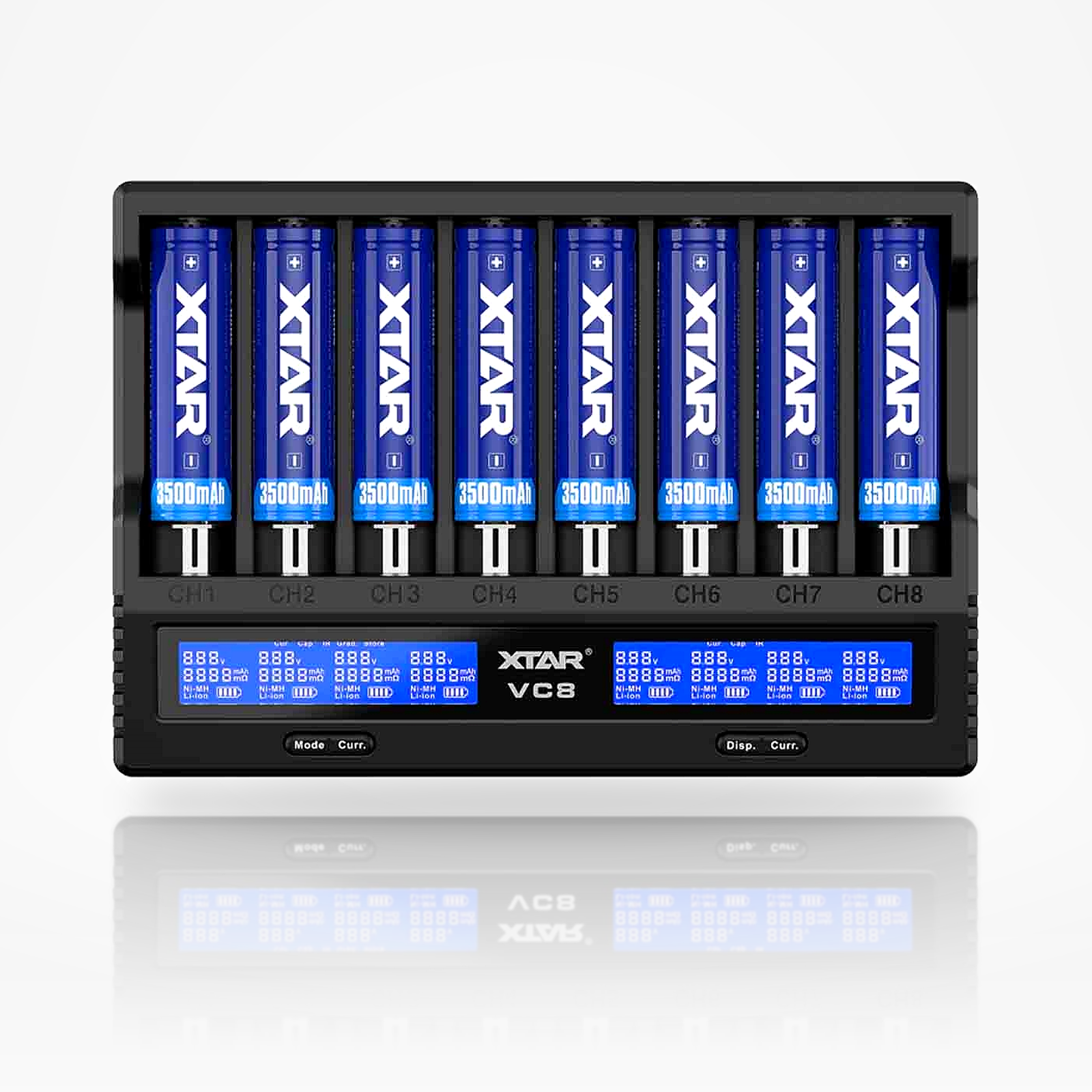
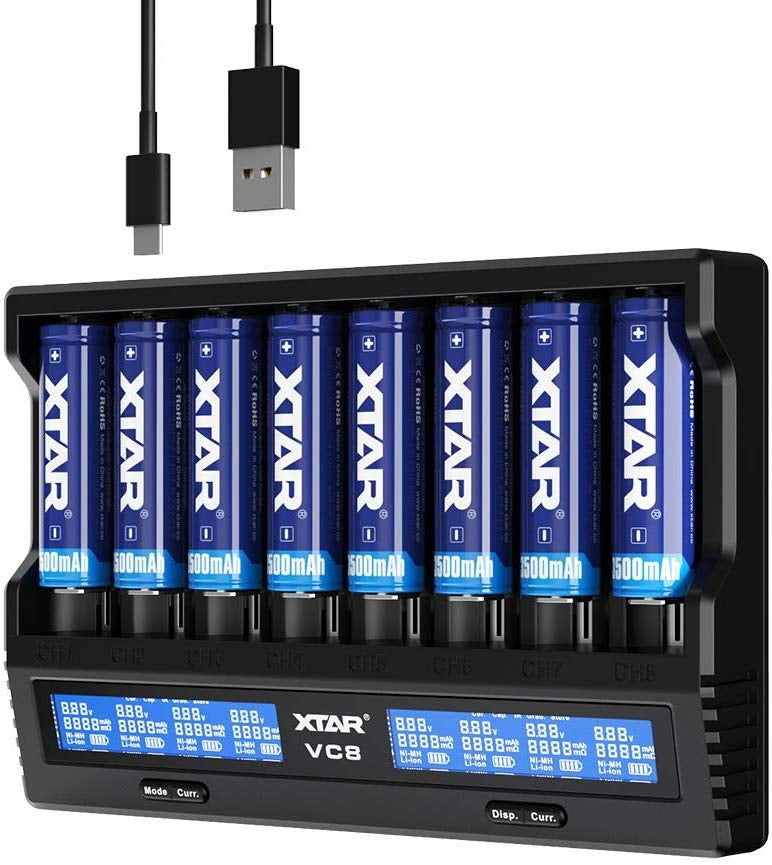


An eight-slot charger and tester for 3.6/3.7 V lithium-ion and 1.2 V Ni-MH/Ni-Cd cells, on a USB-C QC3.0 input: from 3 A in one slot to 0.5 A in all eight, set by button, ending at 4.20 ± 0.05 V for lithium-ion, with a capacity test and a storing mode in four slots [1]. Below: every rating XTAR prints with its condition, where XTAR’s documents differ, which of our cells each setting suits, and charge times we calculated, so you can check each number.
XTAR lists 3.6/3.7 V lithium-ion and 1.2 V Ni-MH/Ni-Cd cells, protected 20700/21700 included [1]. Don’t use it for 1.5 V lithium AA/AAA or alkaline cells, and never charge LiFePO4 in its charging mode (section 04).
01SPEC PLATE
XTAR prints the VC8’s ratings in its user manual [1], in a specification table and a comparison table on its VC8 page [2], and in its charger chart [3]. They agree on the currents and on the end-of-charge voltages in their tables, and differ on the input current at 5 V, the end-of-charge current, the cell sizes and the charger’s height; XTAR’s protection panel also claims end-of-charge precision “up to ±1%”. The manual comes first, copied as printed; each difference is quoted.
| SPECIFICATION | VALUE | CONDITION · SOURCE |
|---|---|---|
| RATED · MANUFACTURER copied from the manual’s specification table, drawings and text [1] | ||
| MODEL | VC8 | as printed [1] |
| INPUT | QC3.0 | “QC3.0 (5V⎓2A / 9V⎓2A)”, “Type-C Input” [1] |
| ADJUSTABLE CONSTANT CURRENT | 3 A × 1 | “3Ax1 / 2Ax2 / 1Ax4 / 0.5Ax8” [1]; the drawing marks CH1 and CH8 “MAX 3.0A” [1] |
| CURRENT SETTINGS | 5 | “five optional charging currents(3A/2A/1A/0.5A/0.25A)” [1] |
| END-OF-CHARGE VOLTAGE, LI-ION | 4.20 V | “4.20±0.05V” [1] |
| END-OF-CHARGE VOLTAGE, NI-MH | 1.45 V | “1.45±0.1V” [1] |
| END-OF-CHARGE CURRENT | ≤ 120 mA | “≤120mA” [1] |
| OPERATING TEMPERATURE | 0 to 40 °C | “0-40°C” [1] |
| LI-ION CELLS | 3.6/3.7 V | “3.6V/3.7V Li-ion/IMR/INR/ICR”, sixteen sizes, 10440 to 26650 [1] |
| NI-MH CELLS | 1.2 V | “1.2V Ni-MH/Ni-CD”: AAAA, AAA, AA, A, SC, C [1] |
| PROTECTED 20700/21700 | Yes | “Can charge protected 20700/21700 batteries.” [1] |
| GRADING (CAPACITY TEST) | CH1–CH4 | charge, discharge at 300 mA counting the capacity, charge again; then “DONE” and the graded capacity [1] |
| STORING | CH1–CH4 | charges cells below 3.7 V / 1.2 V and discharges cells above; then “DONE” and 3.7V/1.2V [1] |
| INTERNAL RESISTANCE | CH1–CH8 | shown as “IR” while charging; skipped once a cell is full, or when the adapter supplies less than 700 mA [1] |
| 0 V ACTIVATION | Yes | “they will be detected and activated automatically”; cells that can’t be activated show “Err” [1] |
| + Source: [1] XTAR, VC8 User Manual, multilingual, file title “VC8 User Manual Multi-Language_V3 20200811”, English section (pages 2–5): introduction, “Apply to”, Specification table, Operation, Button Functions, LCD Display, Warning; in XTAR’s download library, listed as last updated 2024-01-31 · XTAR download page | ||
| SPECIFICATION | VALUE | CONDITION · SOURCE |
|---|---|---|
| FROM XTAR’S VC8 PAGE specification table, comparison table and panels [2], as printed | ||
| INPUT | QC3.0 | “QC3.0 (5V⎓3A/9V⎓2A)” (specification table); “QC3.0(5V 3A/9V 2A) USB-C” (comparison table) [2] |
| CHARGING CURRENT, LI-ION | 0.25–3 A | “3A x 1/2A x 2/1A x 4/0.5A x 8/0.25A x 8” (comparison table) [2] |
| CHARGING CURRENT, NI-MH | 0.25–0.5 A | “0.5A x 8/0.25A x 8” (comparison table) [2] |
| 3 A CONDITION | 1 slot | “max 3A for a single slot when the battery resistance is low enough” [2] |
| END-OF-CHARGE CURRENT | ≤ 120 mA | “≤120mA” in the specification table; “≤200mA” in the comparison table [2] |
| END-OF-CHARGE PRECISION | ± 1 % | “makes the precision of end-of-charge voltage up to ±1%” (protection panel) [2]; the tables print ±0.05 V [1][2] |
| LI-ION SIZES | 17 | the comparison table adds 17335 to the manual’s list; the compatibility panel lists the manual’s sixteen [2] |
| SIZE | 194 × 137 × 34 mm | “L194xW137xH34mm” [2]; 35 mm high in the chart [3] |
| NET WEIGHT | 350 g | [2][3] |
| FROM XTAR’S CHARGER CHART [3], as printed, where it adds to [1] | ||
| LI-ION SIZES | 18 | adds 17335 and 32650 to the manual’s list [3] |
| LIFEPO4 | storage only | “& LiFePO4(storage function)” [3]; the manual: “In storing mode, VC8 can be used to charge LiFePO4 batteries.” [1] |
| IN THE BOX | Charger, cable, manual | “VC8 charger*1, Charging cable*1, Manual *1, Color paper box*1” [3] |
| CALCULATED arithmetic on [1] and [2], shown so you can check it | ||
| MOST CURRENT AT ONCE | 4 A | 2 A × 2, 1 A × 4 or 0.5 A × 8 [1] |
| INPUT POWER, 9 V | 18 W | 9 V × 2 A [1][2] |
| INPUT POWER, 5 V | 10 W | 5 V × 2 A [1]; 15 W from 5 V × 3 A, the rating on XTAR’s VC8 page [2] |
| LI-ION CHARGE POWER, 4 A | 16.8 W | 4.20 V × 4 A at the end of constant current, before conversion losses [1] |
| GRADING DISCHARGE, 3,000 mAh | 10 h | 3,000 mAh ÷ 300 mA, the discharge leg alone [1] |
| + Source: [1] XTAR, VC8 User Manual, multilingual, file title “VC8 User Manual Multi-Language_V3 20200811”, English section (pages 2–5): introduction, “Apply to”, Specification table, Operation, Button Functions, LCD Display, Warning; in XTAR’s download library, listed as last updated 2024-01-31 · XTAR download page + Source: [2] XTAR, VC8 product page, xtar.cc: its feature list, “Specification” table, “Product Comparison Table” (VC8, VC8 PLUS, VC8S) and image panels, retrieved 2026-10-31 · XTAR VC8 page + Source: [3] XTAR, XTAR Charger Range Comparison Chart, the VC8 row; 3 pages, no version printed; listed in XTAR’s download library as last updated 2024-01-21 · XTAR download page | ||
Orange band: the lithium-ion end-of-charge voltage, “4.20±0.05V” [1][2]; Ni-MH ends at 1.45 ± 0.1 V [1]. Scale 4.10–4.30 V.
Input current at 5 V as each XTAR document prints it; all four rows print 2 A at 9 V [1]–[3]. XTAR doesn’t explain the difference. By our reading, a QC3.0 adapter that supplies 9 V 2 A meets the 9 V figure all four print. Scale 0–4 A.
The current at which a charge ends, as each document prints it [1][2]. Neither says how it is measured. Scale 0–250 mA.
Each half has its own “Curr.” button, for CH1–CH4 and CH5–CH8, and each steps through 3 A, 2 A, 1 A, 0.5 A and 0.25 A [1]. XTAR prints 3 A for one cell, 2 A for two, 1 A for four and 0.5 A for all eight [1]; its drawing marks CH1 and CH8 “MAX 3.0A” [1], and its VC8 page says 3 A needs a cell whose resistance is “low enough” [2].
Data: “3Ax1 / 2Ax2 / 1Ax4 / 0.5Ax8” [1] and “0.25A x 8” [2] · black: each slot; gray: the slots together, our arithmetic · scale 0–4 A · 3 A only “when the battery resistance is low enough” [2] · Ni-MH charges at 0.5 or 0.25 A [2]
03CHARGE TIME
Hours = capacity ÷ current, as if the whole charge ran at that current. A real charge from empty takes longer, because the current tapers in the constant-voltage finish, and a cell that isn’t empty needs less. Capacities are each cell’s own printed figure [C].
at full current, from empty
CH1 or CH8 [1]
“0.5Ax8” [1]
the capacity test’s discharge current [1]
| CELL | FORMAT | CAPACITY AS PRINTED, mAh [C] | HOURS AT 3 A | HOURS AT 2 A | HOURS AT 1 A | HOURS AT 0.5 A | HOURS AT 0.25 A |
|---|---|---|---|---|---|---|---|
| Samsung 25R | 18650 | 2,500 minimum | 0.8 | 1.3 | 2.5 | 5.0 | 10.0 |
| Samsung 30Q | 18650 | 3,000 nominal | 1.0 | 1.5 | 3.0 | 6.0 | 12.0 |
| Sony/Murata VTC6 | 18650 | 3,120 nominal | 1.0 (≥ 10 °C) | 1.6 | 3.1 | 6.2 | 12.5 |
| Molicel P28A | 18650 | 2,800 typical | 0.9 (> 23 °C) | 1.4 (> 10 °C) | 2.8 | 5.6 | 11.2 |
| Samsung 35E | 18650 | 3,350 minimum | above its limit | 1.7 (at its limit) | 3.4 | 6.7 | 13.4 |
| Molicel M35A | 18650 | 3,450 typical | above its limit | above its limit | 3.5 | 6.9 | 13.8 |
| EVE 33V | 18650 | 3,200 typical | 1.1 (> 15 °C) | 1.6 (> 15 °C) | 3.2 (> 15 °C) | 6.4 | 12.8 |
| Samsung 40T | 21700 | 4,000 minimum | 1.3 | 2.0 | 4.0 | 8.0 | 16.0 |
| Samsung 50E | 21700 | 4,900 minimum | 1.6 | 2.5 | 4.9 | 9.8 | 19.6 |
| Samsung 50S | 21700 | 5,000 typical | 1.7 | 2.5 | 5.0 | 10.0 | 20.0 |
| Molicel P50B | 21700 | 5,000 typical | 1.7 | 2.5 | 5.0 | 10.0 | 20.0 |
Hours = capacity ÷ current, from each cell’s printed capacity [C] and the VC8’s current [1][2]; scale 0–11 h. As if the whole charge ran at that current. No time is shown where the current is above the cell’s printed charge limit (section 04). The Samsung 35E’s 2 A time is at its printed limit, “2,000mA (not for cycle life)” (section 04). A time marked > 23 °C, > 15 °C, > 10 °C or ≥ 10 °C holds only for a cell in that range: outside it, the cell’s printed limit is under this current (section 04).
Arithmetic, not a measurement; XTAR prints no charge-time example for the VC8. No time is shown where a setting is above the cell’s printed charge limit (section 04): at 3 A, the Samsung 35E and Molicel M35A; at 2 A, the Molicel M35A. A grading run takes much longer than a charge: a full charge, a discharge at 300 mA, then a second full charge [1]. The discharge of a 3,000 mAh cell alone takes about 10 h by our arithmetic.
04COMPATIBILITY
The manual lists sixteen 3.6/3.7 V lithium-ion sizes, 10440 to 26650, and six 1.2 V Ni-MH/Ni-Cd sizes, AAAA to C, and says the VC8 can charge protected 20700/21700 cells [1]. The comparison table on XTAR’s VC8 page adds 17335 [2]; its chart adds 17335 and 32650 [3].
Sizes exactly as printed in the manual [1]. Also printed: 17335 in the comparison table on XTAR’s VC8 page [2]; 17335 and 32650 in XTAR’s chart [3].
Bars: each cell’s printed charge limit [C], on a 0–6 A scale; limits above 6 A run to the edge, and every limit is written above its bar, with any lower limit the cell prints for the cold. Black marks: the VC8’s currents [1][2]. Orange: a cell whose highest printed limit, the bar, is below one of them. 2 A is the Samsung 35E’s printed limit, “2,000mA (not for cycle life)” [C]. In the cold some printed limits are lower (chart figures are our reading). Sony/Murata VTC6: from 0 to below 10 °C its limit is “2.00A” (cell surface, for a charge that ends at 4.25 V or less), so 3 A is above it and 2 A equals it. Molicel P28A: at 0–23 °C its §4.14 chart allows 2.8 A in its safe region, and above 10 °C in its specified region, so 3 A is above it; at 0–10 °C its specified region allows 1.4 A, so 2 A is above it too. EVE 33V: its limit is “≤ 0.2C (620mA)” at “Charge: 0 to 15 °C” (cell surface), so 3 A, 2 A and 1 A are above it. At 1.0–3.0 V the Samsung 30Q, 35E, 40T, 50E and 50S guidelines allow at most 0.5C, which by our arithmetic is below 3 A for all five and below 2 A for the 30Q and 35E [C]; [1] doesn’t say whether the VC8 lowers its current there (section 06). Every verdict in fig 4.2 is for a cell from 0 to 40 °C; ten of the eleven cells print no charge range below 0 °C [C]. Pick a setting at or below your cell’s printed limit, and lower in the cold (section 08); each half’s “Curr.” button sets it [1]. In the data table, each limit starts with the data sheet’s own row label; text in quotation marks is copied as printed, and notes after it are ours.
| CELL | FORMAT | CHARGE LIMIT AS PRINTED [C] | VC8 CURRENTS ABOVE IT |
|---|---|---|---|
| Samsung 25R | 18650 | Rated charge: “CCCV, 4A, 4.20V, 100mA cut-off” (the spec prints no separate maximum charge current) | none |
| Samsung 30Q | 18650 | Rated charge: “CCCV, 4A, 4.20V, 100mA cut-off” (the spec prints no separate maximum charge current); pre-charge 0.1–0.5C at 1.0–3.0 V in its pack design guideline, at most 1.5 A (our arithmetic) | 3 A and 2 A at 1.0–3.0 V (pre-charge limit 1.5 A) |
| Sony/Murata VTC6 | 18650 | Continuous Maximum Charge Current: “5.0A” (“Continuous”); “2.00A” from 0 to below 10 °C cell surface, for a charge that ends at 4.25 V or less (its 4.00 A figure needs one that ends at 4.15 V) | 3 A from 0 to below 10 °C |
| Molicel P28A | 18650 | Maximum charging current: “8.4A” (“See Section 4.14”); its §4.14 chart reaches 8.4 A only from 23 to 45 °C, in its safe region (5.6 A in its specified region); 2.8 A at 0–23 °C in its §4.14 chart’s safe region, and above 10 °C in its specified region; 1.4 A at 0–10 °C in its chart’s specified region (the safe region stays at 2.8 A); the chart figures are our reading | 3 A at 0–23 °C; 2 A at 0–10 °C (specified region) |
| Samsung 35E | 18650 | Max. Charge Current: “2,000mA (not for cycle life)”; pre-charge 0.1–0.5C at 1.0–3.0 V in its pack design guideline, at most 1.7 A (our arithmetic) | 3 A; 2 A at 1.0–3.0 V (pre-charge limit 1.7 A) |
| Molicel M35A | 18650 | Maximum charging current: “1.7 A” (“See Section 4.14”); its §4.14 chart, against cell surface temperature, stays at 1.7 A from 0 to 60 °C (our reading of the chart); Molicel’s older public data sheet prints 3.4 A, and this page uses the lower 1.7 A of Molicel’s newer specification | 3 A, 2 A |
| EVE 33V | 18650 | Operation Temperature (Cell Surface Temperature): “≤ 1.0C (3100mA)” at “Charge: 15 to 50 °C”; “≤ 0.2C (620mA)” at “Charge: 0 to 15 °C” | 3 A, 2 A and 1 A at 0–15 °C |
| Samsung 40T | 21700 | Rated charge: “CCCV, 6A, 4.20 V, 100mA cut-off” (the spec prints no separate maximum charge current); pre-charge 0.1–0.5C at 1.0–3.0 V in its pack design guideline, at most 2 A (our arithmetic) | 3 A at 1.0–3.0 V (pre-charge limit 2 A) |
| Samsung 50E | 21700 | Max. Charge Current: “4,900mA (not for cycle life)”; pre-charge 0.1–0.5C at 1.0–3.0 V in its pack design guideline, at most 2.45 A (our arithmetic) | 3 A at 1.0–3.0 V (pre-charge limit 2.45 A) |
| Samsung 50S | 21700 | Max. charge current: “6A (continuous charge)”; pre-charge 0.1–0.5C at 1.0–3.0 V in its pack design guideline, at most 2.5 A (our arithmetic) | 3 A at 1.0–3.0 V (pre-charge limit 2.5 A) |
| Molicel P50B | 21700 | Charge Current (70 °C cut-off), Maximum: “25 A” | none |
The manual says: “In storing mode, VC8 can be used to charge LiFePO4 batteries.” [1] It doesn’t say what voltage storing mode takes a LiFePO4 cell to; the storing voltages it prints are 3.7 V for lithium-ion and 1.2 V for Ni-MH [1]. XTAR’s chart lists LiFePO4 for the “storage function” only [3]. Charging mode ends at 4.20 V [1], so never charge a LiFePO4 cell in charging mode. Call or text us before using storing mode for one.
05DISPLAY
Each half has its own LCD and buttons: “Mode” and “Curr.” for CH1–CH4, “Disp.” and “Curr.” for CH5–CH8 [1]. Each slot shows its voltage, then its current, capacity or internal resistance, and the cell type [1].
| FUNCTION | CH1–CH4 | CH5–CH8 |
|---|---|---|
| Charge, 0.25 to 3 A (3 A in CH1 and CH8 only) | yes | yes |
| Internal resistance | yes | yes |
| Grading: capacity test | yes | no |
| Storing: to 3.7 V or 1.2 V | yes | no |
3 A is marked on CH1 and CH8 only [1].
| PRESS | WHAT IT DOES |
|---|---|
| “Mode” or “Disp.” | switches the readout: Cur (current), Cap (capacity), IR (internal resistance) |
| “Curr.” | 3 A, 2 A, 1 A, 0.5 A, 0.25 A, then back to the first |
| “Mode”, long press | CH1–CH4: charging, grading (“Grad.”) or storing (“Store”) |
| “Curr.”, long press | backlight off; any button turns it on; the screen dims after 1 minute untouched |
| SCREEN | MEANING, AS PRINTED |
|---|---|
| FULL | charge done; alternates with the capacity, current or internal resistance, whichever is shown |
| DONE and a capacity | grading done: “graded capacity” |
| DONE and 3.7V/1.2V | storing done |
| Err | a cell that couldn’t be activated: “identified as broken batteries” |
Grading runs in CH1–CH4: the VC8 charges the cell, discharges it at 300 mA while counting the capacity, then charges it again, and shows “DONE” with the graded capacity [1]. It measures internal resistance only while charging: not once a cell is full, “in case the battery being overcharged”, and not when the adapter supplies less than 700 mA [1].
06SAFETY
XTAR prints these for the VC8 [1][2], without a test method, so they appear as XTAR’s claims, quoted.
07COMPARE
The XTAR chargers in our store, each from its own XTAR manual, product page or chart [X]. The table quotes each one’s current as printed.
The highest per-slot current each charger’s XTAR manual, product page or chart prints [X], on a 0–3 A scale. Orange: the VC8. More current per slot shortens a charge; use it only where the cell’s printed limit allows it, which for some cells is lower in the cold.
| CHARGER | SLOTS | CURRENT AS PRINTED | MOST AT ONCE* | INPUT | CELL TYPES | DISPLAY |
|---|---|---|---|---|---|---|
| XTAR VC8 | 8 | 3Ax1 / 2Ax2 / 1Ax4 / 0.5Ax8 / 0.25A x 8 | 4 A | QC3.0 (5 V⎓2 A / 9 V⎓2 A), Type-C (manual); QC3.0 (5 V⎓3 A/9 V⎓2 A) on XTAR’s VC8 page | 3.6 V/3.7 V Li-ion/IMR/INR/ICR; 1.2 V Ni-MH/Ni-CD | LCD |
| XTAR SC2 | 2 | 3Ax1 / 2Ax2 | 4 A | QC3.0 (9 V⎓2 A/5 V⎓2 A), Type-C | 3.6/3.7 V Li-ion IMR/INR/ICR | LED indicator |
| XTAR DRAGON VP4L PLUS | 4 | 2A×2 (CH1&CH4) / 1A×4 / 0.5A×4 | 4 A | DC 12 V 3 A | 3.6 V/3.7 V Li-ion/IMR/INR/ICR; 1.2 V Ni-MH/Ni-CD; 11.1 V 3S Battery Pack | LCD |
| XTAR FC2 | 2 | 2A x 1 / 1A x 2 / 0.5A x 2 | 2 A | DC 5 V 2 A, Type-C | 3.6 V/3.7 V Li-ion/IMR/INR/ICR; 1.2 V Ni-MH | LED indicator |
| XTAR SC1 | 1 | 2A×1 | 2 A | 5 V 2.1 A, Type-C | 3.6/3.7 V rechargeable 18650/18700/20700/21700/22650/26650 Li-ion batteries | LED indicator |
| XTAR VC4 | 4 | 1A×2 (CH1 & CH4) / 0.5A×4 | 2 A | DC 5 V 2.1 A | 3.6 V/3.7 V Li-ion/IMR/INR/ICR; 1.2 V Ni-MH/Ni-CD | LCD |
| XTAR VC2 | 2 | 0.5A x 2 | 1 A | DC 5.0 V/1.0 A, Micro USB | 3.6 V/3.7 V Li-ion / IMR / INR / ICR | LCD |
| XTAR MC1 | 1 | 0.5A x 1 | 0.5 A | DC 5 V 0.5 A, Type-C | 3.6 V/3.7 V Li-ion/IMR/INR/ICR | LED indicator |
Current is copied as printed in each charger’s source [X], largest first; input and cell types are condensed from it. * Most at once: the largest current × slots among the rows XTAR prints, our arithmetic. Links go to each charger in our store.
08USE IT RIGHT
What the VC8 is for, and how to use it inside XTAR’s ratings and your cell’s limits.
Questions? Call 1-800-547-3050 or text 1-833-419-2192 to ask a person.
The manual [1] is XTAR’s, linked as published (a 17 MB multilingual PDF; English on pages 2–5). XTAR’s VC8 page [2] and charger chart [3] are linked too.
Ships from Stockbridge, GA. Most in-stock orders ship within 1 business day.
09QUESTIONS
Short answers. Where an answer comes from a document, it carries its source; the rest is standard handling practice. Anything else: call 1-800-547-3050 or text 1-833-419-2192.
XTAR rates the input as QC3.0: 9 V 2 A, and 5 V 2 A in the manual [1] or 5 V 3 A on its VC8 page [2]. By our arithmetic, four cells at 1 A near 4.20 V take about 16.8 W before conversion losses: more than 5 V 2 A (10 W) or 5 V 3 A (15 W) supplies, within 9 V 2 A (18 W). On a weaker supply the VC8 reduces the current [1]. No adapter comes in the box [3].
Press “Curr.”: it steps through 3 A, 2 A, 1 A, 0.5 A and 0.25 A, then back to the first [1]. The left “Curr.” sets CH1–CH4 and the right one CH5–CH8 [1].
CH1 and CH8 are marked “MAX 3.0A” [1]. 3 A is printed for one slot at a time, “3Ax1” [1], and XTAR’s page adds “when the battery resistance is low enough” [2].
Long-press “Mode” to choose grading (“Grad.”) for CH1–CH4. The VC8 charges the cell, discharges it at 300 mA counting the capacity, charges it again, then shows “DONE” and the graded capacity [1]. By our arithmetic, the 300 mA discharge alone takes about 10 h for a 3,000 mAh cell, on top of the two charges.
For cells you won’t use for a while: it charges cells below 3.7 V (1.2 V for Ni-MH) and discharges cells above, then shows “DONE” [1]. CH1–CH4 only [1].
XTAR says only that “In storing mode, VC8 can be used to charge LiFePO4 batteries.” [1] It doesn’t say to what voltage; the storing voltages it prints are 3.7 V for lithium-ion and 1.2 V for Ni-MH [1]. Charging mode ends at 4.20 V [1], so never use it for LiFePO4. Call or text us before using storing mode for a LiFePO4 cell.
Yes, 1.2 V Ni-MH or Ni-Cd from AAAA to C [1], at 0.5 or 0.25 A [2]. Not alkaline, and not 1.5 V lithium AA/AAA.
Yes: “Can charge protected 20700/21700 batteries.” [1]
By our arithmetic (capacity ÷ current), a 3,000 mAh cell from empty takes 1.0 h at 3 A, 1.5 h at 2 A, 3.0 h at 1 A and 6.0 h at 0.5 A, plus a slower finish (section 03). Use a higher setting only where your cell’s printed limit allows it (section 04), and a lower one in the cold (section 08).
No. XTAR’s VC8 page compares them: the VC8 PLUS takes a “DC” input, and the VC8S a “PD3.0(15V 3A)” input, with the capacity test in all eight slots [2]. This page covers the VC8 only.
10SOURCES
Where every number on this page comes from.
Overall rating: 4.7 / 5 from 52 reviews.
I love these chargers. They provide good charging power and these chargers regulate to output based on what is best for the batteries.

Nice charger. I now have two of them.
These battery chargers work great. I now have two of them.
Lo mejores
Works well. Able to charge 8 at a time so there is no complaints
Can’t beat the prices for this quality of batteries and supplies. Shipped immediately with great packing. This was my third order of batts and a charger. And it won’t be my last.
Works well, let me know a few of my batteries are too far gone.
It's a well built charger and works well. However it is very particular about which charging block it needs for it to work. My normal Samsung block for my phone didnt work. Ended up using the block that came with a light from Astro tool.

I liked the first one so much. I bought 2. Very happy.
I can't really say anything to the performance of the charger, but it looks sturdy and reliable. I say that because through some error, I was of the belief that this charger set came with 8 batteries and I had somehow come across a great deal. That's on me, but if I'm not mistaken, I think that there's a deal that sells this charger and its batteries as a package, like many other companies do. I'll have to take a better look next time and go much more slowly, lol.
Great place had questions answered them right away shipped my stuff right out I got it right away highly recommended
I received my items very quick I had questions before I ordered they answered them right away great company will use them again highly recommend it
Pretty confident it won't explode
Works great and easy to use.
Charges 8 batteries 18650 or 21700 without any problem.
Be nice if it had a actual cord instead of a type C with a USB charger takes forever to charge 8 batteries.
Fast charging of 8 batteries at once... yes please!

Awesome charger and fast shipping!!!
This charger is great, shows how much charge the batteries are getting and when they are full.
Really nice battery charger great price and charges your batteries very fast and safely

I've needed a charger for so long! Been using the same ones for years. I love this charger. It was inexpensive and it works excellent
You need to buy a 5V/10-amp brick power supply for this unit. Then cut the output wire, solder on usb-c wire with connector, and you are good to go.
Works well as advertized!

Had 2x4way chargers. This is sooooo much nicer and space saving.
More options than any other charger I’ve owned, with detailed stats on my cells really helps. Being able to charge up to eight cells at a time is great and its mooth as butter when inserting each battery. I am liking this charger.

Thing thing works really great. I charge all my batteries at 250ma. That's 0.25 amps. It keeps them up full charged for when it's time for me to swap out batteries in my device. Shows internal resistances and all the other goodies. Best charger I've had yet and I probably won't be buying a new one any time soon.
Easy to use, plenty of slots, that's the selling main point

Capacity test for the same battery’s are holding pretty close together for all three of my chargers but the internal resistance is varying a lot even in the same slot. So I switched to a multi meter and am getting consistent readings. haven’t had any other problems yet
Terrific product. Consistently charges all 8 bays without issue or failure.
Excellent charger. Fast, efficient and intelligent.
Used especially for outdoor solar lights. Eight at a time is a blessing. Super fast at charging to maximum. Feel good it turns off at capacity. Thanks.
i bought the Xtar VC8 charger to charge 120 21700 cells that i recently bought. the plane was to charge 8 at a time because this charger can hold up to 8 cells, but if you are using a normal phone usb around 1.5a, it will take about 12 hours to charge all 8 cells, i'm sure if you were to get a proper power source it would work quit well! that said with my current set up i am only charging 2 cells at a time and they charge in about 2 hours, so its working but its taking time. its a great charger though, and has lots of features, i would recommend to anyone, just be aware of the charging time with out a good power source.

My previous charger was only a 4-channel Nitecore UM4 so this is a huge upgrade for charging my 18650 & 21700 batteries !

Awesome. Just what I needed. Can fit 8 - 21700 with ample space to get in between batteries for smooth easy removal of any battery. LCD screen is bright and easy to read, navigate and informative. And the stupid low price for a 8-slot charger cant be beat.

Several advanced features to charge, analyze, and store cells (and to know when they need replacing). I purchased the VC8 here due to the best price I could find from a reputable dealer; running it with the QC 3.0 amp plug (also cheapest here). It works very well for my 18650 cells and NiMH Eneloops,

Estoy muy satisfecho.

Very reliable charger
Perfect for handling multiple batteries for my PTZ Cameras using six batteries each.
It’s ok It does a good job. After it shows my 18650’s are charged i put them into my SKYMC 3000 and they still had some charging left to be fully charged. I’m not sure why it does this. I’ve tried charging at different currents but it makes no difference. If i use it when i travel it would be better than charging through a mod. That’s why i only gave it 4 stars. It could and should be doing a better job.
I love this charger 8 bays, easy to use. Best charger that I have