
Quality cells at a fair price.
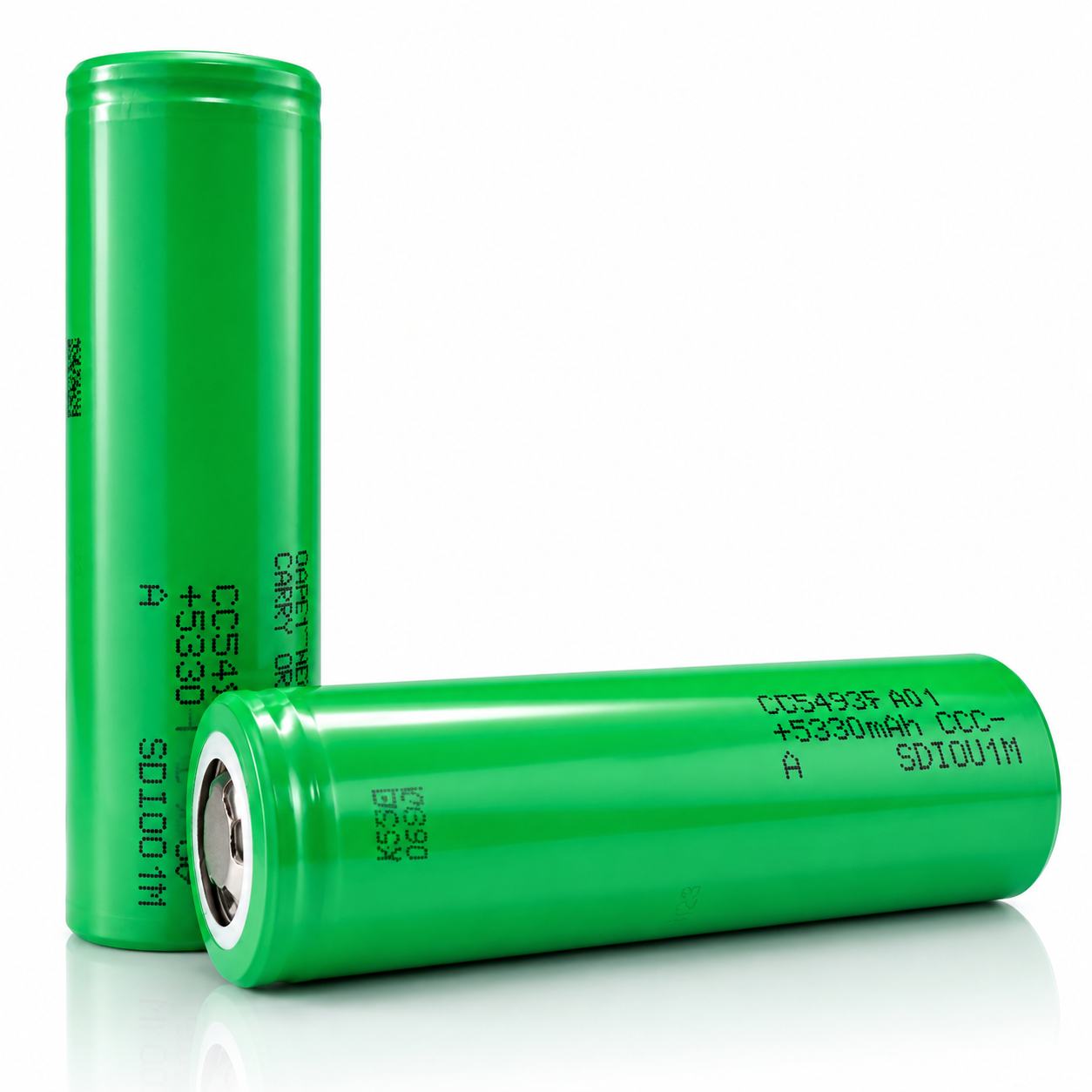
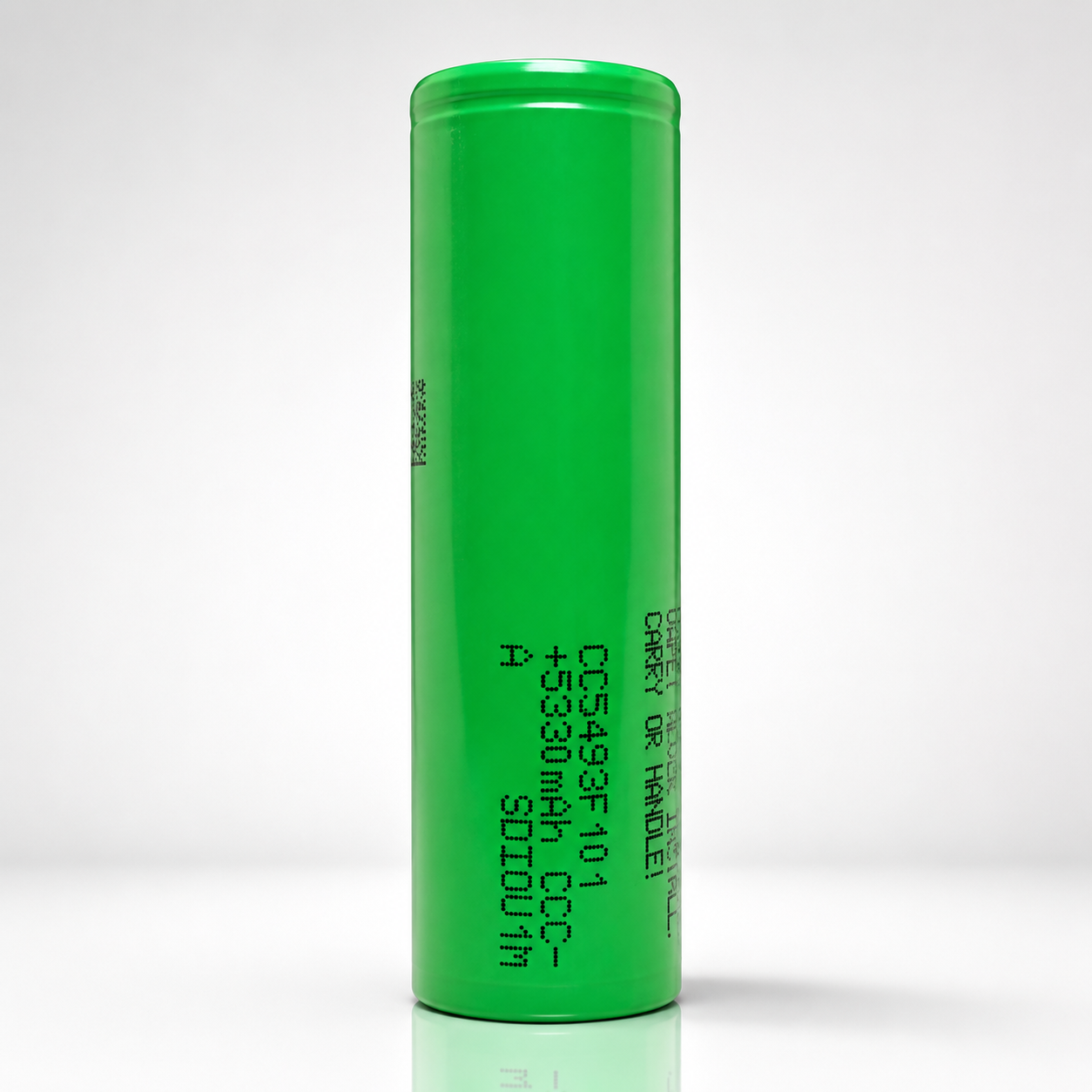


KEY SPECS · SAMSUNG SDI CC5493F101
SOURCE [1]- SIZE
- Ø21.78 × 71.00 mm
- max.
- TEMPERATURE
- −10 to 60 °C
- discharge · ambient
- charge 0 to 45 °C · ambient
[1] SAMSUNG SDI Specification of Product CC5493F101 (Ver. A), Draft V0.1, marked draft, on file since 2025-04-15
SAMSUNG SDI · 21700 · CC5493F101 (Ver. A)
A 21700 lithium-ion cell: 5,330 mAh standard minimum capacity at 0.2C, 5,170 mAh rated minimum at 1C, and a maximum discharge current of “2C (for continuous discharge)”, which is 10,660 mA at the printed 1C of 5,330 mA (2 × 5,330 mA, our arithmetic) [1]. Samsung SDI’s specification identifies the cell as model CC5493F101 (Ver. A); the name 58E is printed in neither of the two versions we hold, Draft V0.1 [1] and the earlier V0.0 [2]. Samsung SDI marks both confidential and [1] is a draft, so we quote them here but don’t link them (section 13). Below: every rating with its condition, the figures Samsung SDI prints in its tables, and what we calculated from them, so you can check each number.
CAPACITY5,330 mAhminimum at 0.2C; no typical mAh printed [1]
CONTINUOUS2C“for continuous discharge”, −10 to 60 °C ambient; 10,660 mA calculated: 2 × 5,330 mA [1]
STANDARD CHARGE0.5CCC-CV to 4.2 V, 4 hours; 1C max, “not for cycle life” [1]
ENERGY20.0 Whtypical, as printed [1]; 19.4 Wh at minimum capacity, calculated: 3.64 V × 5,330 mAh
AC IMPEDANCE≤15 mΩinitial, AC 1 kHz [1]
MASS74 gmaximum [1]
The library holds data sheets where the manufacturer publishes one. This cell’s specification is on file but not linked (section 11).
A bare cell: a component for protected packs and devices built for it. Not for vaping. Charge on a lithium-ion (Li-ion) charger that stops at 4.2 V.
01SPEC PLATE
Every rating, with its condition.
Samsung SDI’s data sheet for this cell is titled Specification of Product [1]; this page calls it the specification. The newest we hold is Draft V0.1, from 2023. It is marked “Draft”, and its cover says the official version is valid only with separate written confirmation by Samsung SDI. Its ratings come first, copied as printed. Then the capacity figures its tables print, our arithmetic, and the documents we hold. Each row names its source or shows its formula.
| SPECIFICATION | VALUE | CONDITION · SOURCE |
|---|---|---|
| RATED · MANUFACTURER copied from specification [1] | ||
| MODEL | CC5493F101 (Ver. A) | SDI Model, as printed [1][2]; neither document prints the name 58E |
| CAPACITY, STANDARD | 5,330 mAh | “Min.”; 0.2C to 2.50 V after a 0.5C charge to 4.2 V with 0.02C cut-off, “@RT” (23 ± 3 °C, §6.1) [1] §3.1 |
| ENERGY, TYPICAL | 20.0 Wh | “(Typ. 20.0 Wh)”, printed beside the standard capacity, same condition [1] §3.1 |
| CAPACITY, RATED | 5,170 mAh | “Min.”; 1C to 2.50 V after the same charge, @RT; “(97% of 5,330 mAh)” [1] §3.2, §7.3 |
| CAPACITY, TYPICAL | Not stated | in [1], which prints a typical energy only; the superseded V0.0 printed a typical mAh (section 07) [2] |
| 1C | 5,330 mA | “*1C=5,330 mA”: the only cell current printed in mA [1] §3.1 |
| NOMINAL VOLTAGE | 3.64 V | [1] §3.4 |
| CHARGE VOLTAGE | 4.2 V | CC-CV, “constant voltage with limited current” [1] §3.3, §3.5 |
| DISCHARGE CUT-OFF | 2.5 V | “2.5V (End of discharge)”; the capacity, cycle and storage conditions print “2.50 V” [1] §3.10 |
| STANDARD CHARGE | 0.5C | CC-CV to 4.2 V, 0.02C cut-off; “Standard charge: 4 hours”; mA in CALCULATED below [1] §3.6, §3.7 |
| CHARGE FOR CYCLE LIFE | 0.5C | “For cycle life : 0.5C”; mA in CALCULATED below [1] §3.6 |
| MAX. CHARGE CURRENT | 1C | “1C (not for cycle life)”; no charge time printed; mA in CALCULATED below [1] §3.8 |
| MAX. CONTINUOUS DISCHARGE | 2C | “2C (for continuous discharge)”; −10 to 60 °C ambient; discharge over-temperature protection no higher than 70 °C at the cell surface, Note (*³); no cell-temperature cut printed; Note (*²): “Max. discharge current condition does not guarantee the cycle life.”; mA in CALCULATED below [1] §3.9, §3.15 |
| CHARGE TEMPERATURE | 0 to 45 °C | “(Ambient)” [1] §3.15 |
| DISCHARGE TEMPERATURE | −10 to 60 °C | “(Ambient)”; Note (*³): discharge over-temperature protection “should not be over 70'C of Cell surface temperature” [1] §3.15 |
| AC IMPEDANCE | ≤ 15 mΩ | initial, AC 1 kHz, after Standard charge [1] §7.4 |
| CYCLE LIFE | ≥ 4,136 mAh | after 500 cycles: 0.5C charge to 4.2 V, CCCV 0.05C cut-off; 1C discharge to 2.50 V; @ RT; “(80% of the Rated Capacity @ RT)” [1] §3.11 |
| AFTER STORAGE AT 60 °C | ≥ 4,797 mAh | 20 days at 60 °C from Standard charge, then 0.2C to 2.50 V @ RT; “(90% of the Standard capacity @ RT)” [1] §3.12 |
| RECOVERY 80 % AFTER STORAGE | −20 to 23 °C | for 1 year; −20 to 45 °C for 3 months; −20 to 60 °C for 1 month; kept as shipped, “(30% of charge)” [1] §3.16 |
| STORAGE | 0 to 23 °C | “0 ~ 23℃, low humidity (below 65%)”, [1] Proper Use 3.1.1; its pack design guideline says “below 60℃, 20℃ is recommended” [1] |
| AS SHIPPED | 3.54–3.64 V | “Charging voltage range” at shipping [1] §7.9; ex-factory status “(30% of charge)” [1] Note (*⁴) |
| DIAMETER | 21.78 mm | “Max. Φ” [1] §3.14, Fig. 1 |
| HEIGHT | 71.00 mm | “Max.” [1] §3.14, Fig. 1 |
| MASS | 74 g | “74 g max” [1] §3.13 |
| TERMINAL | Not stated | Not stated by manufacturer: [1] and [2] state no top style; Fig. 1 prints maximum dimensions only |
| PROTECTION | None | as sold: bare cell, no protection circuit; [1] asks for protection in the pack |
| + Source: [1] Samsung SDI Specification of Product, Spec. No. CC5493F101, Draft V0.1 (2023/12/04); SDI Model “CC5493F101 (Ver. A)”; marked “Draft” and, on every page, “SAMSUNG SDI Confidential Proprietary”; its cover says the official version is valid only with separate written confirmation by Samsung SDI; on file since 2025-04-15; not linked from this page, because Samsung SDI marks it confidential and it is a draft. Call or text with questions about it | ||
| SPECIFICATION | VALUE | CONDITION · SOURCE |
|---|---|---|
| PRINTED IN THE SPECIFICATION’S TABLES percent of the 5,330 mAh standard capacity, as printed; mAh calculated [1] | ||
| CAPACITY AT 2C | 95 % | ≈ 5,064 mAh; 2C to 2.50 V after Standard charge at 23 °C [1] §7.6 |
| CAPACITY AT 1C | 97 % | ≈ 5,170 mAh; matches the 5,170 mAh rated minimum [1] §7.6 |
| CAPACITY AT −10 °C, 1C | 50 % | ≈ 2,665 mAh; 1C discharge at −10 °C, charged at 23 °C [1] §7.5 |
| CAPACITY AT 40 °C, 1C | 97 % | ≈ 5,170 mAh; 1C discharge at 40 °C, charged at 23 °C [1] §7.5 |
| CALCULATED arithmetic on [1], shown so you can check it | ||
| MAX. CONTINUOUS, IN mA | 10,660 mA | 2 × 5,330 mA: “2C (for continuous discharge)” at “*1C=5,330 mA” [1]; printed in no document |
| MAX. CHARGE, IN mA | 5,330 mA | 1 × 5,330 mA: “1C (not for cycle life)” [1] |
| STANDARD CHARGE, IN mA | 2,665 mA | 0.5 × 5,330 mA: “Standard charge: 0.5C” and “For cycle life : 0.5C” [1] |
| RUNTIME AT 2C | 28.5 min | 5,064 mAh ÷ 10,660 mA, from [1] §7.6 |
| ENERGY AT MINIMUM CAPACITY | 19.4 Wh | 3.64 V nominal × 5,330 mAh minimum [1]; an estimate, not a rated minimum: [1] prints no minimum Wh |
| VOLUME | 26.5 cm³ | π × (21.78 mm ÷ 2)² × 71.00 mm ≈ 26,452 mm³, from the maximum size [1] |
| DOCUMENTED · WHAT WE HOLD the documents on file for this cell | ||
| NAME ON THIS PAGE | 58E | the name we list the cell under; printed in neither [1] nor [2], which identify it as model CC5493F101 (Ver. A) |
| SPECIFICATION | Draft V0.1 | 2023/12/04; marked “Draft” and “SAMSUNG SDI Confidential Proprietary”; on file, not linked from this page [1] |
| EARLIER VERSION | V0.0 | 2023/05/03, “Tentative specification”; superseded by [1]; on file, not linked; compared in section 07 below [2] |
| CHEMISTRY | Li-ion | “Lithium-ion Battery”; “Cell (lithium-ion rechargeable cell)”; no cathode chemistry printed [1] |
| SAFETY, AS PRINTED | “UN38.3” | §8 prints only this line: no test list, results, report number, laboratory or date; not a test report [1] |
| UN38.3 TEST REPORT | Not on file | we hold no UN38.3 test report for this cell, so this page makes no transport claim based on one |
| SAFETY DATA SHEET | Not on file | we hold no safety data sheet (SDS) for this cell |
| + Source: [1] Samsung SDI Specification of Product, Spec. No. CC5493F101, Draft V0.1 (2023/12/04); SDI Model “CC5493F101 (Ver. A)”; marked “Draft” and, on every page, “SAMSUNG SDI Confidential Proprietary”; its cover says the official version is valid only with separate written confirmation by Samsung SDI; on file since 2025-04-15; not linked from this page, because Samsung SDI marks it confidential and it is a draft. Call or text with questions about it + Source: [2] Samsung SDI Specification of Product, Spec. No. CC5493F101, Version No. V0.0 (2023/05/03), “Tentative specification” in its revision history; SDI Model “CC5493F101 (Ver. A)”; marked “SAMSUNG SDI Confidential Proprietary”, with Samsung SDI’s draft disclaimer on every page; on file (date not recorded); not linked from this page, for the same reasons; superseded by [1] and used on this page only to show what changed (section 07) | ||
RATED · [1]FIG 1.1
Voltage window
2.5 V3.64 V4.2 Vcut-offnominalcharge
Black marks: rated voltages [1]. Orange band: the voltage cells ship at, 3.54–3.64 V [1] §7.9; ex-factory status is “(30% of charge)” [1] Note (*⁴). The band’s top end is the 3.64 V nominal voltage.
RATED · [1]FIG 1.2
Current limits
Standard charge “Standard charge: 0.5C” · 4 hours · 2,665 mA calculated: 0.5 × 5,330 mA
0.5C
Charge for cycle life “For cycle life : 0.5C” · 2,665 mA calculated: 0.5 × 5,330 mA
0.5C
Max. charge “1C (not for cycle life)” · 5,330 mA, as [1] defines 1C
1C
Max. continuous discharge “2C (for continuous discharge)” · −10 to 60 °C ambient [1] §3.15 · 10,660 mA calculated: 2 × 5,330 mA
2C
Currents as [1] rates them, in C-rates, each with its condition. mA = C-rate × the printed “*1C=5,330 mA”, our arithmetic. [1] also lists 3C under Max. Discharge Current, marked “not for continuous discharge”, with no duration or condition; we publish continuous ratings only, so it is left out.
RATED · [1]FIG 1.3
Temperature envelope
Discharge, ambient −10 to 60 °C · “(Ambient)” [1] §3.15
Charge, ambient 0 to 45 °C · “(Ambient)” [1] §3.15
Discharge over-temperature protection set no higher than 70 °C at the cell surface · Note (*³) [1]
Printed test points [1] §7.5, −10, 23 and 40 °C
Operating temperatures from [1] §3.15, both “(Ambient)”; orange: charge. Note (*³) is the only cell-surface figure: a pack’s discharge over-temperature protection “should not be over 70'C of Cell surface temperature”, set on the hottest cell. Last row: the §7.5 test temperatures (section 04).
RATED · [1]FIG 1.4
Recovery 80 % after storage, by duration
For 1 month −20 to 60 °C
For 3 months −20 to 45 °C
For 1 year −20 to 23 °C
Storage time and temperature for which [1] §3.16 rates more than 80 % capacity recovery; orange: the 1-year range. Note (*⁴): “If Cell is kept as ex-factory status (30% of charge), the capacity recovery rate shall be more than 80%.” [1] prints two other storage statements, each in its own words (fig 6.2).
PRINTED + CALC. · [1]FIG 1.5
Energy, printed and calculated
Typical, as printed “(Typ. 20.0 Wh)” · standard-capacity condition [1] §3.1
20.0 Wh
At minimum capacity, calculated 3.64 V × 5,330 mAh · [1] prints no minimum Wh
19.4 Wh
Bars start at zero. [1] prints a typical energy and no typical capacity in mAh. The second bar is our arithmetic, 3.64 V × 5,330 mAh = 19.4 Wh: an estimate at the minimum capacity, not a rated minimum. It agrees with the “(19.4Wh)” the earlier V0.0 printed beside its minimum [2].
CALCULATED FROM [1]FIG 1.6
Printed C-rates, in mA
[1] prints each current for the cell as a C-rate and defines “*1C=5,330 mA”; the other mA are our arithmetic, C-rate × 5,330 mA. Orange: 2C, the continuous maximum. 3C, “not for continuous discharge”, is left out. V0.0 printed mA beside most of these: two truncated (106 and 266 mA) and “2C (11,200mA)”, which doesn’t match (section 07).
02 · CAPACITY
95 % of 5,330 mAh at 2C.
Samsung SDI’s specification prints the capacity at three currents in [1] §7.6, 0.2C, 1C and 2C, as a percent of the 5,330 mAh standard capacity. At 2C, the continuous maximum, it prints 95 %: about 5,064 mAh. By our arithmetic, 2C is 2 × 5,330 mA = 10,660 mA, and 5,064 mAh lasts about 28.5 minutes at that current.
0.2C5,330 mAhstandard minimum, 100 % [1]; 1,066 mA = 0.2 × 5,330 mA, calculated
2C5,064 mAh95 % printed in [1]; 10,660 mA = 2 × 5,330 mA; mAh and 28.5 min calculated
CALCULATED FROM [1]FIG 2.1
mAh
5,0005,1005,2005,30000.5C1C1.5C2C5,3305,1705,064
Discharge current, C-rate (1C = 5,330 mA)
Data: [1] §7.6, Discharge Rate Capabilities · after Standard charge at 23 °C, to 2.50 V · percent of 5,330 mAh, mAh calculated · the line joins the three printed points; Samsung SDI prints no curve between them · axis starts at 4,950 mAh · data table under fig 3.1
03BY CURRENT
Capacity and runtime, by current.
[1] §7.6 prints the capacity at 0.2C, 1C and 2C as a percent of the 5,330 mAh standard capacity, and prints no currents in mA. The mA, the mAh and the runtime are arithmetic on those figures, with the formula under each.
CALCULATED FROM [1]FIG 3.1
Capacity delivered, by current
Capacity to 2.50 V at each current, after Standard charge at 23 °C, printed in [1] §7.6 as a percent of the 5,330 mAh standard capacity; mAh = percent × 5,330, rounded half up; mA = C-rate × the 5,330 mA that [1] defines as 1C. The 1C row matches the 5,170 mAh rated minimum [1]. Orange: 2C, the continuous maximum.
DATA TABLE · FIG 3.1
| C-RATE | mA | PRINTED % | mAh | RUNTIME |
|---|---|---|---|---|
| 0.2C | 1,066 | 100 | 5,330 | 5 h 00 min |
| 1C | 5,330 | 97 | 5,170 | 58.2 min |
| 2C | 10,660 | 95 | 5,064 | 28.5 min |
CALCULATED FROM [1]FIG 3.2
Runtime at a constant current
Runtime = capacity ÷ current, from the mAh and mA in fig 3.1: one full Standard charge, constant current to 2.50 V at 23 °C. A device whose average draw is below its peak current runs longer than the figure at that peak.
2C, and what it means in amps
- [1] rates 2C “for continuous discharge” and defines “*1C=5,330 mA”. 2 × 5,330 mA = 10,660 mA (10.66 A): our arithmetic. [1] prints no mA or A figure for 2C, and no document prints 10,660 mA; the earlier V0.0 printed “2C (11,200mA)”, which doesn’t match its own 1C (last item).
- Note (*²) adds: “Max. discharge current condition does not guarantee the cycle life.” The cycle-life rating discharges at 1C (section 06 below); [1] gives no cycle-life figure at 2C.
- [1] gives the discharge temperature as −10 to 60 °C “(Ambient)”. Note (*³) asks for a pack’s discharge over-temperature protection to be set no higher than 70 °C at the hottest cell surface [1]. The 2C line itself carries no duration and no cell-temperature cut.
- [1] also lists 3C under Max. Discharge Current, marked “not for continuous discharge”, with no duration or condition. We publish continuous ratings only, so we leave it out.
- The earlier V0.0 printed “2C (11,200mA)” in its rate table, which doesn’t match its own 1C of 5,330 mA (2 × 5,330 mA = 10,660 mA); Draft V0.1 prints no mA there (section 07 below).
04TEMPERATURE
Capacity in the cold and the heat.
One table in [1] §7.5: capacity when a 1C discharge runs at −10, 23 and 40 °C, after a Standard charge at 23 °C. −10 °C is the bottom of the discharge range in [1]; there, [1] prints 50 %. [1] prints no table for charging at other temperatures.
CALCULATED FROM [1]FIG 4.1
Capacity, by discharge temperature
Capacity when the discharge runs at each temperature: 1C (5,330 mA, as [1] defines it) to 2.50 V after Standard charge at 23 °C; where the temperatures differ, [1] sets a 3-hour interval for the temperature change. Printed in [1] §7.5 as a percent of 5,330 mAh; mAh calculated. Orange: −10 °C, the bottom of the discharge range in [1] §3.15, “(Ambient)”.
CALCULATED FROM [1]FIG 4.2
Runtime at 1C, by temperature
Runtime = capacity ÷ 5,330 mA, from fig 4.1. At −10 °C the same discharge ends after about 30.0 min, against 58.2 min at 23 °C: arithmetic on [1] §7.5. Below −10 °C is outside the discharge range in [1].
PRINTED · [1][2]FIG 4.3
Capacity at −10 °C, by version
Draft V0.1 [1]V0.0 [2], superseded
Capacity at −10 °C, 1C, after Standard charge at 23 °C, as each version prints it in its §7.5, as a percent of the standard capacity: 50 % in Draft V0.1, 70 % in V0.0. Both print 97 % at 23 and 40 °C. [1] doesn’t say why the figure changed; this page follows [1].
05CHARGING
Charging: 0.5C standard, 1C maximum.
The specification rates a 0.5C standard charge, CC-CV to 4.2 V with a 0.02C cut-off, “Standard charge: 4 hours”, and a 1C maximum that is “not for cycle life”. At the printed 1C of 5,330 mA, those are 2,665 and 5,330 mA by our arithmetic. Its cycle-life rating charges at 0.5C. Charge between 0 and 45 °C ambient [1].
PACK GUIDELINE · [1]FIG 5.1
Voltage thresholds for a pack
Do not charge below 1.0 V · pack guideline 1.1.7 [1]
Pre-charge 1.0–3.0 V at 0.1–0.5C, 533–2,665 mA calculated: 0.1–0.5 × 5,330 mA · pack guideline 1.1.8 [1]
Discharge cut-off 2.5 V cell rating; a pack’s cut-off “must be over 2.5V” [1]
Re-charge at least 0.1 V below the charge voltage · pack guideline 1.1.6 [1]
Working range 2.5 to 4.2 V [1]
Voltage thresholds for a pack’s battery management system (BMS): the cell ratings in [1], and the pre-charge, re-charge and do-not-charge levels from the pack design guideline printed in [1]. Orange: the working range. The re-charge mark sits at 4.1 V, the highest the guideline allows. Below 1.0 V, the guideline says not to charge the cell at all.
RATED · [1]FIG 5.2
Charge temperature
Charge, ambient 0 to 45 °C · “(Ambient)” [1] §3.15
Pack guideline “Charge temperature ranges : 0℃ ~ 45℃” · 1.1.2 [1]
Standard charge “at 23℃ for capacity” · [1] §7.1
Where [1] allows charging: 0 to 45 °C ambient [1] §3.15, the same range its pack design guideline prints; orange: the §3.15 range. [1] prints no capacity after a charge at any other temperature, and no cell-surface charge limit. Below 0 °C, don’t charge.
Before you charge
- Use a lithium-ion charger with a CC-CV profile that stops at 4.2 V.
- 0.5C, 2,665 mA by our arithmetic (0.5 × 5,330 mA), is the standard charge and the charge for cycle life. 1C, 5,330 mA, is the most [1] allows, and it marks that rate “not for cycle life”: the 500-cycle rating uses a 0.5C charge, and [1] prints no charge time and no cycle-life figure at 1C.
- Charge only between 0 and 45 °C ambient [1]. Below 0 °C, don’t charge.
- Don’t charge a cell that has fallen below 1.0 V; the pack guideline in [1] says not to.
- In a pack, a BMS (battery management system) should end charge at 4.2 V per cell; the pack guideline asks the charger to stop on charging time or current [1].
Fig 5.1 plots values that the pack design guideline in [1] prints as text; Samsung SDI draws no chart of them. The guideline matches the cell ratings: charge cut-off “must be 4.2V”, discharge cut-off “must be over 2.5V” [1]. [1] prints no charge-rate table and no charge-temperature table, so this section has no capacity-by-charge figure.
06CYCLE LIFE AND STORAGE
What it keeps after use and storage.
[1] rates at least 4,136 mAh after 500 cycles, and at least 4,797 mAh after 20 days at 60 °C. It prints no cycle-life curve, so these are the two points on the page. It also prints three storage statements, each worded differently.
RATED · [1]FIG 6.1
Capacity after storage and cycling
Minimum capacity as rated in [1]. New and after 20 days at 60 °C: 0.2C to 2.50 V at room temperature. After 500 cycles of 0.5C charge (CCCV, 0.05C cut-off) and 1C discharge to 2.50 V at room temperature: 80 % of the 5,170 mAh rated capacity. Orange: the cycle-life floor. A rating, not a warranty, and not a curve: [1] prints no capacity between cycle 1 and 500.
PRINTED IN [1]FIG 6.2
Storage, three statements in [1]
Recovery table, [1] §3.16 “1 year -20~23℃” · more than 80 % recovery, kept at the ex-factory 30 % charge
Handling section, [1] Proper Use 3.1.1 “0 ~ 23℃, low humidity (below 65%)”
Pack design guideline, [1] 1.3 “below 60℃, 20℃ is recommended”
The three storage statements in [1], each in its own words; [1] doesn’t reconcile them. Marks on the last row: 20 and 60 °C. All three are met at 0 to 23 °C, dry (our reading). For 3 months or more, [1] §10.1 recommends dry, low-temperature storage; its handling section says to store cells at the shipping voltage, 3.54–3.64 V [1] §7.9.
07WHAT CHANGED
The V0.0 and Draft V0.1 specifications, side by side.
The earlier V0.0 [2] printed some figures that Draft V0.1 [1] does not: a typical capacity in mAh, a minimum energy, and mA beside the C-rates in its test conditions and rate table (not in the ratings). [1] drops those, adds a 0.5C charge for cycle life, tightens the initial impedance from ≤ 18 to ≤ 15 mΩ, lowers the printed capacity at −10 °C from 70 % to 50 %, and widens the shipping-voltage range. [1] doesn’t say why. Every rating on this page follows [1], the newer document.
| ITEM | V0.0, 2023/05/03 [2] | DRAFT V0.1, 2023/12/04 [1] |
|---|---|---|
| Standard capacity line | “Min. 5,330mAh(19.4Wh), Typ. 5,490mAh(20.0Wh)”; the 5,490 mAh typical and the 19.4 Wh appear in V0.0 only | “Min. 5,330 mAh (Typ. 20.0 Wh)”; no typical mAh |
| Currents in the §3 conditions | mA after most C-rates in the test conditions: “0.5C(2,665mA)”, “0.02C(106mA)”, “0.2C(1,066mA)”, “1C(5,330mA)”, “0.05C(266mA)”; §3.6, §3.8 and §3.9 print C-rates only | C-rates only; “*1C=5,330 mA” kept |
| Rate table, current row | “0.2C (1,066mA)”, “1C (5,330mA)”, “2C (11,200mA)”; 2 × 5,330 mA is 10,660 mA, not 11,200 | “0.2C”, “1C”, “2C”; 100 %, 97 % and 95 % in both |
| Charging current | “Standard charge: 0.5C” | “Standard charge: 0.5C” and “For cycle life : 0.5C” |
| Initial internal impedance | “Initial internal impedance ≤ 18 mΩ” | “Initial internal impedance ≤ 15 mΩ”; AC 1 kHz after Standard charge in both |
| Capacity at −10 °C, 1C, charged at 23 °C | “70%” | “50%”; “97%” at 23 and 40 °C in both |
| §7.8 heading | “7.8 Storage Characteristics” | “7.8 Recovery Characteristics”; ≥ 4,797 mAh in both |
| Ex-factory voltage | “3.560 ~ 3.605V” | “3.54 V ~ 3.64 V” |
| Non-tubing (nude) cell page | “* Battery shall be stored at 0 ~ 23℃, and humidity below 60%.” | no such page |
| Fig. 1 caption | “Fig. 1 Outline Dimensions of CC5493F101 (Ver. A)” | “Fig. 1 Outline Dimensions of CC5493F101” |
| Status | “Tentative specification”, in the revision history; the same draft disclaimer on every page | “Draft”, on the cover; the draft disclaimer on the cover only; no revision history |
| Date of application | 2023/05/03 | 2023/12/04 |
Text in quotation marks is copied as printed in [1] and [2]; other cells condense the printed rows, keeping their numbers and symbols; everything else, including the notes after each semicolon, is ours. Unchanged between them: Min. 5,330 mAh at 0.2C and Min. 5,170 mAh at 1C; *1C=5,330 mA; 4.2 V charge, 3.64 V nominal and 2.5 V cut-off; the 0.5C standard charge in 4 hours; the 1C maximum charge; 2C continuous discharge; ≥ 4,136 mAh after 500 cycles; ≥ 4,797 mAh after 20 days at 60 °C; 74 g max in §3.13; Max. 71.00 mm by Max. Φ 21.78 mm; 0 to 45 °C charge and −10 to 60 °C discharge, ambient; the §3.16 storage table; Notes (*¹)–(*⁴); §8 “UN38.3”. The packaging drawings and the cover’s customer line also differ and are not compared, except one figure: V0.0’s pallet drawing, Fig. 2-5, a generic 2019 drawing, prints a cell net weight of “69.5 g/ Cell Max”, where both §3.13 lines print 74 g max. [2] prints units without a space (“4.2V”); [1] adds one (“4.2 V”).
08COMPARE
Where the 58E sits.
Twelve other 21700 cells, each from its own data sheet. Of the twelve, only the M65A prints a higher minimum capacity (6,400 mAh, on a preliminary sheet). Only the 50E prints a lower highest continuous figure (9.8 A); the 50G and M50LT print lower continuous figures in part of their temperature ranges (9.8 A at 31 to 60 °C; 7.2 A at 25 to 55 °C and 2.4 A at −20 to 10 °C). A higher discharge rating usually costs capacity. The conditions behind each rating differ, so the table quotes each sheet’s wording.
DATA SHEETS · [1][3]FIG 8.1
Minimum capacity and rated discharge, side by side
- Molicel P50B INR-21700-P50B4,850 mAh minimum · 5,000 typical60 A continuous · 80 °C cut-off
- Samsung 45T CC4503F1014,400 mAh minimum · 4,500 typical50 A continuous · 80 °C temp. cut; 35 A without
- Molicel P45B INR-21700-P45B4,350 mAh minimum · 4,500 typical45 A max. continuous · no condition printed
- Samsung 40T INR21700-40T4,000 mAh minimum · no typical printed45 A continuous · 80 °C temp. cut; 35 A without
- Molicel P42A INR-21700-P42A4,000 mAh minimum · 4,200 typical45 A continuous · no condition printed
- Samsung 50S INR21700-50SMinimum not stated by manufacturer · 5,000 typical45 A continuous · 80 °C temp. cut; 25 A without
- Sony/Murata VTC6A US21700VTC6A4,000 mAh minimum · 4,160 nominal40 A continuous max. · 80 °C temp. cut
- Molicel M65A 21700-M65A6,400 mAh minimum · 6,500 ± 70 at 0.2C; no typical label25.6 A 90 °C cut-off · the word continuous is not printed; preliminary
- Molicel M50A INR-21700-M50A4,800 mAh minimum · 5,000 typical15 A continuous · no condition printed
- Samsung 50G INR21700-50G (Ver. B)4,900 mAh minimum · no typical printed14.7 A continuous · −20 to 30 °C; 9.8 A at 31 to 60 °C
- LG M50LT INR21700M50LTMinimum not stated by manufacturer · no mAh capacity printed14.4 A max. continuous · 10 to 25 °C; 7.2 A at 25 to 55 °C
- Samsung 58E CC5493F101 (Ver. A)5,330 mAh minimum · no typical mAh printed10.66 A 2C “for continuous discharge” · −10 to 60 °C ambient; over-temperature protection ≤ 70 °C cell surface, Note (*³) · calculated: 2 × 5,330 mA
- Samsung 50E INR21700-50E4,900 mAh minimum · no typical printed9.8 A for continuous discharge · no condition printed
Each cell’s figures copied from its own data sheet [1][3]. Bars start at zero: minimum capacity on a 0–7,000 mAh scale, discharge on 0–60 A. The condition sits beside each current; where a sheet prints more than one continuous figure, the bar shows the highest and the condition names another. The 58E’s 10.66 A is our arithmetic, 2 × 5,330 mA; [1] prints the rating as 2C. The M65A sheet is preliminary R&D data. Pulse and other non-continuous figures are left out.
| CELL | TYPICAL OR NOMINAL mAh | MINIMUM mAh | DISCHARGE RATING AS PRINTED | CHARGE RATING AS PRINTED | MASS g |
|---|---|---|---|---|---|
|
Molicel P50B INR-21700-P50B |
5,000 typical | 4,850 | “Discharge Current, Continuous: 60 A (80°C cut-off)” | “Charge Current, Maximum: 25 A (70°C cut-off)” | 71 max |
|
Samsung 45T CC4503F101 |
4,500 typical | 4,400 | “Max. continuous discharge (Surface temperature): 35A(Without temperature cut) / 50A(With 80℃ temperature cut)” | “Max. charge current: 9A (for step charge) / 6A (continuous charge)” | 72 max |
|
Molicel P45B INR-21700-P45B |
4,500 typical | 4,350 | “Maximum continuous discharging current: 45A” (no condition printed; remark: “Cycle life is reduced at high rates.”) | “Maximum continuous charging current: 9A” (remark: “High rate charge cycle will decay fast.”) | 70 max |
|
Samsung 40T INR21700-40T |
not printed | 4,000 | “Max. continuous discharge (Surface temperature): 35A(Without temperature cut) / 45A(With 80℃ temperature cut)” | “Rated charge: CCCV, 6A, 4.20 V, 100mA cut-off” (no separate Max. charge current item printed) | 70 max |
|
Molicel P42A INR-21700-P42A |
4,200 typical | 4,000 | “Discharge Current, Continuous: 45 A” (no condition printed) | not on the Version 1.7 data sheet (“Charge Current, Standard: 4.2 A”); Doc # INR21700P42A-01 Rev. 0.2: “Maximum charging current: 8.4A, See Section 4.14” | 70 max |
|
Samsung 50S INR21700-50S |
5,000 typical | Not stated by manufacturer | “Max. continuous discharge (Surface temperature): 25A(Without temperature cut) / 45A(With 80℃ temperature cut)” | “Max. charge current: 6A (continuous charge)” | 72 max |
| Sony/Murata VTC6A US21700VTC6A |
4,160 nominal | 4,000 | “Continuous Maximum Discharging Current: 40A (With 80deg.C temperature cut)” | “Maximum Charging Current: 6A (Continuous)” | Not stated by manufacturer |
| Molicel M65A 21700-M65A |
6,500 “Capacity (0.2C): 6500 mAh ± 70 mAh”; no typical or nominal label printed | 6,400 | “Discharge current: 25.6A (90℃cut-off)” (the word continuous is not printed; preliminary R&D data) | “Charge current: 6.5A (Standard) / 6.5A (Max)” | 72.5 ± 1.5 |
| Molicel M50A INR-21700-M50A |
5,000 typical | 4,800 | “Discharge Current, Continuous: 15 A” (no condition printed) | not on the V3 data sheet (“Charge Current, Standard: 2.5 A”); Doc # INR21700M50A-01 Rev. 0.1: “Maximum charging current: 5.0A” | 70 max |
| Samsung 50G INR21700-50G (Ver. B) |
not printed | 4,900 | “Max. Discharge Current (*²): 3C (14,700mA, for continuous discharge @ -20℃~30℃) / 2C (9,800mA, for continuous discharge @ 31℃~60℃)” | “Max. Charge Current: 4,900mA (not for cycle life)” | 71 max |
| LG M50LT INR21700M50LT |
not printed no mAh capacity printed; energy 18.2 Wh nominal, 17.6 Wh minimum | Not stated by manufacturer | “Max. Discharge Current (complete full charge)²⁾: -20 ~ 10℃ 0.5C (2,400mA) / 10 ~ 25℃ 3.0C(14,400mA) / 25 ~ 55℃ 1.5C(7,200mA)” (its note 2) calls these the maximum continuous currents) | “Max. Charge Current (complete full charge)²⁾: 0 ~ 25℃ 0.3C (1,440mA) / 25 ~ 45℃ 0.7C (3,360mA)” | 68.2 ± 1.0, with tube and washer |
| Samsung 58E CC5493F101 (Ver. A) |
not printed “(Typ. 20.0 Wh)” only | 5,330 | “Max. Discharge Current (*²): 2C (for continuous discharge)”; “*1C=5,330 mA” (non-continuous figure not shown; 10.66 A = 2 × 5,330 mA is our arithmetic) | “Max. Charge Current: 1C (not for cycle life)”; “*1C=5,330 mA” | 74 max |
|
Samsung 50E INR21700-50E |
not printed | 4,900 | “Max. Discharge Current: 9,800mA (for continuous discharge)” (non-continuous figure not shown) | “Max. Charge Current: 4,900mA (not for cycle life)” | 69.5 max |
Text in quotation marks is copied as printed from each manufacturer data sheet [1][3], newest version in our files, checked by a second reading; notes in parentheses are ours. Links go to the bare-cell listing in our store; cells without a link aren’t listed there.
09PACK MATH
From one cell to a pack.
How the single-cell ratings scale in series (S) and parallel (P). Illustrative arithmetic, not a pack rating.
V MAX4.2 × S
charge voltage, 4.2 V [1]
V NOMINAL3.64 × S
nominal voltage, 3.64 V [1]
CAPACITY5.33 × P
Ah, standard minimum at 0.2C; 5.17 × P at 1C [1]
CONTINUOUS10.66 × P
A: 2C at the printed 1C of 5,330 mA, per cell [1], times P*
| CONFIG | CELLS | V MAX | V NOMINAL | Ah MINIMUM | Wh AT MINIMUM Ah | CONTINUOUS A, CALCULATED* | CELL MASS g, MAX |
|---|---|---|---|---|---|---|---|
| 1S1P | 1 | 4.2 | 3.64 | 5.33 | 19.4 | 10.66 | 74 |
| 2S1P | 2 | 8.4 | 7.28 | 5.33 | 38.8 | 10.66 | 148 |
| 3S1P | 3 | 12.6 | 10.92 | 5.33 | 58.2 | 10.66 | 222 |
| 4S1P | 4 | 16.8 | 14.56 | 5.33 | 77.6 | 10.66 | 296 |
| 2S2P | 4 | 8.4 | 7.28 | 10.66 | 77.6 | 21.32 | 296 |
| 3S2P | 6 | 12.6 | 10.92 | 10.66 | 116.4 | 21.32 | 444 |
| 4S2P | 8 | 16.8 | 14.56 | 10.66 | 155.2 | 21.32 | 592 |
| 7S3P | 21 | 29.4 | 25.48 | 15.99 | 407.4 | 31.98 | 1,554 |
| 10S3P | 30 | 42.0 | 36.40 | 15.99 | 582.0 | 31.98 | 2,220 |
| 10S4P | 40 | 42.0 | 36.40 | 21.32 | 776.0 | 42.64 | 2,960 |
| 13S4P | 52 | 54.6 | 47.32 | 21.32 | 1,008.9 | 42.64 | 3,848 |
| 14S5P | 70 | 58.8 | 50.96 | 26.65 | 1,358.1 | 53.30 | 5,180 |
CALCULATED FROM [1]FIG 9.1
Continuous current ceiling, by parallel count
10.66 A × P: the single-cell 2C rating at the printed 1C of 5,330 mA [1], times the parallel count; our arithmetic. A ceiling before derating, not a pack rating.
* 10.66 A × P is our arithmetic: “2C (for continuous discharge)” at “*1C=5,330 mA” [1], times the number of cells in parallel; [1] prints no amp figure. Wh = 3.64 V × 5.33 Ah × S × P, an estimate at the minimum standard capacity. [1] gives discharge temperatures of −10 to 60 °C ambient and asks for discharge over-temperature protection at no more than 70 °C on the hottest cell surface, Note (*³); Note (*²) says the maximum discharge current “does not guarantee the cycle life”. Derate for heat, size the BMS, fusing and interconnects for the derated current, and use matched cells of one model and lot; [1] recommends more than 1 mm between cells and a second protective device such as a PTC or PCM. Mass counts cells only. A pack you build needs its own UN38.3 testing before it ships, and we hold no UN38.3 test report for the cell itself (section 01).
10SIZE AND FIT
Ø21.78 × 71.00 mm, maximum.
Drawn at its rated maximum beside nominal 18650 and 21700 outlines. [1] prints maximum dimensions only, with no nominal size or tolerance. Check tight holders against the Ø21.78 mm and 71.00 mm maximums.
RATED · [1]FIG 10.1
Drawn to scale
All outlines drawn to the same scale. The 58E at its maximum [1]; the other outlines are nominal format sizes, for scale only.
| DIMENSION | VALUE | CONDITION |
|---|---|---|
| Diameter | 21.78 mm | “Max. Φ” [1] §3.14, Fig. 1 |
| Height | 71.00 mm | “Max.” [1] §3.14, Fig. 1 |
| Mass | 74 g | “74 g max” [1] §3.13 |
| Terminal | Not stated | Not stated by manufacturer: [1] and [2] state no top style |
| Volume | 26.5 cm³ | π × (21.78 mm ÷ 2)² × 71.00 mm ≈ 26,452 mm³, from the maximum size [1] |
Check that your holder or device takes a cell 71.00 mm long and 21.78 mm across, the maximums in [1]. [1] doesn’t state the top style. Spot-weld nickel strip for packs; don’t solder to the cell.
11USE IT RIGHT
Keep it inside its ratings.
What this cell is, and how to use it within its ratings.
- This is a bare cell: a component for protected packs and devices built for it. It is not a standalone consumer battery and not for vaping.
- Unprotected. [1] doesn’t state the top style: check that your device takes a cell 71.00 mm long and 21.78 mm across, the maximums in [1].
- Charge on a lithium-ion (Li-ion) charger that stops at 4.2 V. Stop discharging at 2.5 V [1].
- Stay inside the ratings [1]: discharge at no more than 2C continuous (10,660 mA: 2 × 5,330 mA, our arithmetic), between −10 and 60 °C ambient; charge at 0.5C standard (1C at most, “not for cycle life”), between 0 and 45 °C ambient.
- Replace a torn wrap before use. Carry cells in a case, never loose.
- For packs: matched cells of one model and lot, a BMS, a second protective device such as a PTC or PCM, more than 1 mm between cells, and a place away from heat sources [1]; add fusing sized for the pack.
Questions? Call 1-800-547-3050 or text 1-833-419-2192 to ask a person.
Documents
The specifications [1] and [2] are on file but not linked here: Samsung SDI marks every page “SAMSUNG SDI Confidential Proprietary”, [1] is marked “Draft”, and both carry Samsung SDI’s draft disclaimer. Call or text with questions about them. They are the only Samsung SDI documents we hold for this cell; we hold no SDS and no UN38.3 test report for it. The data-sheet library lists sheets where the manufacturer publishes one; [1] and [2] are not in it.
Ships from Stockbridge, GA. Most in-stock orders ship within 1 business day.
12QUESTIONS
Questions, answered.
Short answers. Where an answer comes from a document, it carries its source; the rest is standard handling practice. Anything else: call 1-800-547-3050 or text 1-833-419-2192.
Is the 58E a protected cell?
No. It is a bare cell with no protection circuit. Use it only in packs with a battery management system (BMS) or in devices built for unprotected cells. [1] doesn’t state the top style.
Does the specification say 58E?
No. Neither Samsung SDI document we hold prints the name 58E; both identify the cell as SDI Model “CC5493F101 (Ver. A)” [1][2]. 58E is the name we list it under. Every 58E rating on this page comes from the CC5493F101 specification; results from our own lot are not shown (section 13).
Is it a 5,330 mAh cell?
Yes, as a minimum. [1] rates “Min. 5,330 mAh” at 0.2C to 2.50 V (the standard capacity) and 5,170 mAh minimum at 1C (the rated capacity). Draft V0.1 prints no typical capacity in mAh, only a typical energy, “(Typ. 20.0 Wh)”. The earlier V0.0 printed a typical mAh that V0.1 dropped (section 07 below). The name 58E is not a rating; use the printed figures. Every capacity on this page follows [1].
What is “2C (for continuous discharge)” in amps?
10.66 A, by our arithmetic. [1] states its currents as C-rates, multiples of a reference current it sets at “*1C=5,330 mA”, so 2C is 2 × 5,330 mA = 10,660 mA (10.66 A). [1] prints the rating only as “2C (for continuous discharge)”, with no duration or cell-temperature condition on that line. Its temperature conditions are the −10 to 60 °C ambient discharge range and Note (*³): a pack’s discharge over-temperature protection set no higher than 70 °C on the hottest cell surface. Note (*²) says the maximum discharge current “does not guarantee the cycle life”; the 500-cycle rating discharges at 1C. Its handling section says the cell “shall be discharged continuously at less than maximum discharge current”. At 2C, [1] §7.6 prints 95 % of the standard capacity, about 5,064 mAh. In a pack, plan for less than 10.66 A per cell.
Why might other listings show a different current?
[1] lists a second figure under Max. Discharge Current, 3C, marked “not for continuous discharge”, with no duration or condition. A listing that repeats it is quoting a non-continuous maximum with no duration or condition printed; we don’t list it. The earlier V0.0 also printed “2C (11,200mA)” in its rate table, which doesn’t match its own 1C of 5,330 mA (2 × 5,330 mA = 10,660 mA); Draft V0.1 prints no mA there. A figure of 10.7 A is 10.66 A rounded. 2C, 10,660 mA by our arithmetic, is the continuous rating, so it is the discharge figure we publish.
How fast can I charge it?
Standard is 0.5C, 2,665 mA by our arithmetic (0.5 × 5,330 mA): CC-CV to 4.2 V with a 0.02C cut-off, “Standard charge: 4 hours” [1]. The most [1] allows is 1C, 5,330 mA, marked “not for cycle life”: the 500-cycle rating uses a 0.5C charge, and [1] gives no cycle-life figure or charge time at 1C. Charge between 0 and 45 °C ambient [1].
What charger should I use?
A lithium-ion charger with a CC-CV profile (constant current, then constant voltage) that stops at 4.2 V. Not a NiMH, LiFePO4 or lead-acid charger.
How long will it run at my current?
Runtime ≈ capacity ÷ current. Calculated from the capacities in [1] §7.6, after a full Standard charge at 23 °C: about 5 h 00 min at 0.2C (1,066 mA), 58.2 min at 1C (5,330 mA) and 28.5 min at 2C, 10,660 mA (fig 3.2); the mA are C-rate × 5,330 mA. For your own draw, divide 5,330 mAh by your current in mA to get hours. Expect a little less at higher currents (fig 3.1) and about half at −10 °C (fig 4.1).
How does cold affect it?
At −10 °C, the coldest discharge temperature in [1], its table in §7.5 prints 50 % of the standard capacity at 1C, about 2,665 mAh, against 97 % at 23 °C. The earlier V0.0 printed 70 % there (fig 4.3). [1] prints no capacity after a cold charge; don’t charge below 0 °C.
How many cycles will it last?
The specification rates at least 4,136 mAh, 80 % of the rated capacity, after 500 cycles of 0.5C charge (CCCV, 0.05C cut-off) and 1C discharge to 2.50 V at room temperature [1]. It gives no figure for other currents or temperatures, and no end-of-life count; Note (*²) says the maximum discharge current “does not guarantee the cycle life”. Heat, current, depth of discharge and storage all change the result.
Is there an SDS or a UN38.3 test report?
Not on file. We hold no safety data sheet (SDS) and no UN38.3 test report for this cell. Its specification lists only “UN38.3” under safety, in [1] §8, with no report number, test list, results or date, so this page makes no transport claim based on a report. We can’t supply a UN38.3 test summary or an SDS for this cell; if you need either to ship cells or packs, call or text before you order.
Can I use it in a vape or e-cigarette?
No. It is a bare cell: a component for protected packs and devices built for it, not for vaping. Samsung SDI’s specification says its cells “are not designed or manufactured for use in any vape or e-cigarette devices” [1] (handling precaution 3.6.1).
Can I solder to it?
Don’t solder directly to the cell: the heat can damage the seal and internal parts. Spot-weld nickel strip, or use a holder.
Can I mix 58E cells with other cells?
No, not in the same pack. Use cells of the same model and lot, at the same state of charge; [1] also says “Don't use or assemble old and new batteries together.” In series, the weakest cell reaches 2.5 V first and limits the whole pack, and mismatched cells drift further apart with every cycle.
How should I store spare cells?
In a case, away from metal objects, somewhere dry and cool. [1] prints three storage statements, each worded differently: its handling section says to store cells at “0 ~ 23℃, low humidity (below 65%)”; its pack design guideline says “below 60℃, 20℃ is recommended”; and its recovery table rates more than 80 % recovery after 1 year at −20 to 23 °C, for a cell kept at the ex-factory 30 % charge (fig 1.4). Storage at 0 to 23 °C, below 65 % humidity, meets all three (our reading). For long-term storage, it says to keep cells at the shipping voltage, 3.54–3.64 V. Check the voltage every few months.
13SOURCES
Sources and method.
Where every number on this page comes from.
- + Source: [1] Samsung SDI Specification of Product, Spec. No. CC5493F101, Draft V0.1 (2023/12/04); SDI Model “CC5493F101 (Ver. A)”; marked “Draft” and, on every page, “SAMSUNG SDI Confidential Proprietary”; its cover says the official version is valid only with separate written confirmation by Samsung SDI; on file since 2025-04-15; not linked from this page, because Samsung SDI marks it confidential and it is a draft. Call or text with questions about it
- + Source: [2] Samsung SDI Specification of Product, Spec. No. CC5493F101, Version No. V0.0 (2023/05/03), “Tentative specification” in its revision history; SDI Model “CC5493F101 (Ver. A)”; marked “SAMSUNG SDI Confidential Proprietary”, with Samsung SDI’s draft disclaimer on every page; on file (date not recorded); not linked from this page, for the same reasons; superseded by [1] and used on this page only to show what changed (section 07)
- + Source: [3] Samsung 40T: INR21700-40T data sheet, Spec. No. INR21700-40T, Version No. 0.0, December, 2017 (pages watermarked Tentative); on file
- + Source: [3] Samsung 45T: CC4503F101 data sheet, Spec. No. CC4503F101, Version No. V0.1 (Draft), Date of Application 24/02/01; on file
- + Source: [3] Samsung 50E: INR21700-50E data sheet, Spec. No. INR21700-50E, Version No. V1.0 (General Version), 2018/07/11; on file
- + Source: [3] Samsung 50G: INR21700-50G (Ver. B) data sheet, Spec. No. INR21700-50G, Version No. Draft V0.2, Date of Application 2023/05/10; on file
- + Source: [3] Samsung 50S: INR21700-50S data sheet, Spec. No. INR21700-50S, Version No. V1.0, Date of Application 2021/04/19; on file
- + Source: [3] Molicel P42A: INR-21700-P42A data sheet, Product Data Sheet Version: 1.7; max charge from Doc # INR21700P42A-01, Rev. 0.2, 8/17/2018; on file
- + Source: [3] Molicel P45B: INR-21700-P45B data sheet, Doc # INR21700P45B-01, Rev. 0.2, 2022/01/06 (Approval Sheet (tentative)); on file
- + Source: [3] Molicel P50B: INR-21700-P50B data sheet, Product Data Sheet Version 1.1; on file
- + Source: [3] Molicel M50A: INR-21700-M50A data sheet, Product Data Sheet, no version printed (file INR21700M50A-V3-80097, PDF dated 2020-04-01); max charge from Doc # INR21700M50A-01, Rev. 0.1, 6/4/2019; on file
- + Source: [3] Molicel M65A: 21700-M65A data sheet, R&D Update, M65A performance (preliminary); no version printed (file dated 2025.04.29); on file
- + Source: [3] LG M50LT: INR21700M50LT data sheet, Doc No. 2021-LSD-MBD-b00002, Rev 2, 2021-07-06 (For (Promotion) only; marked This document is NOT final version); on file
- + Source: [3] Sony/Murata VTC6A: US21700VTC6A data sheet, Tohoku Murata Spec. No. KU※※※※※, Ver. 0.1, 1st issue 2017.11.27 (Products Information, Tentative); on file
- + Method: the specifications [1][2] print two relative-capacity tables, not performance charts, and none of the documents we hold has a curve for this cell. Every chart on this page plots a figure printed in [1], [2] or [3], or arithmetic on those figures with the formula under it; where a line joins printed points, nothing between them is printed. [1] prints its currents as C-rates: every mA or A figure for this cell, other than those quoted from [2], is the C-rate × the printed 1C of 5,330 mA. mAh from a printed percent = percent × 5,330 mAh, rounded half up. Each figure was copied from the document and checked against it by a second reading.
- + Not shown from [1]: its 3C discharge figure, printed “not for continuous discharge” with no duration or condition, because we publish continuous ratings only; the rest of its vape and e-cigarette warning (handling precautions 3.6.2–3.6.5), which also addresses handling by individual consumers (3.6.3) and online e-commerce and consumer sales (3.6.5); its warranty clause, which applies to Samsung SDI’s direct customers; and its packaging drawings and bill of materials.
- + Not shown: results from our own lot. We will add them only once our incoming-inspection procedure is published, with sample size, instrument and date.
Customer Reviews
Overall rating: 4.9 / 5 from 87 reviews.
Product worked as expected. If ordering from Canada, beware of surprise import duties collected by FedEx: $70CAD on $300CAD order (ordered 2026-06-17).
Packaged very well, arrived as expected. Excellent value.
Same price as 18650, it was a better choice for me.
Fast shipping. Accurate product. Good prices.
I like this company, reliable and fast. But to be honest the battery capacity is about 4600mAh. Measured it twice
Quick shipping!
Most reasonable prices I could find — stellar products — recommend 100%
I was very upset when they didn’t come in the plastic battery holders like the other several orders I made
I stalked and working well on leaf blower.
I cycled them twice at 1A and down to 3.0v, most were 5000mah

I was able to built for 48v in 13s4p on my ebike.
Batteries shipped quickly and arrived on time
On time, no issues
I ordered wrong battery thought I was getting 18650 my bad. Have not used may not have A project that I can use them in.
now all my flashlights have new batteries that stay charged a long time
Good job! Need more deals. Thanks.
I enjoyed the easy ordering process. The batteries arrived quickly and by appearance in good shape. I look forward to using them in the project I bought them for.
Great prices, fast shipping, and quality cells just as shown. Also came with complementary storage boxes. Will buy from here again. Thanks!
Working great. Has some charge in them right out of the box. Put them in my Astrolux ST02 flashlights. Still hasn't charged them after 7 months of light usage. The plastic storage box they came in is a nice touch.
Good prices on first quality products. I’ll return to buy more when the time comes. Thanks again

great batteries for a great price.
Good packaging, fast shipping. Have yet to fully test.
Great service, Quick shipping. All 21700 batteries were equal in charge state when received and in good condition. Worked perfectly for my 10s8p pack project!
They came just like their website said.
All good except the positive post is pretty small. May be hard to get 3 welds.
My first batch of 20 cells after a few Cycles ended up getting 5,200ish milliamps of capacity. Few months later I purchased 20 more and so far after 5 cycles I'm still at 3,200 milliamps of capacity. They might come up but we're a long way to their stated capacity.
👍
High quality and fast delivery
Great website for buying cells to use in projects! Internal resistance on all cells was perfect, and the cells arrived unharmed and as described in their listing.
Bought these to power camping flashlights. They do the trick and power led lights and lanterns for days!
good
As always 18650 Battery Store is the best game in town
Great
Very quick delivery
I received the order very quickly and good condition 3.7 V
Just got them but so far so good, I run a dual battery setup and every battery set I use lasts 1 day. This set an easy 2, 2-1/2 days. I'm glad I stocked up!
Arrived on time came with a plastic case 2 batteries per case.Chargedvand discharged no problems.5300mah Samsung worth every penny thus far had them for a week.cut off volt 4.2 standard charge volt 3.7.Woukd buy again
Shipped on time...packaged well and were fresh batteries not old like some suppliers sell!!
Easy ordering and gast shipping