
Battery works pretty. Shipping is fast. Product arrived as described. So far, mine works great .
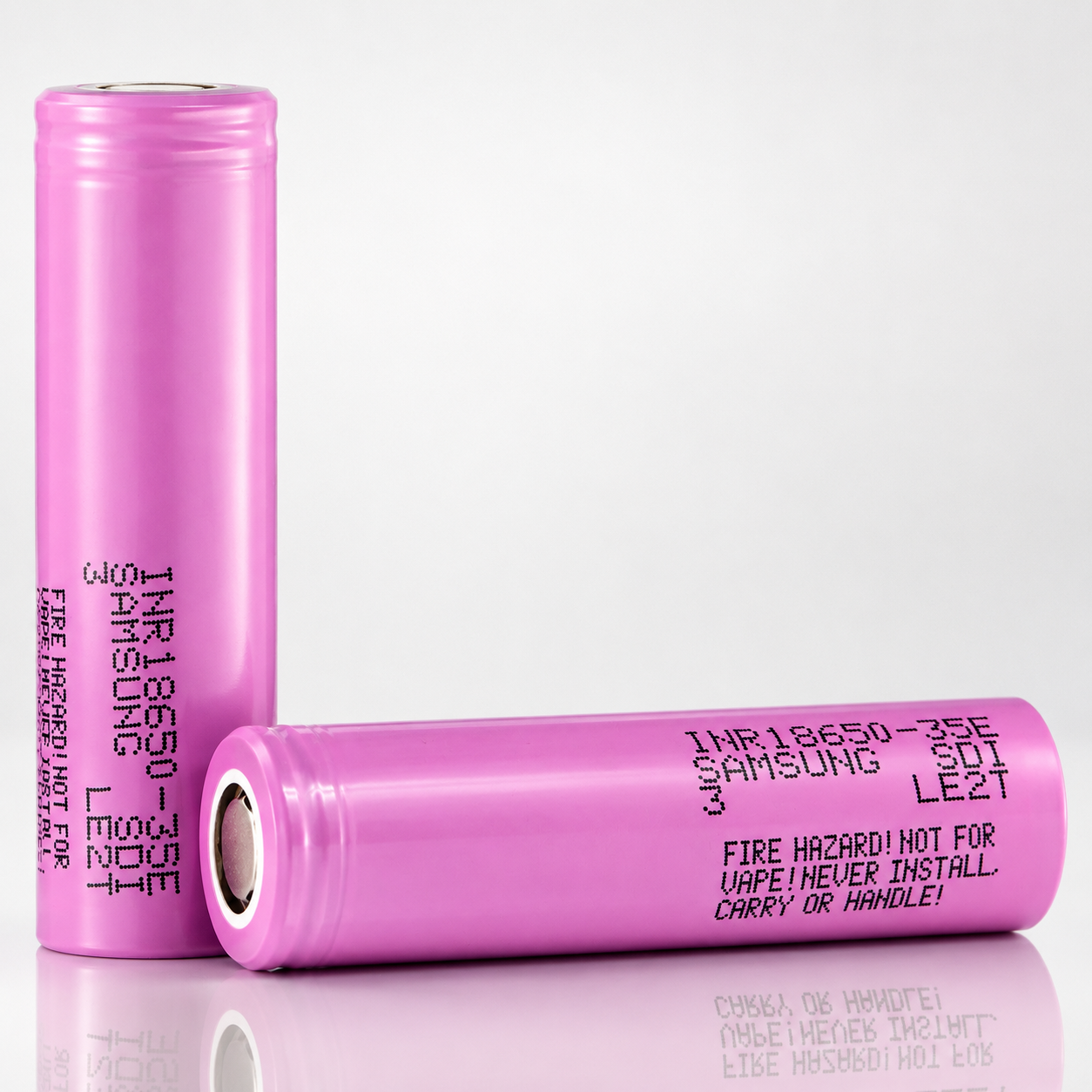
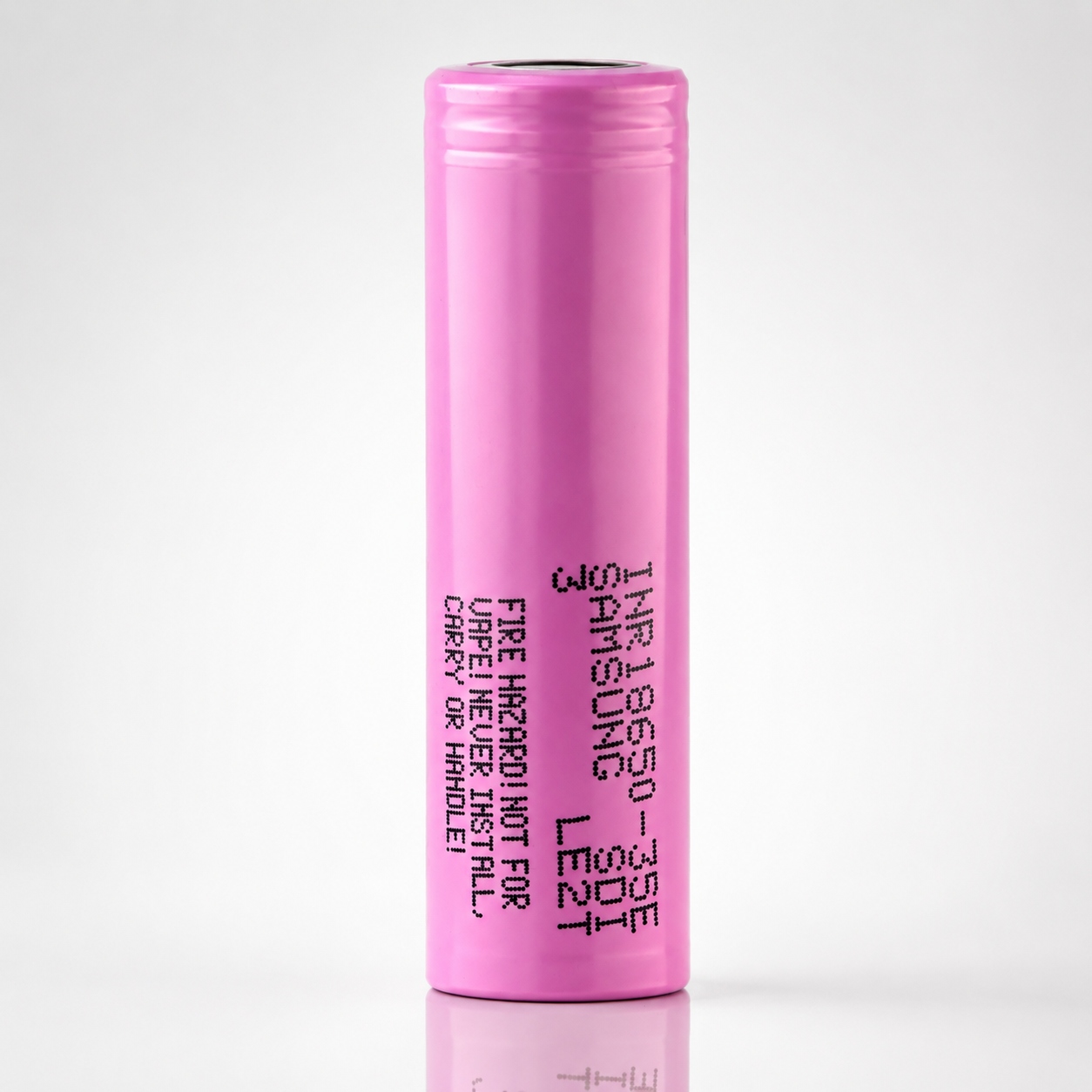
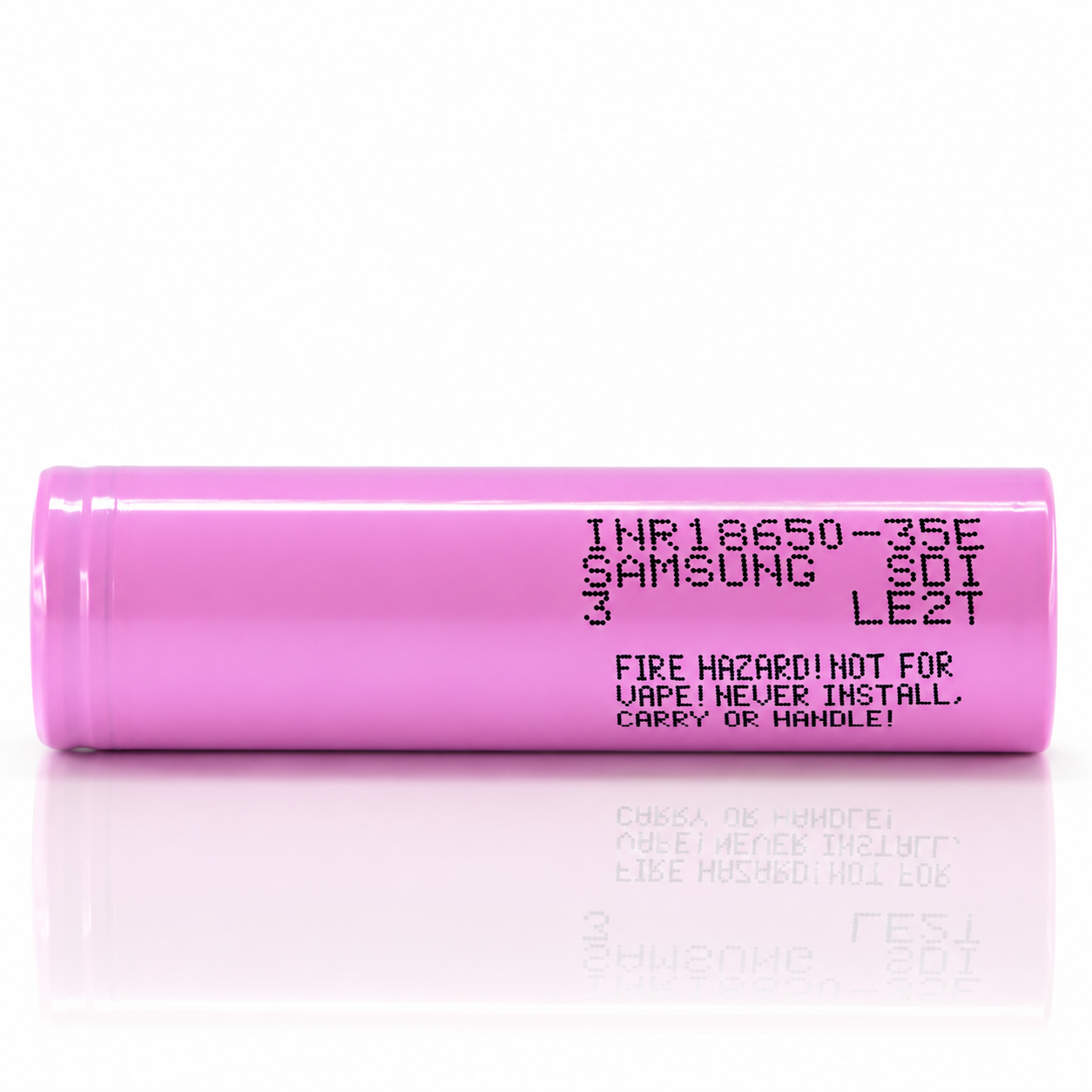


KEY SPECS · SAMSUNG SDI INR18650-35E
SOURCE [1]- SIZE
- Ø18.55 × 65.25 mm
- max.
- CAPACITY
- Not stated by manufacturer typ.
- 3,350 mAh min.
- 0.2C to 2.65 V, 23°C
- CURRENT
- 8 A
- max. continuous
- condition not stated by manufacturer
- TEMPERATURE
- −10 to 60 °C
- discharge · cell surface
- charge 0 to 45 °C · cell surface
SAMSUNG SDI · 18650 · INR18650-35E
An 18650 high-capacity cell: 3,350 mAh standard minimum capacity at 0.2C, 3,250 mAh rated minimum at 1C, and 8 A maximum continuous discharge [1]. Below: every rating with its condition, the figures Samsung prints in its tables and reports, and what we calculated from them, so you can check each number.
CAPACITY3,350 mAhminimum at 0.2C; typical not stated [1]
CONTINUOUS8 Amaximum, for continuous discharge [1]
STANDARD CHARGE1.7 ACC-CV to 4.2 V, 4 h; 2 A max, not for cycle life [1]
ENERGY12.06 Whminimum: 3.60 V × 3,350 mAh [1]; 12.2 Wh rating in the SDS [2]
AC IMPEDANCE≤35 mΩinitial, AC 1 kHz [1]
MASS50 gmaximum [1]
DATA SHEET · VER. 1.1 · PDFSDS · REV. 01 · PDFUN38.3 REPORT · PDFALL DATA SHEETSFLAT TOPUNPROTECTEDBARE CELL
A bare cell: a component for protected packs and devices built for it. Not for vaping. Charge on a lithium-ion (Li-ion) charger that stops at 4.2 V.
01SPEC PLATE
Every rating, with its condition.
Samsung’s data sheet for the 35E is titled Specification of Product [1]; this page calls it the specification. Its ratings come first, copied as printed. Then the capacity figures its tables print, our arithmetic, and facts from the safety data sheets (SDS) [2][3] and the UN38.3 transport test report [4]. Each row names its source or shows its formula.
| SPECIFICATION | VALUE | CONDITION · SOURCE |
|---|---|---|
| RATED · MANUFACTURERcopied from specification [1] | ||
| MODEL CODE | INR18650-35E | as printed [1] |
| CAPACITY, STANDARD | 3,350 mAh | minimum; 0.2C (680 mA) to 2.65 V after standard charge, 23 °C [1] |
| CAPACITY, RATED | 3,250 mAh | minimum; 1C (3,400 mA) to 2.65 V after standard charge, 23 °C; printed as 97 % of 3,350 [1] |
| CAPACITY, TYPICAL | — | Not stated by manufacturer [1] |
| 1C | 3,400 mA | the current [1] defines as 1C |
| NOMINAL VOLTAGE | 3.60 V | [1] |
| CHARGE VOLTAGE | 4.2 V | CC-CV (constant current, then constant voltage); the handling section prints 4.20 V [1] |
| DISCHARGE CUT-OFF | 2.65 V | end of discharge [1] |
| STANDARD CHARGE | 1.7 A | 0.5C, CC-CV to 4.2 V, 68 mA (0.02C) cut-off; 4 h [1] |
| CHARGE FOR CYCLE LIFE | 1.02 A | the charge current of the cycle-life rating [1] |
| MAX. CHARGE CURRENT | 2.0 A | “not for cycle life” [1] |
| MAX. CONTINUOUS DISCHARGE | 8 A | “for continuous discharge”; no temperature or other condition printed [1] |
| CHARGE TEMPERATURE | 0 to 45 °C | cell surface [1] |
| DISCHARGE TEMPERATURE | −10 to 60 °C | cell surface [1] |
| AC IMPEDANCE | ≤ 35 mΩ | initial, AC 1 kHz, after standard charge [1] |
| CYCLE LIFE | ≥ 2,010 mAh | after 500 cycles: 1.02 A charge (100 mA cut-off), 3.4 A discharge to 2.65 V; 60 % of standard capacity [1] |
| AFTER STORAGE AT 60 °C | ≥ 3,183 mAh | 20 days at 60 °C from standard charge, then 0.2C to 2.65 V; 95 % of standard capacity [1] |
| STORAGE TEMPERATURE | −20 to 25 °C | up to 1 year; to 45 °C up to 3 months; to 60 °C up to 1 month [1] |
| AS SHIPPED | 3.49–3.69 V | ex-factory voltage; about 30 % charge [1] |
| DIAMETER | 18.55 mm | maximum [1] |
| HEIGHT | 65.25 mm | maximum [1] |
| MASS | 50 g | maximum [1] |
| TERMINAL · PROTECTION | Flat top · none | as sold: bare cell, no protection circuit; terminal style not stated in [1] |
| + Source: [1] Samsung SDI, Specification of Product, Model INR18650-35E, Spec. No. INR18650-35E, Ver. 1.1, July 9th, 2015 (as printed); marked “Tentative” on every page; on file since 2020-11-10 · data sheet PDF | ||
| SPECIFICATION | VALUE | CONDITION · SOURCE |
|---|---|---|
| PRINTED IN THE SPECIFICATION’S TABLESpercent of the 3,350 mAh minimum, as printed; mAh calculated [1] | ||
| CAPACITY AT 8 A | 92 % | ≈ 3,082 mAh; to 2.65 V after standard charge, 23 °C; table 7.8 [1] |
| CAPACITY AT 2C | 95 % | ≈ 3,183 mAh at 6.8 A; table 7.8 [1] |
| DISCHARGE AT −10 °C | 40 % | ≈ 1,340 mAh at 3.4 A, charged at 23 °C; table 7.5 [1] |
| CHARGE AT 0 °C | 60 % | ≈ 2,010 mAh, then 0.2C at 23 °C; table 7.6 [1] |
| CALCULATEDarithmetic on [1], shown so you can check it | ||
| CONTINUOUS AS C-RATE | 2.35C | 8 A ÷ 3.4 A, the 1C in [1] |
| STANDARD CHARGE AS C-RATE | 0.5C | 1.7 A ÷ 3.4 A, as printed in [1] |
| RUNTIME AT 8 A | 23.1 min | 3,082 mAh ÷ 8 A, from table 7.8 [1] |
| ENERGY, MINIMUM | 12.06 Wh | 3.60 V nominal × 3,350 mAh minimum [1] |
| VOLUME | 17.6 cm³ | π × (18.55 ÷ 2)² × 65.25 mm³, the maximum size [1] |
| FROM THE SAFETY DATA SHEETS (SDS) AND UN38.3 TRANSPORT TEST REPORTcopied as printed from [2]–[4] | ||
| CHEMISTRY | Li-ion | [1] says lithium-ion only; the SDS describes the cathode as “based on lithiated metal oxide (Cobalt, Nickel)” and lists lithium nickel oxide at 25–35 % of the cell’s weight [2] |
| ENERGY RATING | 12.2 Wh | Wh rating, SDS [2]; 12.06 Wh in the 2017 SDS [3]; 12.5 Wh in the UN38.3 report [4] |
| RATED CAPACITY, SDS | 3.40 Ah | [2]; 3.35 Ah in [3]; 3,480 mAh in [4] |
| TRANSPORT | UN3480 · Class 9 | “Lithium Ion Batteries”; UN3481 when packed with or contained in equipment [2] |
| UN38.3 | SDI-UN-141218-01 | Revision 07; T1–T6 and T8 Pass; T7 not applicable to cells; Samsung SDI Safety Center, 2014-12-18 [4] |
| MASS · UN38.3 TEST CELLS | 47.01–47.99 g | the 10 cells Samsung weighed before T1 [4]; not our lot; maximum 50 g [1] |
| SAFETY DATA SHEET | Revision no. 01 | 2019-01-01; lists INR18650-35E by name [2] |
| STORAGE · SDS | ≈ 20 °C | at about 40 % of capacity [2]; the 2017 SDS said 20–60 % [3] |
| + Source: [1] Samsung SDI, Specification of Product, Model INR18650-35E, Spec. No. INR18650-35E, Ver. 1.1, July 9th, 2015 (as printed); marked “Tentative” on every page; on file since 2020-11-10 · data sheet PDF + Source: [2] Samsung SDI, Safety Data Sheet, Model INR18650-35E, Revision no. 01, 2019-01-01 (section 16 prints “Date Updated: 28 June 2018”); on file 2026-10-20 · SDS PDF + Source: [3] Samsung SDI, Safety Data Sheet, Model INR18650-35E, Revision no. 00, 2017-01-01; on file, not posted; superseded by [2] + Source: [4] Samsung SDI Energy Business Division, Test report, UN Manual of Tests and Criteria Part III Subsection 38.3 (2013, Rev. 5, Amend. 2), INR18650-35E, Document No. SDI-UN-141218-01, Revision 07, 2014-12-18; tests run at the Samsung SDI Safety Center, Cheonan, Korea; on file 2026-10-20 · UN38.3 report PDF | ||
RATED · [1]FIG 1.1
Voltage window
2.65 V3.60 V4.2 Vcut-offnominalcharge
Black marks: rated voltages [1]. Orange band: the voltage cells leave the factory at, 3.49–3.69 V, about 30 % charge [1].
RATED · [1]FIG 1.2
Current limits
Charge, for cycle life 1.02 A · 0.3C · used for the cycle-life rating
1.02 A
Standard charge 1.7 A · 0.5C · 4 h
1.7 A
Max. charge 2.0 A · 0.59C · “not for cycle life”
2 A
Max. continuous discharge 8 A · 2.35C · no condition printed
8 A
Currents as rated in [1], each with its condition. C-rates against the 3,400 mA that [1] defines as 1C. [1] also prints a second, non-continuous discharge figure with no duration; pulse figures are not ratings, so it is not shown.
RATED · [1]FIG 1.3
Temperature envelope
Discharge −10 to 60 °C, cell surface
Charge 0 to 45 °C, cell surface
Printed test points tables 7.5 and 7.6, −10 to 45 °C
Operating ranges as rated in [1], measured at the cell surface. Ticks on the last row: the temperatures of the capacity tables in [1], shown in section 04. There is no printed capacity figure between them, or above 45 °C.
RATED · [1]FIG 1.4
Storage temperature, by duration
Up to 1 month −20 to 60 °C
Up to 3 months −20 to 45 °C
Up to 1 year −20 to 25 °C
Storage temperature by duration, as rated in [1]: the longer the storage, the cooler, up to 25 °C for a year. [1] says capacity recovers to more than 80 % if the cell is kept as shipped, at about 30 % charge, and its handling section recommends below 20 °C.
DOCUMENTS · [1]–[4]FIG 1.5
Capacity, as each document prints it
Rated, at 1C ≥ 3,250 mAh minimum at 3.4 A [1]
3,250
Standard, at 0.2C ≥ 3,350 mAh minimum [1]
3,350
SDS 2017 rated capacity 3.35 Ah [3]
3,350
SDS 2019 rated capacity 3.40 Ah [2]
3,400
UN38.3 report rated capacity 3,480 mAh [4]
3,480
Each document’s capacity figure, as printed, on a 3,200–3,600 mAh scale; the axis doesn’t start at zero. [1] also uses 3,400 mA as 1C. None of the four documents prints 3,500 mAh. Ratings on this page follow the specification [1].
DOCUMENTS · [1]–[4]FIG 1.6
Energy, by document
Specification, calculated 3.60 V × 3,350 mAh minimum; [1] prints no Wh
12.06
SDS 2017 Wh rating [3]
12.06
SDS 2019 Wh rating [2]
12.2
UN38.3 report Wh capacity [4]
12.5
Wh as printed in [2]–[4], beside our 3.60 V × 3,350 mAh for the specification [1], which prints no Wh figure. Each is 3.6 V times that document’s own capacity (figure 1.5), rounded: 3.6 × 3.35 = 12.06, 3.6 × 3.40 = 12.24, 3.6 × 3.48 = 12.53. Scale 11.8–12.8 Wh.
02 · CAPACITY
92 % of 3,350 mAh at 8 A.
Samsung’s table 7.8 prints the 35E’s capacity at four currents, from 0.68 A to its 8 A continuous maximum. At 8 A it prints 92 % of the 3,350 mAh standard capacity: about 3,082 mAh, or about 23 minutes at 8 A by our arithmetic.
0.68 A · 0.2C3,350 mAhstandard minimum, 100 % [1]
8 A · 2.35C3,082 mAh92 % printed in [1]; mAh and 23.1 min calculated
CALCULATED FROM [1]FIG 2.1
mAh
3,0003,1003,2003,3003,400024683,3503,2503,1833,082
Discharge current, A
Data: table 7.8 of [1], Discharge Rate Capabilities · after standard charge, 23 °C, to 2.65 V · percent of 3,350 mAh, mAh calculated · the line joins the four printed points; Samsung prints no curve between them · axis starts at 2,900 mAh · data table under fig 3.1
03BY CURRENT
Capacity and runtime, by current.
Table 7.8 of [1] prints the capacity at 0.2C, 1C, 2C and 8 A as a percent of the 3,350 mAh minimum. The mAh and the runtime are arithmetic on those percents, with the formula under each.
CALCULATED FROM [1]FIG 3.1
Capacity delivered, by current
Capacity to 2.65 V at each current, after standard charge at 23 °C, printed in table 7.8 of [1] as a percent of the 3,350 mAh minimum; mAh = percent × 3,350, rounded. The 3.4 A row matches the ≥ 3,250 mAh rated capacity [1]. 8 A is the continuous maximum.
DATA TABLE · FIG 3.1
| CURRENT | C-RATE | PRINTED % | mAh | RUNTIME |
|---|---|---|---|---|
| 0.2C (680mA) | 0.2C | 100 | 3,350 | 4 h 56 min |
| 1C (3,400mA) | 1C | 97 | 3,250 | 57 min |
| 2C (6,800mA) | 2C | 95 | 3,183 | 28 min |
| 8000mA | 2.35C | 92 | 3,082 | 23 min |
CALCULATED FROM [1]FIG 3.2
Runtime at a constant current
Runtime = capacity ÷ current, from the mAh in figure 3.1: one full standard charge, constant current to 2.65 V at 23 °C. A device whose average draw is below its peak current runs longer than the figure at that peak.
CALCULATED FROM [1]FIG 3.3
Capacity not delivered, by current
How much less each current delivers to 2.65 V than the 0.2C discharge: 3,350 mAh minus the mAh in figure 3.1. At 8 A the difference is 8 % of the standard capacity [1].
04TEMPERATURE
Capacity in the cold and the heat.
Two tables in [1]: capacity when the discharge runs at −10, 23 and 40 °C (charged at 23 °C), and when the charge runs at 0, 23 and 45 °C (discharged at 23 °C). −10 °C is the bottom of the rated discharge range; there, table 7.5 prints 40 % at 1C.
CALCULATED FROM [1]FIG 4.1
Capacity, by discharge temperature
Capacity when the discharge runs at each temperature: 3.4 A (1C) to 2.65 V after standard charge at 23 °C, with 3 h at the test temperature first. Printed in table 7.5 of [1] as a percent of 3,350 mAh; mAh calculated. −10 °C is the bottom of the rated discharge range.
CALCULATED FROM [1]FIG 4.2
Capacity, by charge temperature
Capacity when the standard charge runs at each temperature, then 0.2C (680 mA) to 2.65 V at 23 °C, with 3 h between. Printed in table 7.6 of [1]; mAh calculated. After a charge at 0 °C, the edge of the rated charge range, the table prints 60 %, against 100 % after a 23 °C charge.
CALCULATED FROM [1]FIG 4.3
Runtime at 3.4 A, by temperature
Runtime = capacity ÷ 3.4 A, from figure 4.1. At −10 °C the same discharge ends after about 24 min, against 57 min at 23 °C: arithmetic on table 7.5 of [1]. Below −10 °C is outside the rated discharge range.
05CHARGING
Charging: 1.7 A standard, 2 A maximum.
The specification rates a 1.7 A standard charge, CC-CV to 4.2 V in 4 h, and a 2 A maximum that is “not for cycle life”. Its cycle-life rating charges at 1.02 A. Charge only between 0 and 45 °C at the cell surface [1].
CALCULATED FROM [1]FIG 5.1
Capacity, by charge current
Capacity after a CC-CV charge to 4.2 V at each current, then 0.2C to 2.65 V, at 23 °C. Printed in table 7.7 of [1] as 100 and 97 % of 3,350 mAh; mAh calculated. Gray: 3.4 A is above the 2,000 mA maximum charge current in [1], a test row, not a charge rating.
PACK GUIDELINE · [1]FIG 5.2
Charge voltage, by application
Portable IT charge 4.20 V · re-charge at 4.10 V
4.20
Power-Tool charge 4.20 V · re-charge at 4.10 V
4.20
Medical charge 4.10 V · re-charge at 4.05 V
4.10
E-Bike charge 4.10 V · re-charge at 4.05 V
4.10
E-Scooter charge 4.10 V · re-charge at 4.05 V
4.10
EV/LEV charge 4.10 V · re-charge at 4.05 V
4.10
ESS/UPS charge 4.00 (4.05) V · re-charge at 4.00 (4.05) V
4.00
Samsung’s generic pack design guideline, printed in [1], for 4.20 V cells: each bar runs from the re-charging voltage to the standard charging voltage. Orange: the 4.2 V the 35E is rated to [1]. The guideline doesn’t say which column fits a given product, or why the voltages differ; figures in parentheses are printed so.
PACK GUIDELINE · [1]FIG 5.3
Voltage thresholds for a pack
Do not charge below 1.00 V · pack guideline [1]
Pre-charge 1–3 V at 0.1C–0.5C · pack guideline [1]
BMS shut-down 2.00 V · pack guideline [1]
Discharge cut-off 2.65 V [1]
Working range 2.65 to 4.2 V [1]
Voltage thresholds a pack’s battery management system (BMS) works to: the cell ratings in [1], and the pre-charge, shut-down and do-not-charge levels from the pack design guideline in [1]. End discharge at 2.65 V [1]; 2.00 V is where the guideline has the BMS shut itself down, not a discharge end point. Below 1.0 V, the guideline says not to charge the cell at all.
Before you charge
- Use a lithium-ion charger with a CC-CV profile that stops at 4.2 V.
- 1.7 A is the standard charge. 2 A is the most [1] allows, and it marks that rate “not for cycle life”. The cycle-life rating in [1] is specified at a 1.02 A charge; [1] gives no cycle-life figure at 1.7 or 2 A.
- Charge only between 0 and 45 °C at the cell surface [1]. Below 0 °C, don’t charge.
- Don’t charge a cell that has fallen below 1.0 V; the pack guideline in [1] says not to.
- In a pack, a BMS (battery management system) should end charge at 4.2 V per cell and stop on temperature.
The 3.4 A row in figure 5.1 is a test Samsung printed, not a charge rating: it is above the 2 A maximum in [1]. The pack design guideline in figures 5.2 and 5.3 is Samsung’s general template for 4.20 and 4.35 V cells of several chemistries, printed in the 35E specification. The 35E’s own ratings set the limits: charge to no more than 4.2 V and end discharge at 2.65 V [1]. The guideline’s lower charge voltages sit inside those limits; its 2.00 V BMS shut-down is below the 2.65 V cut-off, not a discharge end point.
06CYCLE LIFE AND STORAGE
What it keeps after use and storage.
[1] rates at least 2,010 mAh after 500 cycles, and at least 3,183 mAh after 20 days at 60 °C. It prints no cycle-life curve, so these are the two points on the page.
RATED · [1]FIG 6.1
Capacity after storage and cycling
Minimum capacity as rated in [1]. New and after 20 days at 60 °C: measured at 0.2C to 2.65 V. After 500 cycles of 1.02 A charge (100 mA cut-off) and 3.4 A discharge to 2.65 V: [1] prints no separate measuring current, charge voltage or temperature. A rating, not a warranty, and not a curve: [1] prints no capacity between cycle 1 and 500.
DOCUMENTS · [1]–[4]FIG 6.2
Storage charge, by document
As shipped about 30 % · 3.49–3.69 V [1]
30 %
SDS 2019 about 40 % at about 20 °C [2]
40 %
SDS 2017 about 20–60 %, 3.6–3.9 V, at about 20 °C [3]
State of charge for storage, as each document prints it. [1] says capacity recovers to more than 80 % after storage at the as-shipped charge. The newer SDS [2] narrows the older advice [3] to about 40 %.
07TRANSPORT TESTS
What Samsung’s UN38.3 report records.
Samsung’s own UN38.3 report [4] records Pass for T1–T6 and T8 on the INR18650-35E; T7, overcharge, doesn’t apply to cells. Its tables also print what each cell did. This is Samsung SDI’s in-house Safety Center report from 2014: a manufacturer sample, not our lot.
PRINTED IN [4]FIG 7.1
Highest temperature, by abuse test
T5 external short 10 cells · 100 % charge · 99–111 °C
T6 impact 5 cells · 50 % charge · 89–105 °C
T8 forced discharge, new 10 cells · 0 % charge · 68–91 °C
T8 forced discharge, cycled 10 cells · after 50 cycles, 0 % charge · 69–96 °C
Pass limit, T5 and T6 external temperature below 170 °C [4]
Highest external temperature each cell reached, as printed in [4]: one tick per cell, the bar spans the lowest to the highest. T5 external short circuit: 10 cells at 100 % charge, after T1–T4; [4] prints no short-circuit resistance or starting temperature. T6 impact: 5 new cells at 50 %. T8 forced discharge: 10 new cells and 10 after 50 cycles, from 0 % charge, initial current 8 A, 30 min interval. Pass criteria as printed: T5, below 170 °C with no disassembly, rupture or fire within 6 h; T6, below 170 °C with no disassembly or fire within 6 h; T8, no disassembly or fire within 7 days. [4] records a Pass for all 35 samples in T5, T6 and T8.
DATA TABLE · FIG 7.1
| TEST | CELLS | MAX °C, EACH CELL | RANGE |
|---|---|---|---|
| T5 external short | 10 | 105, 103, 103, 105, 99, 105, 111, 102, 102, 102 | 99–111 |
| T6 impact | 5 | 105, 102, 89, 95, 103 | 89–105 |
| T8 forced discharge, new | 10 | 85, 81, 79, 85, 68, 84, 88, 91, 85, 82 | 68–91 |
| T8 forced discharge, cycled | 10 | 79, 88, 69, 81, 95, 90, 95, 88, 96, 78 | 69–96 |
PRINTED IN [4]FIG 7.2
Voltage kept through T1–T4
Pass criterion residual voltage not less than 90% [4]
T1 altitude 100.00 % [4]
T2 thermal cycling 98.55 % [4]
T3 vibration 100.00 % [4]
T4 shock 99.76–100.00 % [4]
Open-circuit voltage after each test, as a percent of the voltage after the test before it, printed in [4]: 10 cells at 100 % charge, 4.15 V before T1 and 4.08–4.09 V after T4. Where [4] prints a range, the mark shows its lower end. The scale starts at 85 %.
PRINTED IN [4]FIG 7.3
Mass of the cells in the report
g
474849501234567891050.0 g maximum [1][4]
Cell
Mass of the 10 cells Samsung weighed before T1, as printed in [4]: 47.01–47.99 g, mean 47.49 g, against the 50 g maximum in [1]. Mass loss after each of T1–T4: 0.00–0.01 % [4]. The axis starts at 46.5 g. A 2014 manufacturer sample, not our lot.
DATA TABLE · FIG 7.3
| CELL | BEFORE T1 g | AFTER T1 | AFTER T2 | AFTER T3 | AFTER T4 |
|---|---|---|---|---|---|
| 1 | 47.930 | 47.932 | 47.932 | 47.932 | 47.931 |
| 2 | 47.907 | 47.907 | 47.904 | 47.904 | 47.904 |
| 3 | 47.103 | 47.103 | 47.100 | 47.102 | 47.104 |
| 4 | 47.040 | 47.042 | 47.042 | 47.042 | 47.043 |
| 5 | 47.052 | 47.054 | 47.050 | 47.052 | 47.052 |
| 6 | 47.986 | 47.986 | 47.984 | 47.985 | 47.984 |
| 7 | 47.013 | 47.014 | 47.014 | 47.014 | 47.014 |
| 8 | 47.029 | 47.027 | 47.029 | 47.027 | 47.025 |
| 9 | 47.931 | 47.931 | 47.930 | 47.931 | 47.931 |
| 10 | 47.912 | 47.914 | 47.911 | 47.911 | 47.912 |
Safety tests the specification lists
| TEST | METHOD, CONDENSED FROM [1] | CRITERIA | SECTION |
|---|---|---|---|
| Overcharge | standard charged cell charged with 12V and 3C (10.2A) at 23°C for 7 hours; performed with the UL1642 standard | No fire, and no explosion | [1] §9.1 |
| External short-circuit | standard charged cell shorted with less than 80±20mΩ wire for 3 hours | No fire, and no explosion | [1] §9.2 |
| Reverse charge | standard discharged cell charged reversely at 3,400mA for 1.5 hours | No fire, and no explosion | [1] §9.3 |
| Heating | standard charged cell heated at 5°C per minute up to 130°C, kept 10 minutes | No fire, and no explosion | [1] §9.4 |
| Drop | fully charged cell dropped three times from 1.0 m onto a concrete floor in random orientations, then at least 1 hour of rest and a visual inspection; criteria per IEC 62133 | No fire, no explosion | [1] §8.1 |
| Vibration | per UN38.3, each axis (X and Y for cylindrical cells): 7Hz→200Hz→7Hz in 15min, repeated 12 times, 3 hours in total; 1g from 7 to 18Hz, 8g (amplitude 1.6mm) up to 200Hz | No leakage, with less than 10mV of OCV drop | [1] §8.2 |
Methods condensed from sections 8 and 9 of [1]; criteria as printed. [1] lists these as tests the cell is specified to meet and prints no results. The UN38.3 results above are a different set of tests, from [4].
08COMPARE
Where the 35E sits.
Nine other 18650 cells, each from its own data sheet. The 35E trades discharge current for capacity: the lowest continuous rating here, tied for the highest minimum capacity. The conditions behind each rating differ, so the table quotes each sheet’s wording.
DATA SHEETS · [1][5]FIG 8.1
Minimum capacity and rated discharge, side by side
- Molicel P28B INR-18650-P28B2,650 mAh minimum · 2,800 typical40 A continuous · 80 °C cut-off
- Molicel P28A INR-18650-P28A2,700 mAh minimum · 2,800 typical35 A max. · 80 °C temp. cut
- Molicel P26A INR-18650-P26A2,500 mAh minimum · 2,600 typical35 A max. · no condition printed
- Sony/Murata VTC6 US18650VTC63,000 mAh minimum · 3,120 nominal30 A continuous max. · 80 °C temp. cut
- Samsung 30Q INR18650-30Q62,950 mAh minimum · 3,000 nominal30 A continuous · 80 °C cut; 15 A without
- Molicel P30B INR-18650-P30B2,900 mAh minimum · 3,000 typical30 A continuous · 80 °C cut-off
- Samsung 25R INR18650-25R2,500 mAh minimum · no typical printed20 A max. continuous · at room temperature
- LG HG2 18650HG2Minimum not stated by manufacturer · 3,000 nominal20 A for continuous discharge · no temperature condition printed
- Molicel M35A INR-18650-M35A3,350 mAh minimum · 3,450 typical10 A max. · no condition printed
- Samsung 35E INR18650-35E3,350 mAh minimum · no typical printed8 A for continuous discharge · no condition printed
Each cell’s figures copied from its own data sheet [1][5]. Bars start at zero: minimum capacity on a 0–3,500 mAh scale, discharge on 0–40 A. The condition sits beside each current. The 35E’s 3,350 mAh is its 0.2C standard minimum; its 1C rated minimum is 3,250 mAh [1]. Pulse and other non-continuous figures are left out.
| CELL | TYPICAL OR NOMINAL mAh | MINIMUM mAh | DISCHARGE RATING AS PRINTED | CHARGE RATING AS PRINTED | MASS g |
|---|---|---|---|---|---|
| Molicel P28B INR-18650-P28B |
2,800 typical | 2,650 | “Discharge Current, Continuous: 40 A (80°C cut-off)” | “8.4 A (70°C cut-off)” | 48 max |
|
Molicel P28A INR-18650-P28A |
2,800 typical | 2,700 | “Maximum discharging current: 35A (with 80 °C temp. cut)” | “8.4A, see Section 4.14” | 48 max |
|
Molicel P26A INR-18650-P26A |
2,600 typical | 2,500 | “Maximum discharging current: 35A” (no condition printed) | “6A” | 48 max |
|
Sony/Murata VTC6 US18650VTC6 |
3,120 nominal | 3,000 | “Continuous Maximum Discharge Current: 30A (With 80 deg temperature cut)” | “Continuous Maximum Charge Current: 5.0A” | 46.6 typical |
|
Samsung 30Q INR18650-30Q6 |
3,000 nominal | 2,950 | “Max. continuous discharge: 15A (Without temperature cut) / 30A (With 80℃ temperature cut)” | “Rated charge: CCCV, 4A, 4.20V, 100mA cut-off” | 48 max |
|
Molicel P30B INR-18650-P30B |
3,000 typical | 2,900 | “Discharge Current, Continuous: 30 A (80°C cut-off)” | “9 A (60°C cut-off)” | 47 max |
|
Samsung 25R INR18650-25R |
not printed | 2,500 | “Max. continuous discharge: 20A (@ RT)” | “Rated charge: CCCV, 4A, 4.20V, 100mA cut-off” | 45 max |
| LG HG2 18650HG2 |
3,000 nominal | Not stated by manufacturer | “Max. Discharge Current, For continuous discharge: 20000mA” | “Max. Charge Current: 4000mA” | 48 max |
|
Molicel M35A INR-18650-M35A |
3,450 typical | 3,350 | “Maximum discharging current: 10 A” (no condition printed) | “1.7 A, see Section 4.14” | 48 max |
| Samsung 35E INR18650-35E |
not printed | 3,350 | “Max. Discharge Current: 8,000mA (for continuous discharge)” (non-continuous figure not shown) | “2,000mA (not for cycle life)” | 50 max |
Text in quotation marks is copied as printed from each manufacturer data sheet [1][5], newest version in our library, checked by a second reading; notes in parentheses are ours. Links go to the bare-cell listing in our store.
09PACK MATH
From one cell to a pack.
How the single-cell ratings scale in series (S) and parallel (P). Illustrative arithmetic, not a pack rating.
V MAX4.2 × S
charge voltage, 4.2 V [1]
V NOMINAL3.6 × S
nominal voltage, 3.60 V [1]
CAPACITY3.35 × P
Ah, standard minimum at 0.2C; 3.25 × P at 1C [1]
CONTINUOUS8 × P
A: the 8 A single-cell continuous rating [1], times P*
| CONFIG | CELLS | V MAX | V NOMINAL | Ah MINIMUM | Wh MINIMUM | CONTINUOUS A* | CELL MASS g, MAX |
|---|---|---|---|---|---|---|---|
| 1S1P | 1 | 4.2 | 3.6 | 3.35 | 12.1 | 8 | 50 |
| 2S1P | 2 | 8.4 | 7.2 | 3.35 | 24.1 | 8 | 100 |
| 3S1P | 3 | 12.6 | 10.8 | 3.35 | 36.2 | 8 | 150 |
| 4S1P | 4 | 16.8 | 14.4 | 3.35 | 48.2 | 8 | 200 |
| 2S2P | 4 | 8.4 | 7.2 | 6.70 | 48.2 | 16 | 200 |
| 3S2P | 6 | 12.6 | 10.8 | 6.70 | 72.4 | 16 | 300 |
| 4S2P | 8 | 16.8 | 14.4 | 6.70 | 96.5 | 16 | 400 |
| 7S3P | 21 | 29.4 | 25.2 | 10.05 | 253.3 | 24 | 1,050 |
| 10S3P | 30 | 42.0 | 36.0 | 10.05 | 361.8 | 24 | 1,500 |
| 10S4P | 40 | 42.0 | 36.0 | 13.40 | 482.4 | 32 | 2,000 |
| 13S4P | 52 | 54.6 | 46.8 | 13.40 | 627.1 | 32 | 2,600 |
| 14S5P | 70 | 58.8 | 50.4 | 16.75 | 844.2 | 40 | 3,500 |
CALCULATED FROM [1]FIG 9.1
Continuous current ceiling, by parallel count
8 A × P: the single-cell continuous rating [1] times the parallel count. A ceiling before derating, not a pack rating.
* 8 A × P multiplies the single-cell rating (8 A, printed with no temperature condition [1]) by the number of cells in parallel. Wh = 3.60 V × 3.35 Ah × S × P, from the minimum standard capacity. [1] rates discharge between −10 and 60 °C at the cell surface: derate for heat, size the BMS, fusing and interconnects for the derated current, and use matched cells of one model and lot. Samsung’s pack guideline in [1] lists charge voltages by application (figure 5.2). Mass counts cells only. The UN38.3 report [4] covers the bare cell; a pack you build needs its own UN38.3 testing before it ships as UN3480.
10SIZE AND FIT
Ø18.55 × 65.25 mm, flat top.
Drawn at its rated maximum beside nominal outlines of three common formats. Check tight holders against the 65.25 mm maximum length.
RATED · [1]FIG 10.1
Drawn to scale
All outlines drawn to the same scale. The 35E at its maximum [1]; the other outlines are nominal format sizes, for scale only.
| DIMENSION | VALUE | CONDITION |
|---|---|---|
| Diameter | 18.55 mm | maximum [1] |
| Height | 65.25 mm | maximum [1] |
| Mass | 50 g | maximum [1]; 47.01–47.99 g for the 10 cells weighed in [4] |
| Terminal | Flat top | as sold, bare cell |
| Volume | 17.6 cm³ | π × (18.55 ÷ 2)² × 65.25 mm³, the maximum |
Check that your holder or device takes a flat-top cell 65.25 mm long (maximum) [1]. Spot-weld nickel strip for packs; don’t solder to the cell.
11USE IT RIGHT
Keep it inside its ratings.
What this cell is, and how to use it within its ratings.
- This is a bare cell: a component for protected packs and devices built for it. It is not a standalone consumer battery and not for vaping.
- Flat top, unprotected. Check that your device takes a flat-top cell 65.25 mm long (maximum) [1].
- Charge on a lithium-ion (Li-ion) charger that stops at 4.2 V. Stop discharging at 2.65 V [1].
- Stay inside the ratings [1]: discharge at no more than 8 A continuous, between −10 and 60 °C at the cell surface; charge at 1.7 A standard (2 A at most, “not for cycle life”), between 0 and 45 °C.
- Replace a torn wrap before use. Carry cells in a case, never loose.
- For packs: matched cells of one model and lot, a BMS, fusing, and a way for heat to leave.
Questions? Call 1-800-547-3050 or text 1-833-419-2192 to ask a person.
Documents
Each document is linked as published by its author; versions are listed as printed. The specification is Ver. 1.1, marked “Tentative”; it is the newest Samsung specification for the 35E in our library.
Ships from Stockbridge, GA. Most in-stock orders ship within 1 business day.
12QUESTIONS
Questions, answered.
Short answers. Where an answer comes from a document, it carries its source; the rest is standard handling practice. Anything else: call 1-800-547-3050 or text 1-833-419-2192.
Is the 35E a protected cell?
No. It is a bare flat-top cell with no protection circuit. Use it only in packs with a battery management system (BMS) or in devices built for unprotected cells.
Is it a 3,500 mAh cell?
Samsung rates it at 3,350 mAh minimum, not 3,500. The specification gives 3,350 mAh minimum at 0.2C and 3,250 mAh minimum at 1C, and uses 3,400 mA as 1C [1]. The other Samsung documents we hold print 3.40 Ah (2019 SDS [2]), 3.35 Ah (2017 SDS [3]) and 3,480 mAh (UN38.3 report [4]); none prints 3,500 mAh. Every capacity on this page follows the specification.
What does “8 A for continuous discharge” mean?
It is the specification’s maximum continuous discharge [1]. Unlike some data sheets, it attaches no temperature cut-off or ambient condition to it; the discharge range is −10 to 60 °C at the cell surface. At 8 A, table 7.8 prints 92 % of the standard capacity, about 3,082 mAh [1]. In a pack, plan for less than 8 A per cell.
Why do some listings quote a higher current?
The specification prints a second discharge figure marked “not for continuous discharge”, with no duration or condition, and some listings repeat it as if it were a rating. We don’t list it. 8 A is the continuous rating, so it is the discharge figure we publish.
How fast can I charge it?
The standard charge is 1.7 A, CC-CV to 4.2 V, in 4 h. The maximum is 2 A, which [1] marks “not for cycle life”; its cycle-life rating charges at 1.02 A. Charge between 0 and 45 °C at the cell surface [1].
What charger should I use?
A lithium-ion charger with a CC-CV profile (constant current, then constant voltage) that stops at 4.2 V. Not a NiMH, LiFePO4 or lead-acid charger.
How long will it run at my current?
Runtime ≈ capacity ÷ current. Calculated from the capacities in table 7.8 of [1], after a full standard charge at 23 °C: about 4 h 56 min at 0.68 A, 57 min at 3.4 A and 23 min at 8 A (figure 3.2). For your own draw, divide 3,350 mAh by your current in mA to get hours, and expect a little less at higher currents (figure 3.1).
How does cold affect it?
At −10 °C, the coldest it is rated to discharge at, table 7.5 prints 40 % of the standard capacity at 1C, about 1,340 mAh, against 97 % at 23 °C [1]. After a charge at 0 °C, table 7.6 prints 60 %. Don’t charge below 0 °C.
How many cycles will it last?
The specification rates at least 2,010 mAh, 60 % of the standard capacity, after 500 cycles of 1.02 A charge and 3.4 A discharge [1]. It gives no figure for other currents or temperatures, and no end-of-life count. Heat, current, depth of discharge and storage all change the result.
Can I use it in a vape or e-cigarette?
No. It is a bare cell: a component for protected packs and devices built for it, not for vaping.
Can I solder to it?
Don’t solder directly to the cell: the heat can damage the seal and internal parts. Spot-weld nickel strip, or use a holder.
Can I mix 35E cells with other cells?
No, not in the same pack. Use cells of the same model and lot, at the same state of charge. In series, the weakest cell reaches 2.65 V first and limits the whole pack, and mismatched cells drift further apart with every cycle.
How should I store spare cells?
In a case, away from metal objects, somewhere dry and cool. The specification allows −20 to 25 °C for up to a year and recommends below 20 °C [1]; the SDS suggests about 20 °C at about 40 % charge [2]. Check the voltage every few months.
How does it ship?
As UN3480, lithium-ion batteries, Class 9, under the SDS [2]; the UN38.3 report [4] covers the bare cell. A pack built from it needs its own UN38.3 testing.
13SOURCES
Sources and method.
Where every number on this page comes from.
- + Source: [1] Samsung SDI, Specification of Product, Model INR18650-35E, Spec. No. INR18650-35E, Ver. 1.1, July 9th, 2015 (as printed); marked “Tentative” on every page; on file since 2020-11-10 · data sheet PDF
- + Source: [2] Samsung SDI, Safety Data Sheet, Model INR18650-35E, Revision no. 01, 2019-01-01 (section 16 prints “Date Updated: 28 June 2018”); on file 2026-10-20 · SDS PDF
- + Source: [3] Samsung SDI, Safety Data Sheet, Model INR18650-35E, Revision no. 00, 2017-01-01; on file, not posted; superseded by [2]
- + Source: [4] Samsung SDI Energy Business Division, Test report, UN Manual of Tests and Criteria Part III Subsection 38.3 (2013, Rev. 5, Amend. 2), INR18650-35E, Document No. SDI-UN-141218-01, Revision 07, 2014-12-18; tests run at the Samsung SDI Safety Center, Cheonan, Korea; on file 2026-10-20 · UN38.3 report PDF
- + Source: [5] Molicel INR-18650-P30B data sheet, Version 1.0 (as printed) · copy in our data-sheet library
- + Source: [5] Molicel INR-18650-P28B data sheet, no version printed (as printed) · copy in our data-sheet library
- + Source: [5] Molicel INR-18650-P28A data sheet, Doc # INR18650P28A-01, Rev. 1.2, 2024/05/21 (as printed) · copy in our data-sheet library
- + Source: [5] Molicel INR-18650-P26A data sheet, Doc # INR18650P26A-01, Rev. 1.2, 8/17/2018 (as printed) · copy in our data-sheet library
- + Source: [5] Samsung INR18650-30Q6 data sheet, Spec. No. INR18650-30Q6, Version 1.0, 2020/06/04 (as printed) · copy in our data-sheet library
- + Source: [5] Sony/Murata US18650VTC6 data sheet, Murata Version 001; ratings from Sony Ver. 0.1, 2015.06.30 (as printed) · copy in our data-sheet library
- + Source: [5] LG 18650HG2 data sheet, BCY-PS-HG2-Rev0, 2014-04-24 (as printed) · copy in our data-sheet library
- + Source: [5] Samsung INR18650-25R data sheet, Version 1.0, 2016/04/15 (as printed) · copy in our data-sheet library
- + Source: [5] Molicel INR-18650-M35A data sheet, Doc # INR18650M35A-02, Rev. 0.1, 10/21/2019 (as printed) · copy in our data-sheet library
- + Method: the specification [1] prints capacity tables, not performance charts, and none of the documents we hold has a 35E curve. Every chart on this page plots a figure printed in [1]–[4], or arithmetic on those figures with the formula under it; where a line joins printed points, nothing between them is printed. Each figure was copied from the document and checked against it by a second reading.
- + Not shown from [1]: its non-continuous discharge figure, which has no duration or condition, because pulse figures are not ratings; and its warranty clause, which applies to Samsung’s direct customers.
- + Not shown: lot measurements. We will add Measured rows only once our incoming-inspection procedure is published, with sample size, instrument and date.
Customer Reviews
Overall rating: 4.9 / 5 from 224 reviews.
Fast shipping, great service
Great!
good

Good, honest company. They send verifiable SAMSUNG when you ask for the brand you expect. NO KNOCK-OFFS. I've been dealing with them for almost two years now. Good, fair pricing, and shipping has always been quick and acceptable.
Perfect, fast shipping!
Very pleased. Laptop can now go mobile again😊
Great inventory, fast shipping. My goto place for hard to fine batteries.
Worked great to replace failing battery for Vaultek MXi safe
Great service and fast shipping, all around great experience
Just what I needed!
I do not order many of these batteries but this is always my first and only stop. Their prices are great, shipping is speedy, and all of the cells ARRIVED within .05V of each other.
the product came well packaged/protected and with information regarding the safety and handling of said battery. I was impressed, battery works great and I have no complaints. Just make sure you are purchasing the right battery for your device, button top or flat, protected or unprotected, size and output. I would recommend only buying battery cells from official retailers like this one. Fakes can end up causing damage and failing or worse, safety first !
Seems to be in good condition and delivered exactly as advertised (save 100mAh additional capacity). I don't have any experience with this type of battery, so I can't say for sure, but I tested them, charged them up and they seem to work quite well for my purpose (batteries for a nighttime solar charged address sign).
just great experience, for what they where build for better than some factory's.. performance...Thank you
Quick service, well packaged and good price. Thanks
Thanks
Purchased a solar powered device, batteries not included... Found your online store.... Haven't used them yet, but they look good... Thnx...
Second time buying this battery from these guys and it’s always a fast process and quality batteries
I was having trouble sourcing these batteries for a multinode sensor project. These batteries showed up in two days as expected. I had to charge them, but after that they seem to work as expected.

Worked as described.
Shopping and shipping was a breeze. The cells arrived on time and in excellent condition.
They worker perfectly in replacing the cells in my Porter Cable batteries.
I saw, I bought, I got, they work.
good order
Works great. Perfect replacement.
Works great
As described, so far so good, only time will tell in terms off durability cycles of charge and discharge.
Great price and very fast shipping.
Good product and timely delivery.
They work well! Good charge and discharge rate..
Anytime ups transfers to local post office delivery times turn to shit. Don't do it. Just adds a couple days.
Great product replaced my original Vaultek gun safe discontinued batteries perfectly.
Delivery was prompt. All six batteries charged quickly and provide the power promised.

Almost got scammed by a fake store, but this is the real deal. The batteries are legit, the checkout was easy & fast, and the delivery was quick. Would definitely buy again.
quality items and great price
Best site to order the batteries you need. Fast delivery and they charge up perfectly.
Battery’s lasted one day
Muy buenas y buen presio
Easy ordering and a very nice selection. Will order from again!