
How cool, they included plastic holders for each type. Very helpful cause I forgot to buy those. The batteries are legit. This is the only online store I entirely trust for 18650/21700. Im very happy with the ourchase and they got them across country to menin california in five biz days for pretty cheap.
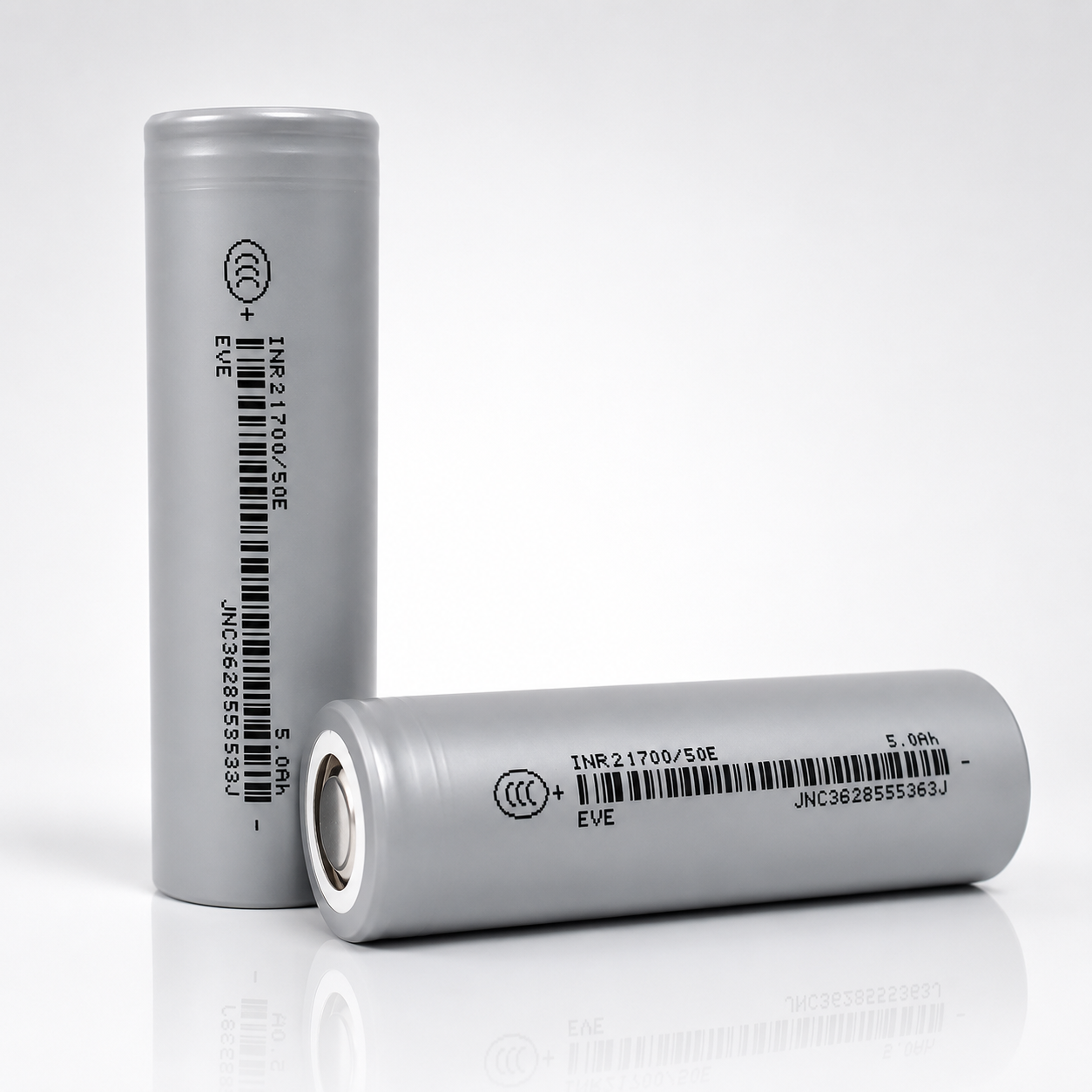
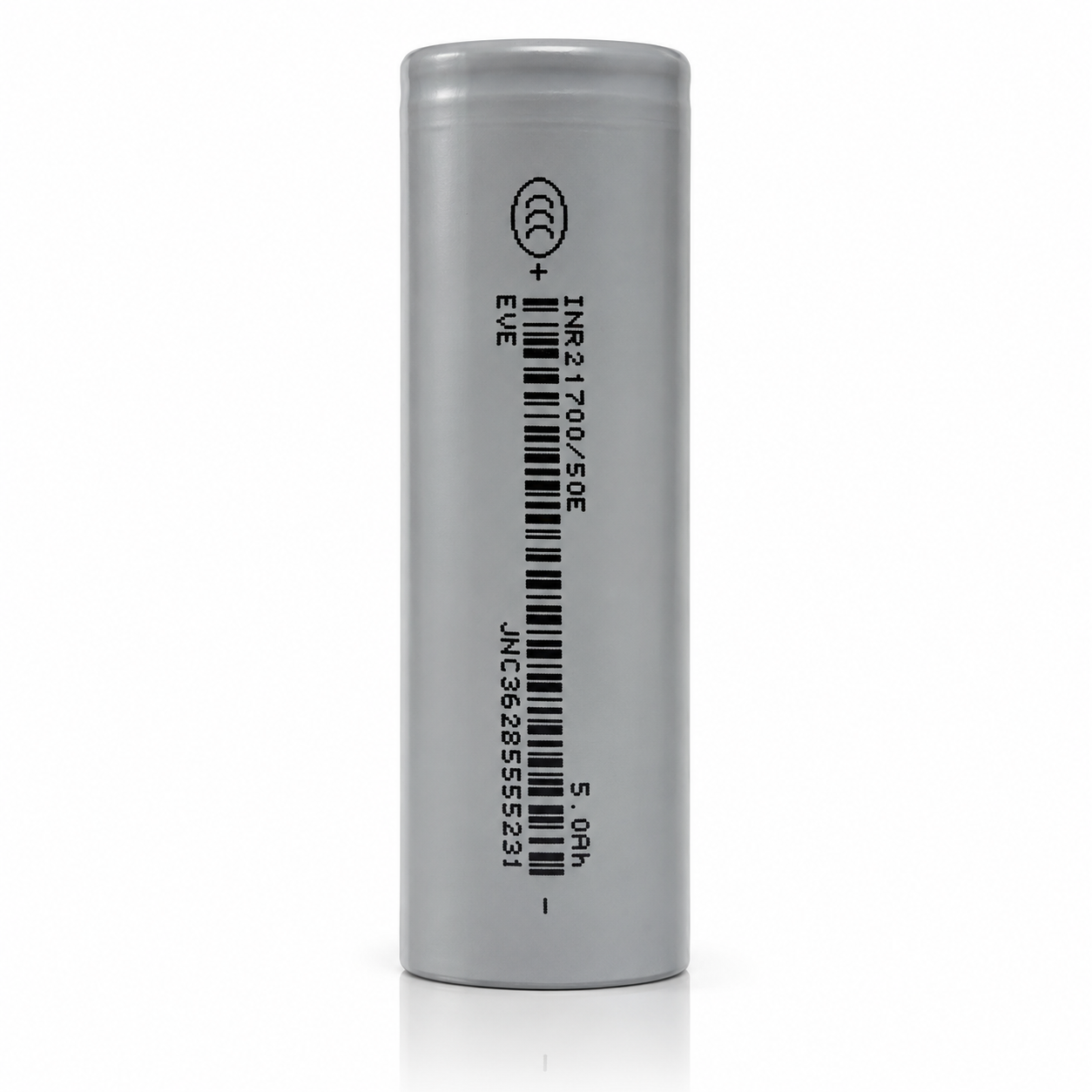


KEY SPECS · EVE ENERGY INR21700/50E
SOURCE [1]- SIZE
- Ø21.15 × 70.15 mm
- nominal ±0.10 / ±0.15
- CAPACITY
- 5,000 mAh typ.
- 4,900 mAh min.
- 0.2C to 2.5 V
- CURRENT
- 15 A
- max. continuous
- condition not stated by manufacturer
- TEMPERATURE
- −20 to 60 °C
- discharge
- charge 0 to 55 °C
EVE 50E 21700
5000mAh / 15A Max
High-capacity 5.0Ah 21700 lithium-ion cell engineered for long runtime and stable moderate-drain output.
5000mAh Nominal Capacity 15A Maximum Discharge 10A Moderate-Drain Reference 3.65V Nominal 21700 Energy Cell Unprotected Flat Top
5000mAhNominal Capacity
4900mAhMinimum Standard Capacity
15AMax. Continuous Discharge
≤20mΩInitial AC Impedance @ 1kHz
2.5AMax. Continuous Charge
21.15 × 70.15mmCell Envelope With Tube
EVE 50E 21700 5000mAh 15A Battery
The EVE 50E is an energy-focused 21700 cell designed for applications that value runtime, stable capacity, and efficient pack-level energy density over extreme high-drain output. It is a strong fit for moderate-drain battery packs, portable power systems, electric mobility modules, and applications where 5000mAh-class capacity is more important than maximum current per cell.
| Brand / Model | EVE INR21700/50E |
|---|---|
| Cell Type | 21700 cylindrical lithium-ion rechargeable cell |
| Nominal Capacity | 5000mAh |
| Minimum Standard Capacity | 4900mAh after 1.0A standard charge/discharge test |
| Nominal Voltage | 3.65V data-sheet value |
| Charge Voltage | 4.20V ±0.05V |
| Discharge Cut-Off Voltage | 2.50V |
| Standard Charge | 1.0A / 0.2C, 4.20V CCCV, 0.1A cut-off |
| Maximum Charge | 2.5A / 0.5C, 4.20V CCCV, 0.1A cut-off Max. continuous |
| Standard Discharge | 1.0A / 0.2C to 2.50V cut-off |
| Maximum Discharge | 15.0A / 3C to 2.50V cut-off Max. continuous |
| Initial Internal Impedance | ≤20mΩ AC at 1kHz, measured at 20%~30% SOC |
| Cell Dimensions | 21.15mm ±0.10 diameter × 70.15mm ±0.15 height, with tube |
| Cell Weight | 69.0g ±2.0g |
| Ambient Operating Temperature | Charge: 0°C to 55°C; Discharge: -20°C to 60°C |
| Cell-Surface Temperature | Charge: 0°C to 60°C, recommended recharge release <45°C; Discharge: -20°C to 70°C, recommended re-discharge release <60°C |
| Storage Temperature | 1 year: 0°C to 25°C; 3 months: 0°C to 45°C; 1 month: 0°C to 60°C |
| Storage Humidity | ≤65% RH |
| Ex-Factory Voltage | 3.450V to 3.600V charging voltage range |
| Protection | No — unprotected flat-top cell |
Electrical operating envelope at a glance.
These quick-reference visuals summarize capacity class, current capability, voltage range, and C-rate conversion.
1. Current Capability Stack
Key current reference points for long-runtime use, standard tests, charging, and maximum discharge.
2. Voltage Operating Window
Basic per-cell voltage limits for charger, BMS, and host electronics.
3. Capacity and Energy Translation
Nominal watt-hours estimated from nominal capacity and data-sheet nominal voltage.
4. C-Rate Conversion
EVE defines 1C as 5.0A for this cell.
| 1.0A | 0.2C standard charge / standard discharge |
|---|---|
| 2.5A | 0.5C charge or discharge reference |
| 5.0A | 1C discharge reference |
| 10.0A | 2C moderate-drain / listing-body current reference |
| 15.0A | 3C max continuous discharge |
High-capacity cells should be evaluated by runtime, voltage sag, and cycle profile.
The EVE 50E is not a pure high-current power cell. Its strength is long runtime in a compact 21700 format. The rate-capability table shows high relative capacity at 2.5A, 5A, and 10A, with the 15A maximum discharge condition retaining at least 90% relative capacity in the specified test.
The simplified discharge graph below visualizes voltage versus delivered capacity under 1A, 5A, 10A, and 15A loading. It is designed for clear comparison, not as a digitized laboratory curve.
Relative rate capability summary
| 1.0A / 0.2C | 100% relative capacity reference |
|---|---|
| 2.5A / 0.5C | ≥97% relative capacity |
| 5.0A / 1C | ≥95% relative capacity |
| 10.0A / 2C | ≥93% relative capacity |
| 15.0A / 3C | ≥90% relative capacity |
| Design takeaway | Best suited to energy-focused and moderate-drain systems; use 15A only within the data-sheet limits and with thermal validation. |
5. Simplified Discharge-Curve Graph
Voltage vs. capacity illustration for 1A, 5A, 10A, and 15A operation.
6. Estimated IR Voltage Drop
Using the published ≤20mΩ AC impedance as a rough planning reference. Real DC sag also depends on pack construction and temperature.
7. Rate Capability Bar Chart
Minimum relative capacity by discharge current under the EVE data-sheet rate-discharge test.
8. Energy-Cell Positioning
The 50E is optimized for capacity and steady moderate-drain output rather than extreme power density.
Temperature, charge current, storage, and cycle life affect long-term pack performance.
EVE specifies operating-temperature ranges, storage limits, discharge-temperature capacity criteria, and cycle-life test methods. These diagrams condense those criteria into technical visuals.
9. Charge Profile Reference
Standard charge is 1.0A CCCV to 4.20V with 0.1A cut-off; max. continuous charge is 2.5A.
10. Thermal Operating Envelope
Ambient operating range and cell-surface limits from the EVE specification.
11. Temperature Discharge Capacity
Relative capacity at 1.0A discharge after storage at each test temperature.
12. Cycle-Life Visualization
Published cycle-life criteria at 1.0A discharge to 3.0V under two charge-current profiles.
13. Storage Performance
Published storage and recovery criteria for inventory and pack-management planning.
| 1-Year Storage | 0°C to 25°C at shipping SOC |
|---|---|
| 3-Month Storage | 0°C to 45°C at shipping SOC |
| 1-Month Storage | 0°C to 60°C at shipping SOC |
| Storage Humidity | ≤65% RH |
| Recovery Criterion | Recovery capacity more than 90% of standard discharge capacity after storage under the specified conditions. |
| Ex-Factory Voltage | 3.450V to 3.600V |
14. Safety Test Summary
High-level overview of safety-characteristic criteria from the EVE specification.
| Free Fall | No fire, no explosion under stated IEC62133-style test method. |
|---|---|
| Vibration | No fire, no explosion, no leakage, less than 10% OCV drop under stated UN38.3-style vibration test. |
| Overcharge | No fire, no explosion under stated UL1642-style test method. |
| External Short-Circuit | No fire, no explosion under stated IEC62133-style test condition. |
| Heating / Low Pressure | No fire / no explosion criteria under stated test conditions. |
21700 dimensional envelope for holders, sleds, chargers, and pack CAD.
Mechanical fit is critical in 21700 cells. The EVE specification gives dimensions with tube, so the visual below should be treated as the nominal manufacturing envelope for fitment checks.
15. Cell Dimension Diagram
Mechanical envelope based on the EVE outline dimension drawing.
16. Pack Scaling Formulas
Quick math for series/parallel planning. Validate current limits thermally and electrically.
Pack Voltage ≈ Series Count × 3.65V
Pack Capacity ≈ Parallel Count × 5.0Ah
Pack Energy ≈ S × P × 18.25Wh
Max Cell-Level Discharge Reference ≈ P × 15A
17. Example Parallel Scaling
Approximate scaling using the 15A data-sheet maximum discharge rating, not a finished-pack guarantee.
| 1P | 5.0Ah, ≈18.25Wh, 15A max cell-level discharge reference |
|---|---|
| 2P | 10.0Ah, ≈36.5Wh, 30A max cell-level discharge reference |
| 3P | 15.0Ah, ≈54.75Wh, 45A max cell-level discharge reference |
| 4P | 20.0Ah, ≈73.0Wh, 60A max cell-level discharge reference |
| 5P | 25.0Ah, ≈91.25Wh, 75A max cell-level discharge reference |
18. Common Series Voltage Examples
Nominal voltage examples only. Full-charge and cut-off pack voltages scale separately.
| 1S | 3.65V nominal / 4.2V full / 2.5V cut-off |
|---|---|
| 3S | 10.95V nominal / 12.6V full / 7.5V cut-off |
| 4S | 14.6V nominal / 16.8V full / 10.0V cut-off |
| 5S | 18.25V nominal / 21.0V full / 12.5V cut-off |
| 10S | 36.5V nominal / 42.0V full / 25.0V cut-off |
| 13S | 47.45V nominal / 54.6V full / 32.5V cut-off |
Use the EVE 50E inside a voltage-, current-, and temperature-controlled system.
This is an unprotected 21700 cell. Safe implementation requires pack-level or device-level protection, especially against over-charge, over-discharge, over-current, short-circuit, and over-temperature conditions.
19. Suggested Control Threshold Map
System-level control guidance derived from the EVE specification.
| Charge upper limit | 4.20V ±0.05V per cell |
|---|---|
| Discharge floor | 2.50V per cell |
| Standard charge | 1.0A CCCV to 4.20V, 0.1A termination |
| Maximum charge | 2.5A CCCV to 4.20V, 0.1A termination |
| Charge temperature gate | Ambient 0°C to 55°C; surface 0°C to 60°C |
| Discharge temperature gate | Ambient -20°C to 60°C; surface -20°C to 70°C |
| Current planning | Use 15A as maximum discharge limit and 10A as a conservative moderate-drain design reference when runtime and cycle life are priorities. |
20. Risk-Control Checklist
Recommended pack-building and use practices.
- Use only in devices or packs designed for unprotected 21700 lithium-ion cells.
- Use a BMS or controller that monitors voltage, current, and temperature.
- Do not charge above 4.20V or discharge below 2.50V per cell.
- Use conservative current limits when long cycle life is the primary objective.
- Never carry loose cells with conductive objects such as keys, coins, tools, or metal cases.
- Spot weld for pack assembly; do not solder directly to the cell body.
- Inspect wraps and top insulator rings before use.
- Size nickel, busbars, wiring, fuses, and BMS MOSFETs for both electrical resistance and heat rise.
Best suited for high-capacity, moderate-drain battery systems.
E-Bike / Mobility Packs
- Good fit for runtime-focused mobility packs with moderate current per cell.
- Parallel count should be selected from measured current, thermal rise, and voltage sag.
Energy Storage
- Suitable for compact storage modules where capacity and cycle life matter.
- Use with proper pack-level BMS and thermal controls.
Power Banks / Backup
- Strong option for high-capacity portable power devices.
- Best in systems with moderate discharge rate and controlled charging.
Medical / Instrumentation
- Useful in compatible equipment that prioritizes steady runtime over peak power.
- Always follow the device manufacturer’s battery requirements.
Consumer Electronics
- Suitable for devices designed around flat-top unprotected 21700 cells.
- Confirm dimensions, terminal design, and current draw.
Custom Battery Packs
- Designed for experienced builders who can manage cell matching, welding, insulation, and BMS settings.
- Not the best choice when maximum current per cell is the primary requirement.
21. Application Suitability Matrix
Simple fit guidance.
| Runtime-focused packs | Strong fit |
|---|---|
| Energy storage modules | Strong fit |
| Power banks / backup | Strong fit |
| Moderate e-bike packs | Good with BMS and thermal validation |
| High-current tools / RC | Consider high-drain cells |
| Vape / e-cigarette devices | Do not use |
22. Selection Bias: Energy vs. Power
This cell is biased toward energy capacity and runtime.
| Choose EVE 50E when | You need 5000mAh-class capacity, moderate current, and strong runtime per cell. |
|---|---|
| Choose a high-drain cell when | Your device pulls high sustained current per cell, has severe voltage sag requirements, or needs tool/RC-level output. |
| Pack design priority | More parallel cells reduce current per cell, improve runtime, and reduce heat generation. |
| Cycle-life priority | Stay below maximum current and use controlled charge profiles to reduce stress. |
Safety, Handling & Compatibility Notice
This product is an unprotected lithium-ion cell. It should only be used by customers who understand lithium-ion cell safety and who are using the battery in compatible hardware, managed packs, or professionally designed assemblies. Improper use can lead to overheating, venting, fire, or explosion.
- Charge only with lithium-ion chargers or managed battery systems designed for the correct chemistry and cell count.
- Never short circuit, crush, puncture, incinerate, or expose the cell to water.
- Do not use cells with damaged wraps, dented cans, or missing top insulator rings.
- Do not mix with cells of different age, capacity, model, or state of charge in the same pack.
- For assembly, use spot welding rather than direct soldering to reduce heat damage risk.
- Store and transport in non-conductive cases; never carry loose cells in pockets or bags.
- Keep away from children and from applications for which the product is not specified.
- Not for e-cigarette, vape, or similar use.
Common technical questions about the EVE 50E.
What is the capacity of the EVE 50E?
The EVE 50E has a nominal capacity of 5000mAh and a minimum standard discharge capacity of 4900mAh under the EVE data-sheet test method.
Is this a 10A or 15A battery?
The EVE specification lists 15A max. continuous discharge to 2.5V. For long-runtime designs, 10A or lower is the more conservative planning reference.
Is this a protected battery?
No. This is an unprotected flat-top 21700 cell and should only be used in systems with appropriate voltage, current, short-circuit, and temperature protection.
What charger should be used?
Use a lithium-ion charger or battery-management system that charges to 4.20V per cell using a CCCV profile. The standard charge current is 1.0A with 0.1A cut-off.
Can the EVE 50E fast charge?
The EVE specification lists 2.5A max. continuous charge. For routine use and longer service life, standard or conservative charge currents are preferred.
What is the correct discharge cut-off voltage?
The specification states a 2.50V discharge cut-off voltage per cell. Many pack designers choose a higher system cut-off to reduce stress and improve cycle life.
Can the EVE 50E be used in battery packs?
Yes. It is a strong candidate for capacity-focused custom packs when cell matching, spot welding, BMS sizing, fusing, insulation, and thermal validation are properly engineered.
Can I solder wires directly to this cell?
Direct soldering is not recommended. Spot welding is the preferred pack-assembly method because it reduces the risk of heat damage to the cell.
What are the cell dimensions?
The EVE specification lists 70.15mm ±0.15 height and 21.15mm ±0.10 diameter, with tube. Always confirm fit in the actual device, holder, or pack fixture.
What temperature range is allowed?
The ambient operating ranges are 0°C to 55°C for charging and -20°C to 60°C for discharging. Cell-surface limits are 0°C to 60°C for charge and -20°C to 70°C for discharge, with recommended release temperatures below 45°C and 60°C respectively.
What does ≤20mΩ internal impedance mean?
It is the initial AC internal impedance measured at 1kHz at 20%~30% state of charge. Lower resistance helps reduce voltage sag, but pack resistance also includes welds, nickel, busbars, wiring, holders, fuses, and BMS components.
How many cycles should I expect?
The specification gives a 1000-cycle criterion with 1.0A charge and 1.0A discharge to 3.0V, and a 500-cycle criterion with 5A charge and 5A discharge to 3.0V, both requiring at least 70% of initial capacity under the stated test conditions. Actual service life depends on current, temperature, charge voltage, depth of discharge, and pack design.
What is the shipment voltage?
The specification states that the cell should be shipped in the 3.450V to 3.600V charging voltage range.
Can I carry this battery loose?
No. Loose transport is unsafe because conductive objects can short the terminals. Always use a non-conductive battery case.
Customer Reviews
Overall rating: 5.0 / 5 from 33 reviews.
Fantastic prices and lighting fast shipping! A+ customer support
I really like the whole store and am happy with my small purchases.
Functionally sound delivered on time!
Perfect batteries, extremely well priced, fast shipping.
They were well packed as usual. All batteries tested to spec.

Happy with the batttery! Thanks!
Perfect yo build a pack for my FPV plane.
Outstanding service and quality products. Great battery source and reliability. Thank you.
A high-quality battery with all cells at the same voltage level doesn't even require balancing.
Dependable cell
Excellent store Excellent quality 👌 fast shipping

48v 20Ah pack ready for BMS and to marry to the case. I've used these same cells on similar builds and I'm very happy with them.
Quick delivery. 100 % ok batteries Happy!
These cells are my go to for long range battery pack for my FPV wing. 4s2p making 10,000mAh capacity. Burst discharge of 30 A with no issues and then constant 9A draw and the battery handles it with no issues whether it's cold or hot. I am sure it can handle higher continuous discharge with no problems whatsoever.
Powers my bike at full throttle for quite a while, gets me to and from work reliably, and they don't even get warm while doing it
Arrived well packaged and fast
excellent battery
Good quality
First time buying from this site, found it after a google/reddit search, no disappointment here. Very powerful battery compared the junk i got with my flashlight from ebay. It had to be fully charged but wow, worth the money all day long, thanks
Much better overall battery and dollars per piece cheaper than the batteries available on the gargantuan site we all know about. Buy here, you won’t be disappointed!!
Fast service, great cells and great value. My goto store for batteries!
Good charge……lasts just as well as the others. Will buy again!!!

All 50 cells came balanced to 0.05V. Worked a charm. Planned for a 4P10S but ended up with a 5P10S because every single cell seems to be from the same batch. I expected a few might not be close enough to use in parallel. I was happily mistaken.
As described very happy
The batteries were well packed and arrived in good working condition. I'll be able to make so many cool things with these.
Thank you
Fast shipping Great cells!
well packaged, quick delivery. Everything was as advertised. Batteries were fantastic,
great battery

Amazing batteries.
Battery is perfect! Will buy more, thanks!
Shipped quickly and as described