
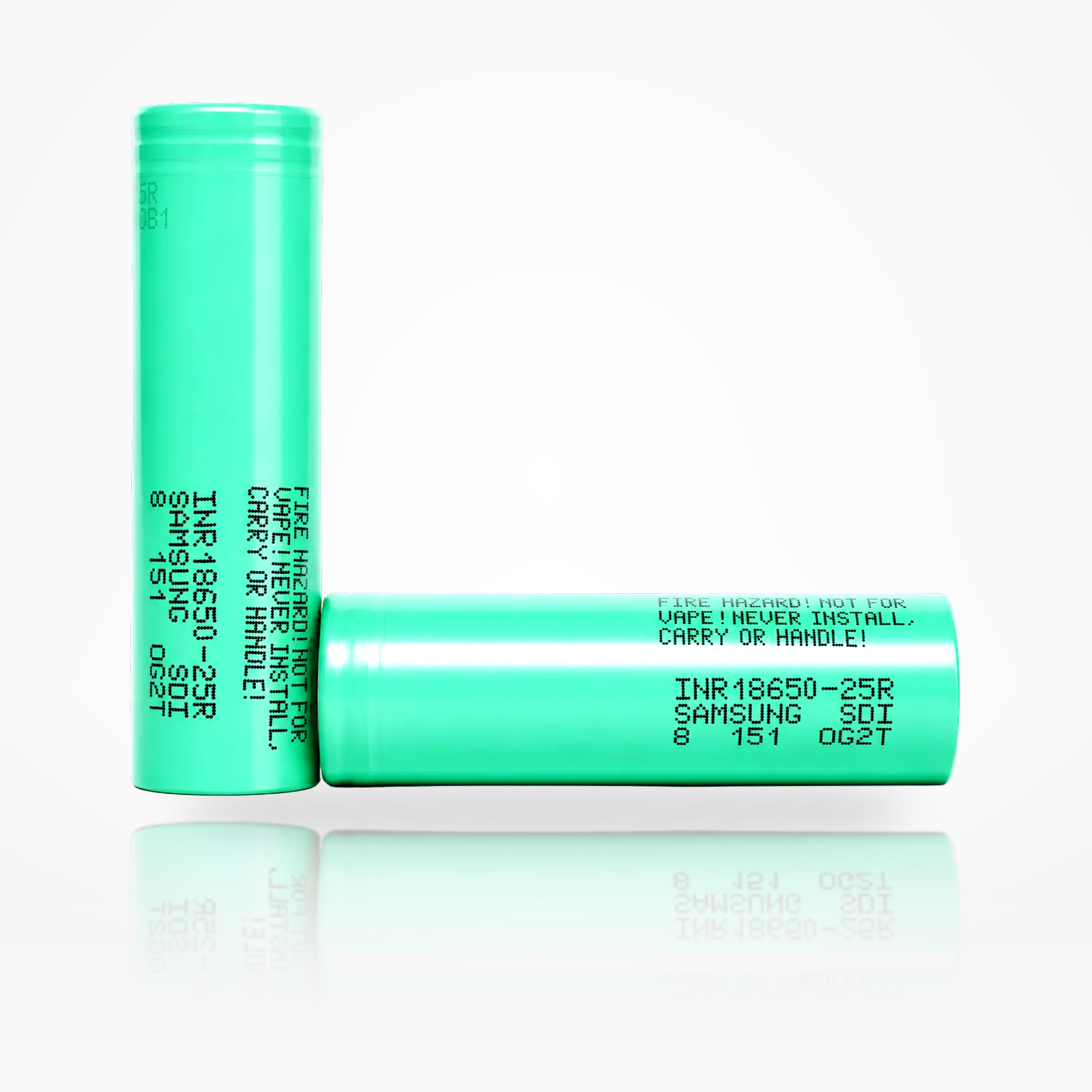
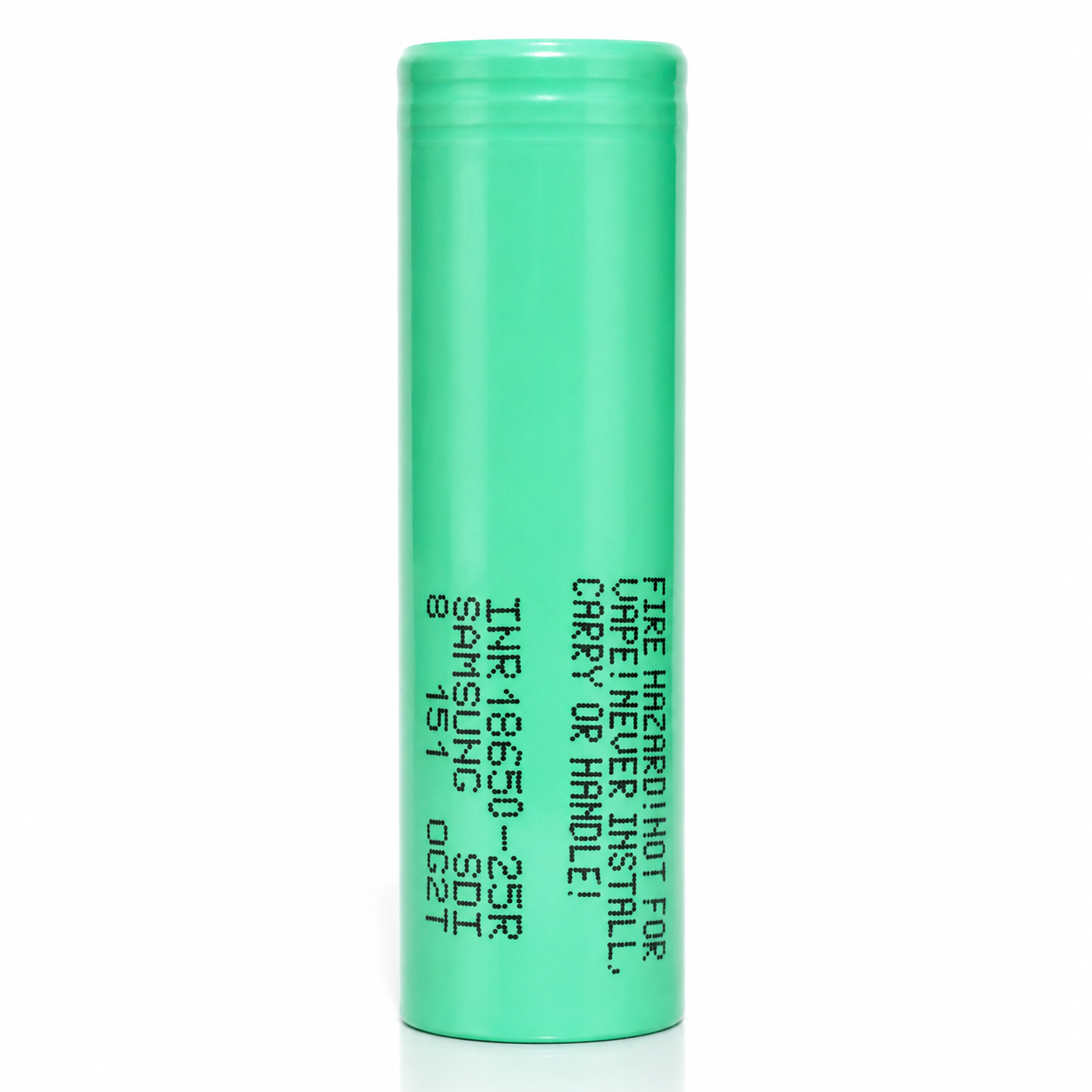
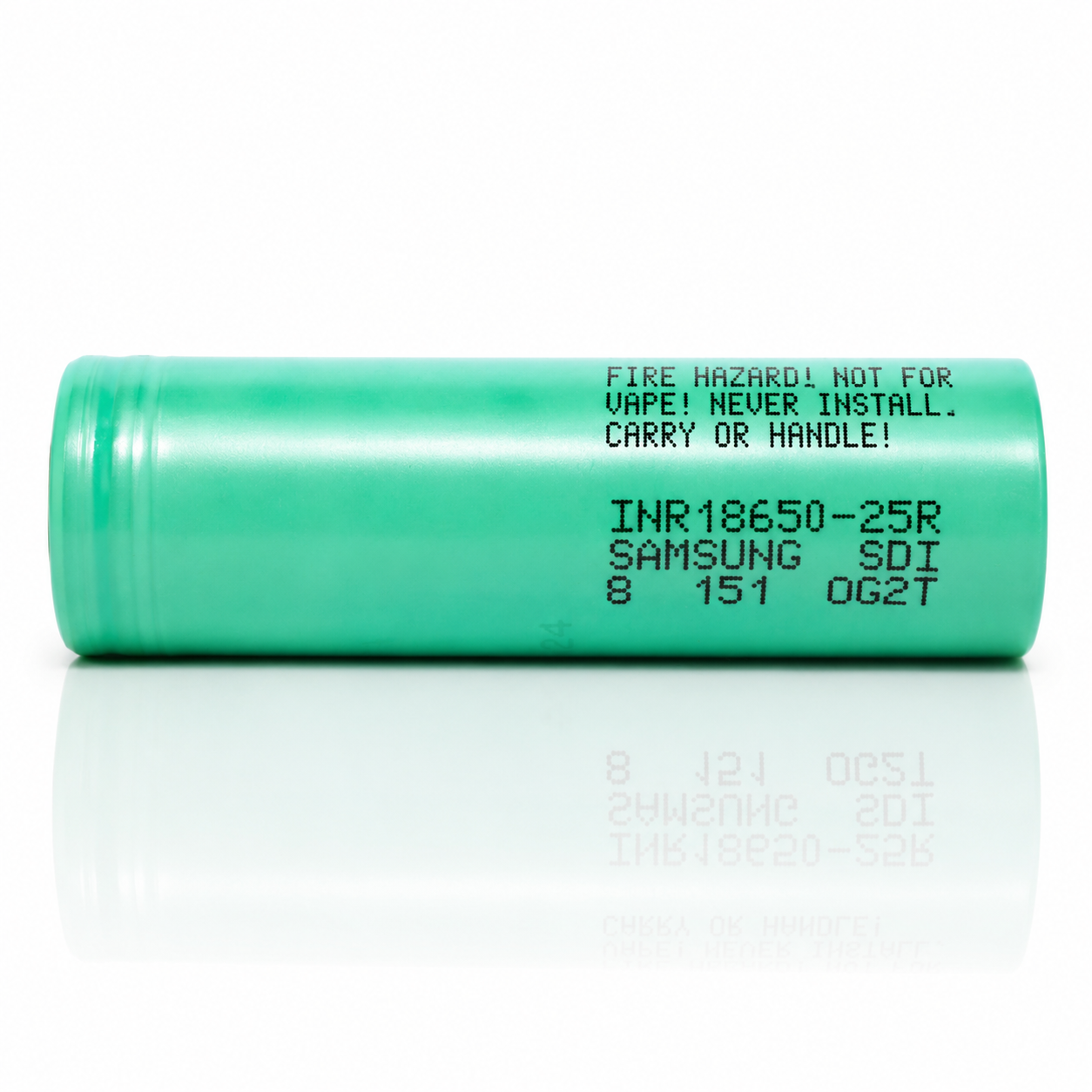
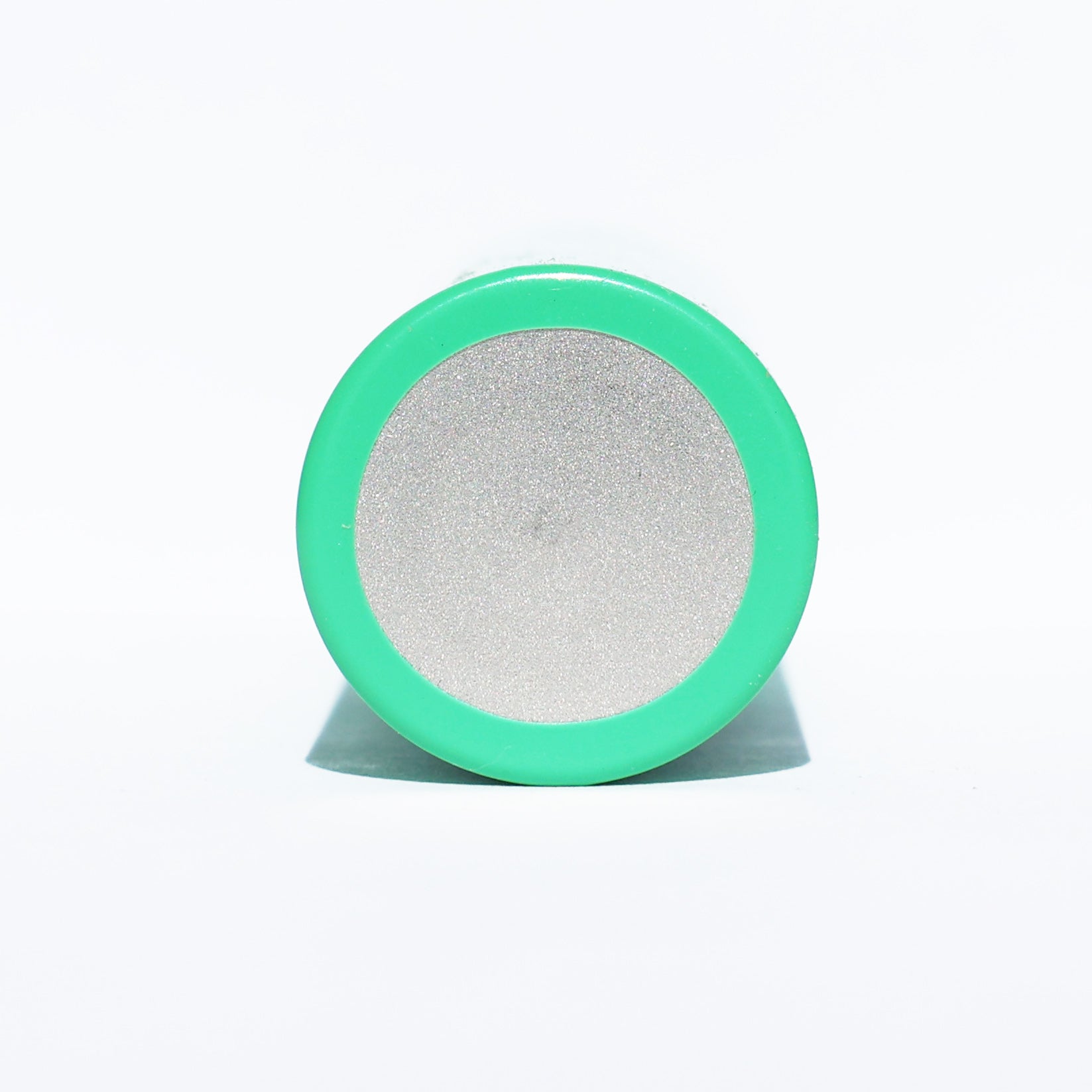


Samsung 25R 18650
2500mAh / 20A
High-drain 2.5Ah 18650 lithium-ion power cell designed for applications that need proven Samsung SDI quality, a strong 20A continuous-discharge rating, compact 18650 compatibility, and a rugged performance profile for tools, lighting, RC systems, robotics, and custom packs.
Samsung 25R 18650 2500mAh 20A Battery
The Samsung INR18650-25R is one of the classic high-drain 18650 cells: moderate capacity, strong discharge current, predictable pack behavior, and broad compatibility with 18650-oriented systems. It is best used where current delivery matters more than maximum runtime per cell.
For engineering calculations, use 2500mAh standard discharge capacity, 2450mAh rated discharge capacity at 10A, 3.6V nominal voltage, and 20A maximum continuous discharge.
| Brand / Model | Samsung SDI INR18650-25R |
|---|---|
| Cell Type | 18650 cylindrical lithium-ion rechargeable cell |
| Standard Discharge Capacity | Minimum 2500mAh at 0.2C / 500mA discharge to 2.5V |
| Rated Discharge Capacity | Minimum 2450mAh at 10A discharge to 2.5V after rated charge |
| Nominal Voltage | Samsung specification: 3.6V; live retail listing: 3.7V |
| Charge Cut-Off Voltage | 4.20V |
| Discharge Cut-Off Voltage | 2.50V |
| Standard Charge Method | 1.25A CC-CV to 4.20V, terminate at 125mA |
| Rated Charge Method | 4A CC-CV to 4.20V, terminate at 100mA |
| Charging Time | Standard charge approx. 180 minutes; rated charge approx. 62 minutes |
| Max Continuous Discharge | 20A at room temperature Primary product rating |
| Pulse Discharge Reference | 100A momentary pulse, less than 1 second, in Samsung characterization material |
| Initial Impedance | ≤18mΩ AC at 1kHz; ≤30mΩ DC reference in Samsung characterization material |
| Dimensions | Height max 65.00mm; diameter max 18.40mm in product specification |
| Weight | 45.0g max; characterization material shows ~43.8g typical |
| Operating Temperature | Charge 0°C to 45°C; discharge -20°C to 60°C ambient |
| Storage Temperature | 1 year: 0–23°C; 3 months: 0–45°C; 1 month: 0–60°C at ex-factory status |
| Shipment Voltage | 3.43V to 3.58V charging-voltage range |
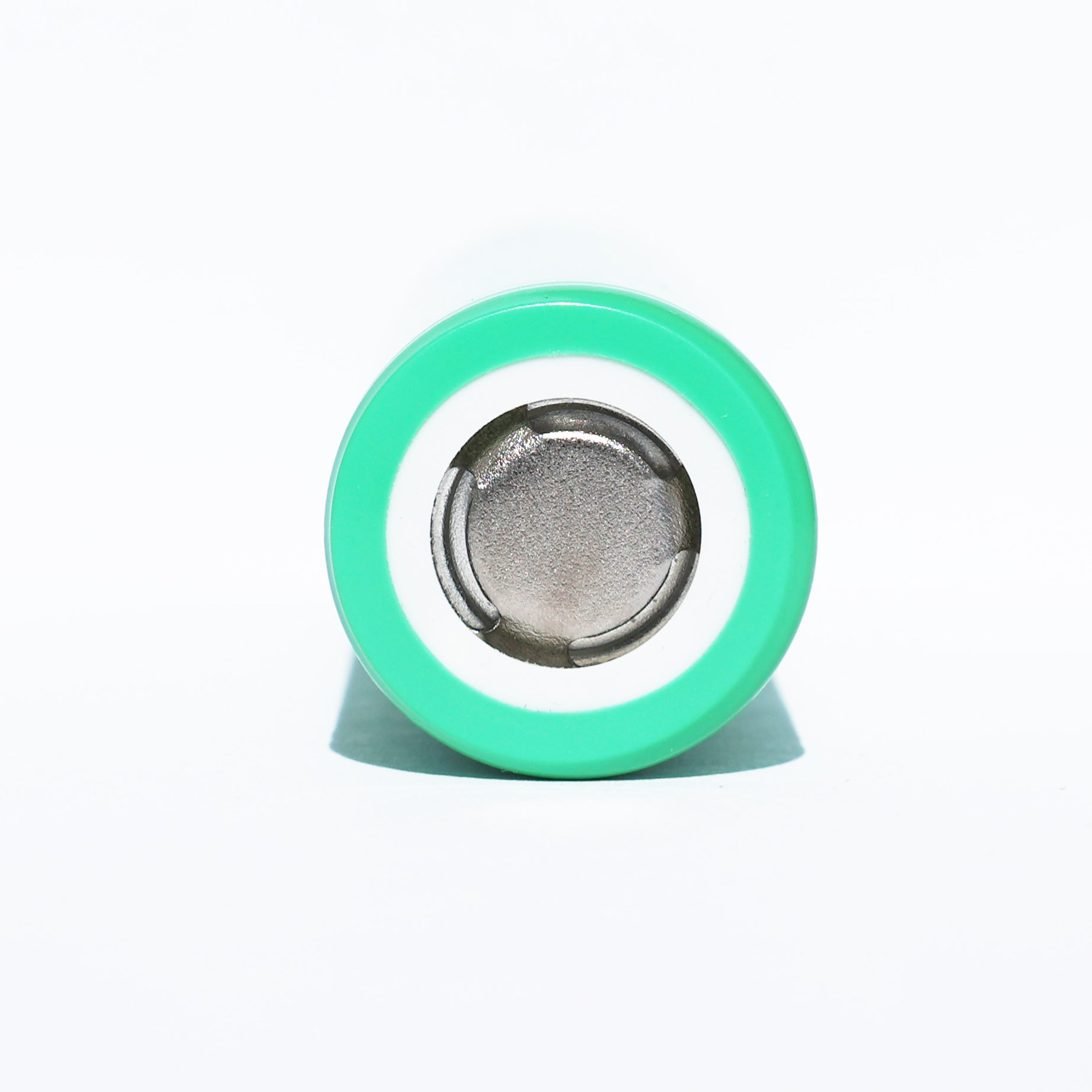
| Protection | No — unprotected bare cell |
Electrical operating envelope at a glance.
These quick-reference visuals summarize how the 25R behaves in relation to current, voltage window, capacity-to-energy translation, and C-rate interpretation.
1. Current Capability Stack
Key current reference points for standard charge, rated charge, rated capacity testing, continuous discharge, and momentary pulse characterization.
2. Voltage Operating Window
Basic per-cell voltage limits used for charger, BMS, and pack configuration.
3. Capacity and Energy Translation
Approximate nominal energy using Samsung’s 3.6V nominal-voltage specification.
4. C-Rate Conversion
For a 2500mAh cell, 1C equals approximately 2.5A.
| 0.5C | 1.25A standard charge |
|---|---|
| 1C | 2.5A normalized current reference |
| 4A | ≈1.6C rated charge |
| 10A | ≈4C rated discharge-capacity test |
| 20A | ≈8C maximum continuous discharge rating |
| 100A | ≈40C momentary pulse characterization, <1 second |
Discharge-rate capability is the 25R’s primary strength.
Samsung’s product specification indexes discharge-rate capability against the 10A rated-discharge result: 5A is listed at 97%, 10A at 100%, and 20A at 95%. Samsung’s characterization material also shows discharge data through 25A, but cell temperature rises sharply at the highest currents, so 20A remains the correct continuous product rating.
The simplified discharge graph below visualizes voltage versus capacity under 5A, 10A, 20A, and 25A loading so shoppers can understand the trade-off between current, voltage sag, delivered energy, and heat.
Rate and energy summary
| 1C / 2.5A | 9.02Wh, 3.61V average in Samsung characterization |
|---|---|
| 5A | 8.95Wh, 3.54V average |
| 10A | 8.79Wh, 3.44V average |
| 15A | 8.55Wh, 3.35V average |
| 20A | 8.25Wh, 3.27V average |
| 25A | 7.84Wh, 3.18V average, high temperature rise in characterization |
5. Simplified Discharge-Curve Graph
Voltage vs. capacity illustration under 5A, 10A, 20A, and 25A discharge. Simplified for product-page visualization.
6. Estimated IR Voltage Drop
Using the specification limit of ≤18mΩ AC impedance as a fast order-of-magnitude planning reference.
Thermal conditions affect current capability, cycle life, and voltage behavior.
The Samsung 25R is often used near its current ceiling, so temperature rise should be treated as a primary design constraint. Characterization data shows a sharp increase in surface temperature as discharge current rises from 10A to 20A and beyond.
7. Charge Profile Reference
Standard charge: 1.25A CC-CV to 4.2V, terminate at 125mA. Rated charge: 4A CC-CV to 4.2V, terminate at 100mA.
8. Thermal Operating Envelope
Published operating temperature ranges from the Samsung product specification.
9. Rate Capability and Heat Rise
Samsung characterization data: capacity stays strong, but temperature rises rapidly with current.
10. Energy and Average Voltage vs Current
Higher current lowers average voltage and delivered watt-hours.
| 1C | 9.02Wh, 3.61V average |
|---|---|
| 5A | 8.95Wh, 3.54V average |
| 10A | 8.79Wh, 3.44V average |
| 15A | 8.55Wh, 3.35V average |
| 20A | 8.25Wh, 3.27V average |
| 25A | 7.84Wh, 3.18V average |
11. Cycle-Life Visualization
Product specification criterion: ≥1500mAh after 250 cycles using rated charge and 20A discharge.
12. Storage Recovery Reference
Samsung product specification: capacity recovery after 30 days at 60°C should be ≥1960mAh.
| Condition | Rated charge, storage for 30 days at 60°C |
|---|---|
| Measurement | 10A discharge to 2.5V at room temperature |
| Minimum Recovery | ≥1960mAh, equal to 80% of rated capacity |
| Storage Guidance | For long storage, keep cells dry and cool, and avoid full-charge or high-temperature storage where possible. |
18650 dimensional envelope for holders, packs, and chargers.
The Samsung product specification gives a maximum 65.00mm height and 18.40mm diameter; characterization material lists 18.33 ± 0.07mm diameter and 64.85 ± 0.15mm height.
13. Cell Dimension Diagram
Mechanical envelope for 18650 holders, pack CAD, wrappers, and spot-weld layouts.
14. Pack Scaling Formulas
Quick math for series/parallel planning.
Pack Voltage ≈ Series Count × 3.6V
Pack Capacity ≈ Parallel Count × 2.5Ah
Pack Energy ≈ S × P × 9.0Wh
Pack Current Capability ≈ Parallel Count × 20A
15. Example Parallel Scaling
Approximate scaling, assuming balanced cells and proper thermal/electrical design.
| 1P | 2.5Ah, 9.0Wh, 20A |
|---|---|
| 2P | 5.0Ah, 18.0Wh, 40A |
| 3P | 7.5Ah, 27.0Wh, 60A |
| 4P | 10.0Ah, 36.0Wh, 80A |
| 5P | 12.5Ah, 45.0Wh, 100A |
16. Common Series Voltage Examples
Nominal voltage examples only. Full-charge and cut-off pack voltages scale separately.
| 1S | 3.6V nominal / 4.2V full / 2.5V cut-off |
|---|---|
| 3S | 10.8V nominal / 12.6V full / 7.5V cut-off |
| 4S | 14.4V nominal / 16.8V full / 10.0V cut-off |
| 10S | 36.0V nominal / 42.0V full / 25.0V cut-off |
| 13S | 46.8V nominal / 54.6V full / 32.5V cut-off |
Best suited for high-drain 18650 systems with proven pack controls.
Power Tools
- Classic use case for the 25R power-cell profile.
- Works well in packs that need discharge capability more than maximum energy per cell.
RC / Robotics
- Appropriate for motor-driven systems with controlled high-current duty cycles.
- Pack temperature and voltage sag should be validated under real load.
High-Output Lighting
- Reliable fit for 18650 lights designed for unprotected flat-top cells.
- Good voltage support under high LED-driver current.
Custom Battery Packs
- Useful for designers optimizing around current-per-cell and common 18650 size.
- Requires matched cells, welding, BMS, and thermal controls.
Portable Equipment
- Balanced option for devices that need more current than energy-focused cells provide.
- Use only in protected, compatible systems.
Runtime-Focused Packs
- Not the maximum-capacity choice.
- Consider 3000mAh–3500mAh energy cells when current demand is lower.
Safety, Handling & Compatibility Notice
This product is an unprotected lithium-ion cell. It should only be used by customers who understand cell-level lithium-ion safety and who are using the battery in compatible hardware, managed packs, or professionally designed assemblies. Improper use can lead to overheating, venting, fire, or explosion.
- Charge only with lithium-ion chargers or managed battery systems designed for the correct chemistry and cell count.
- Never short circuit, crush, puncture, incinerate, or expose the cell to water.
- Do not use cells with damaged wraps, dented cans, or missing top insulator rings.
- Do not mix with cells of different age, capacity, or state of charge in the same pack.
- Use spot welding for pack assembly; do not solder directly to the cell body.
- Store and transport in non-conductive cases; never carry loose cells in pockets or bags.
- Not for e-cigarette, vape, or similar use.
Common technical questions about the Samsung 25R.
What is the capacity of the Samsung 25R?
The Samsung product specification lists 2500mAh minimum standard discharge capacity and 2450mAh minimum rated discharge capacity at 10A.
What is the discharge rating?
The maximum continuous discharge rating is 20A at room temperature. Samsung characterization material also includes higher-current test points, but those are not the primary continuous product rating.
Is this a protected battery?
No. This is an unprotected bare 18650 cell and should only be used in compatible equipment or battery packs with proper voltage, current, short-circuit, and temperature protection.
What charger should be used?
Use a lithium-ion charger or BMS using a CC-CV profile to 4.20V per cell. Standard charge is 1.25A; rated charge is 4A.
What is the discharge cut-off voltage?
The Samsung product specification uses 2.50V as the end-of-discharge voltage. Some systems may use a higher cut-off to reduce stress and improve service life.
Can the Samsung 25R be used in battery packs?
Yes. It is widely used in custom 18650 packs where current capability matters, but packs must use matched cells, proper welding, insulation, fusing, BMS protection, and thermal validation.
What are the cell dimensions?
Samsung’s product specification lists a maximum height of 65.00mm and maximum diameter of 18.40mm.
What temperature range is allowed?
The product specification lists charge operation from 0°C to 45°C and discharge operation from -20°C to 60°C ambient. Samsung also notes that discharge over-temperature protection should not exceed 70°C at the cell surface.
How many cycles should I expect?
The product specification states capacity should remain at least 1500mAh after 250 cycles using rated charge and 20A discharge under the stated room-temperature conditions. Real service life depends heavily on load, temperature, depth of discharge, and charge limits.
Can I carry this battery loose?
No. Loose transport is unsafe because metal objects can short the terminals. Always use a non-conductive battery case.