
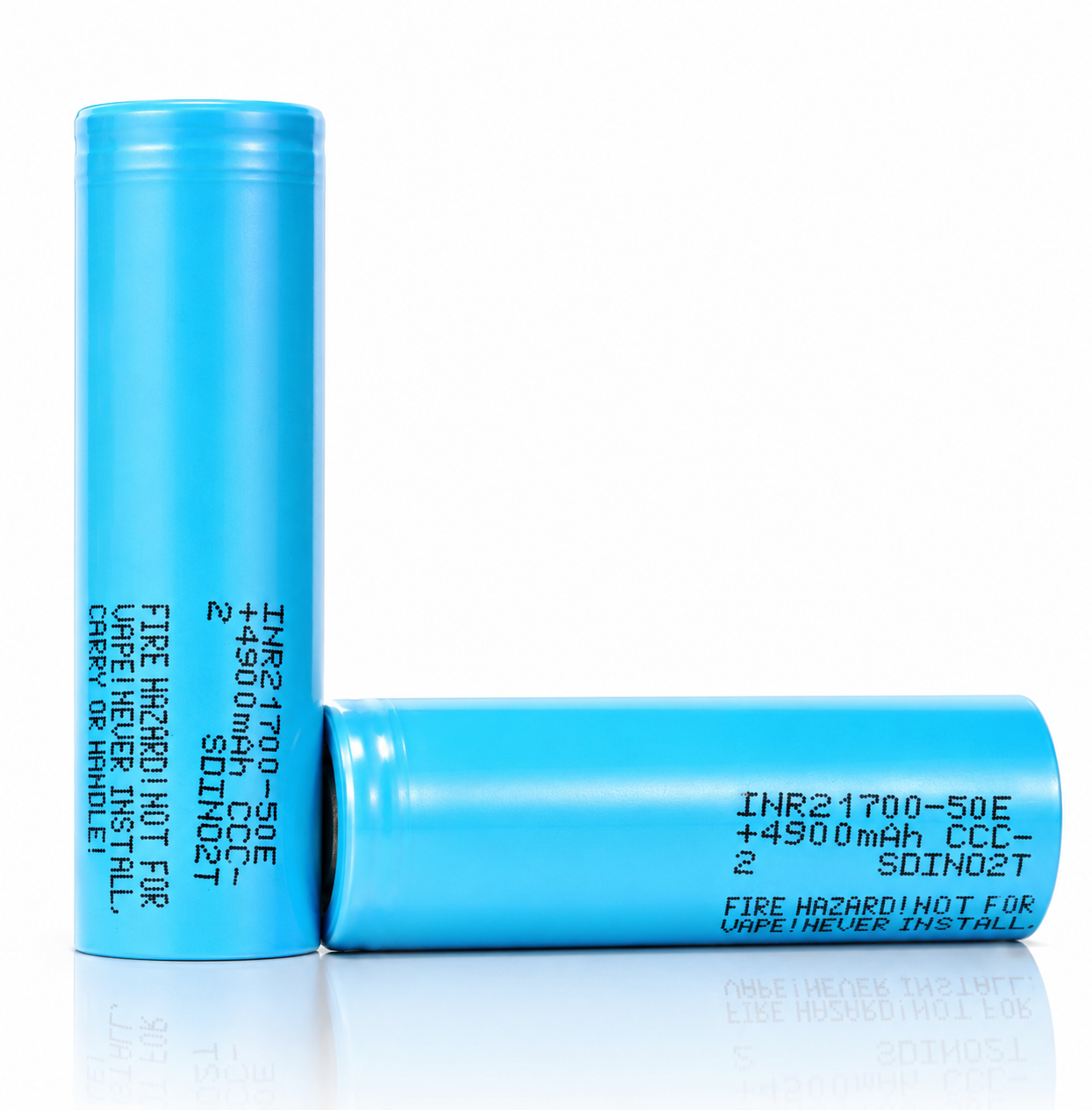
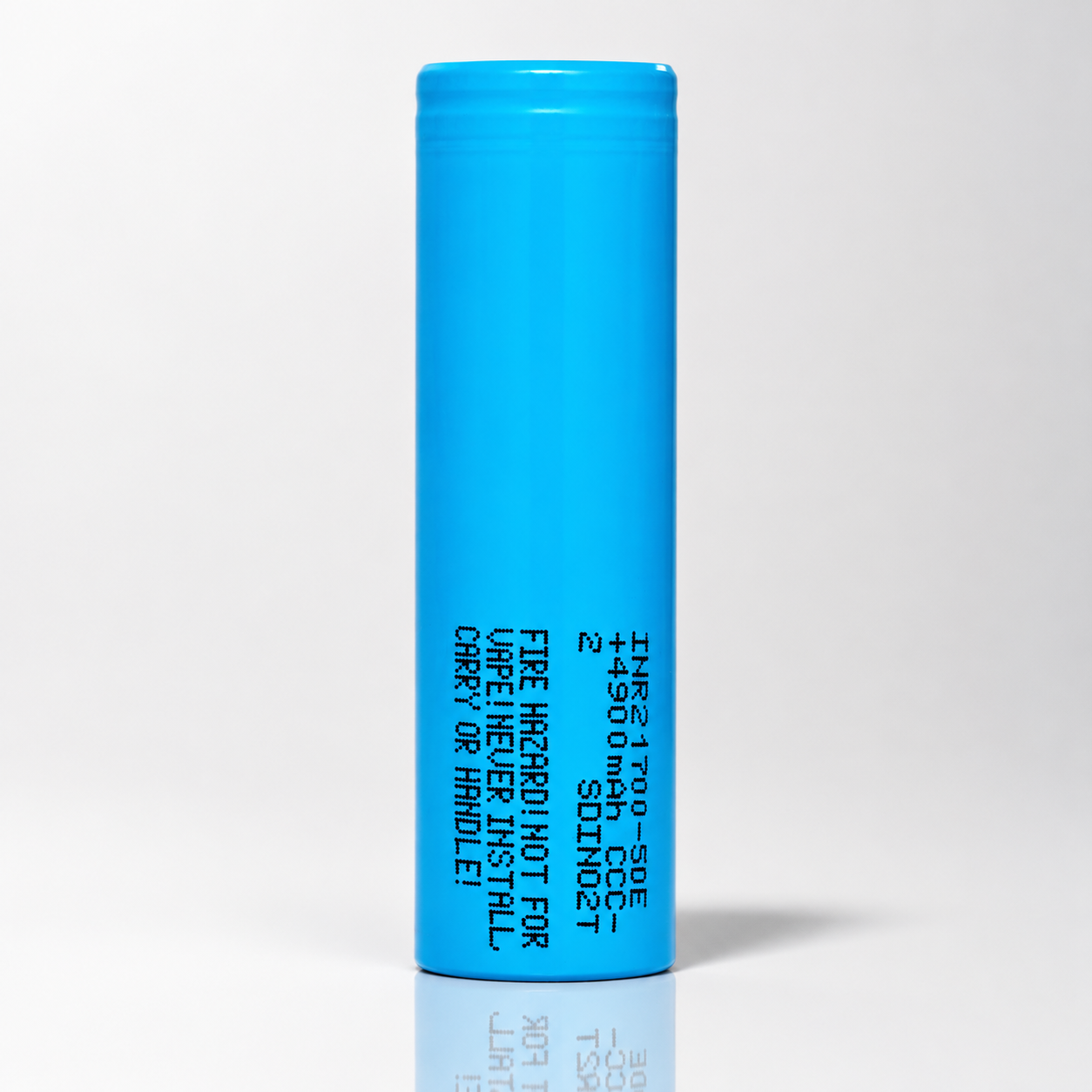
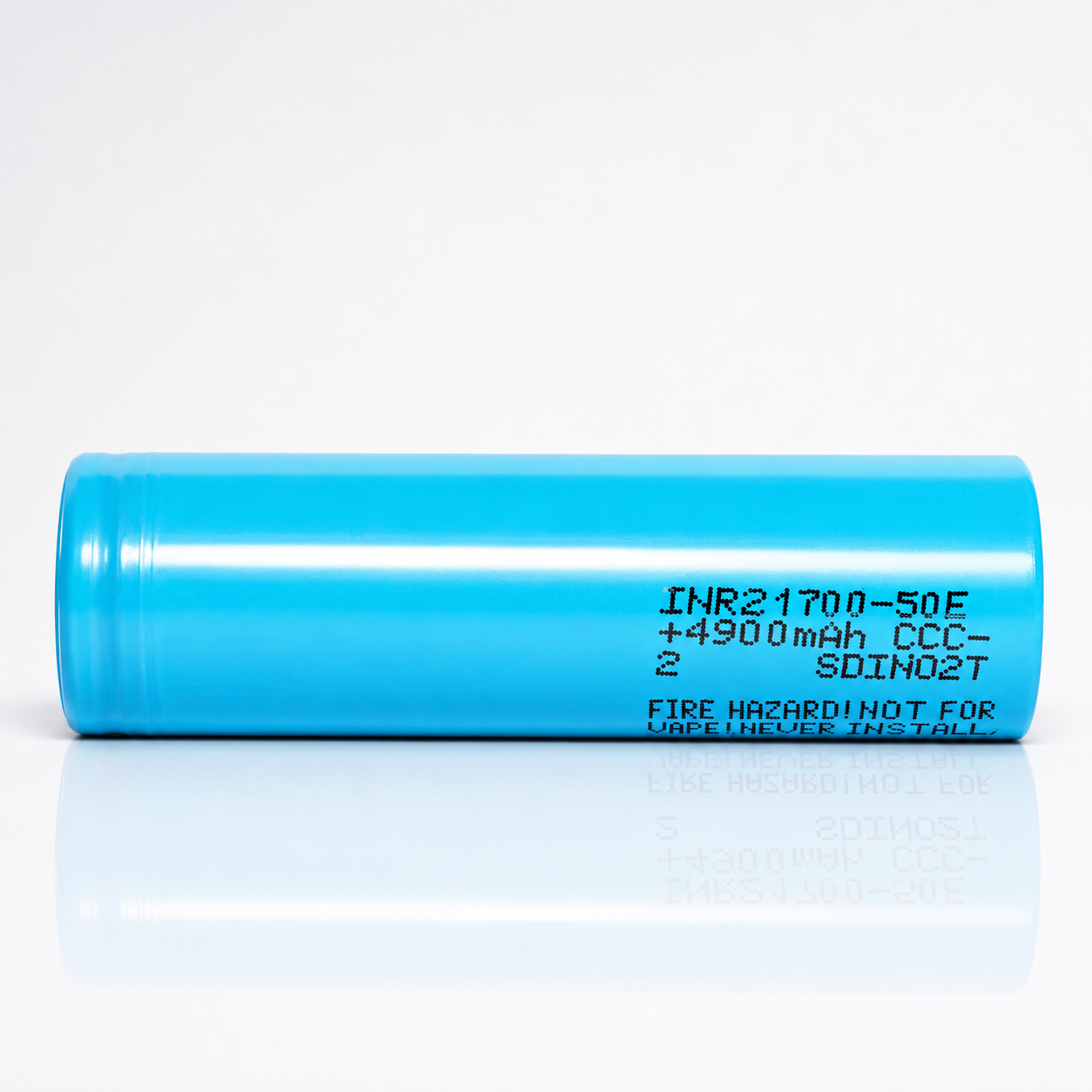
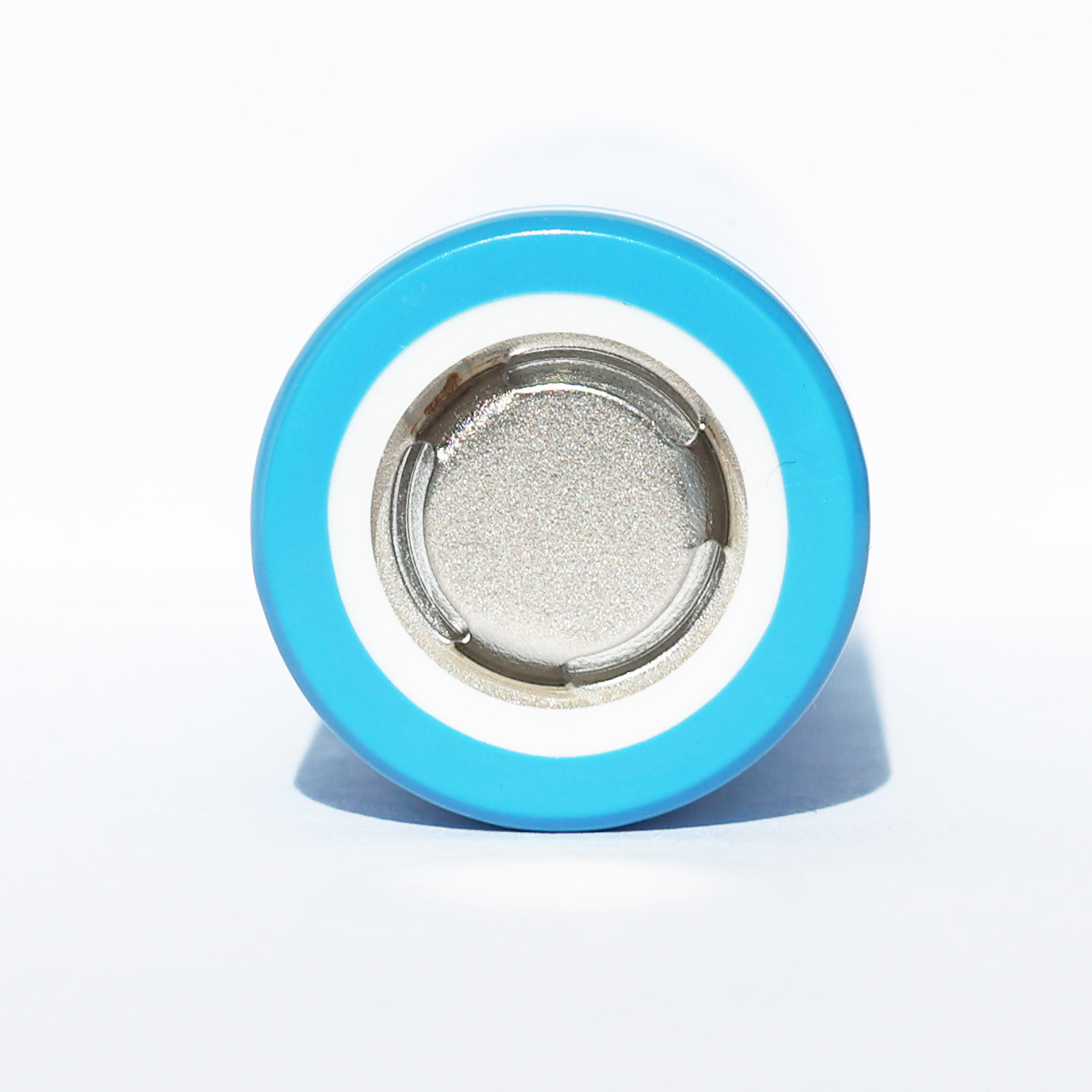
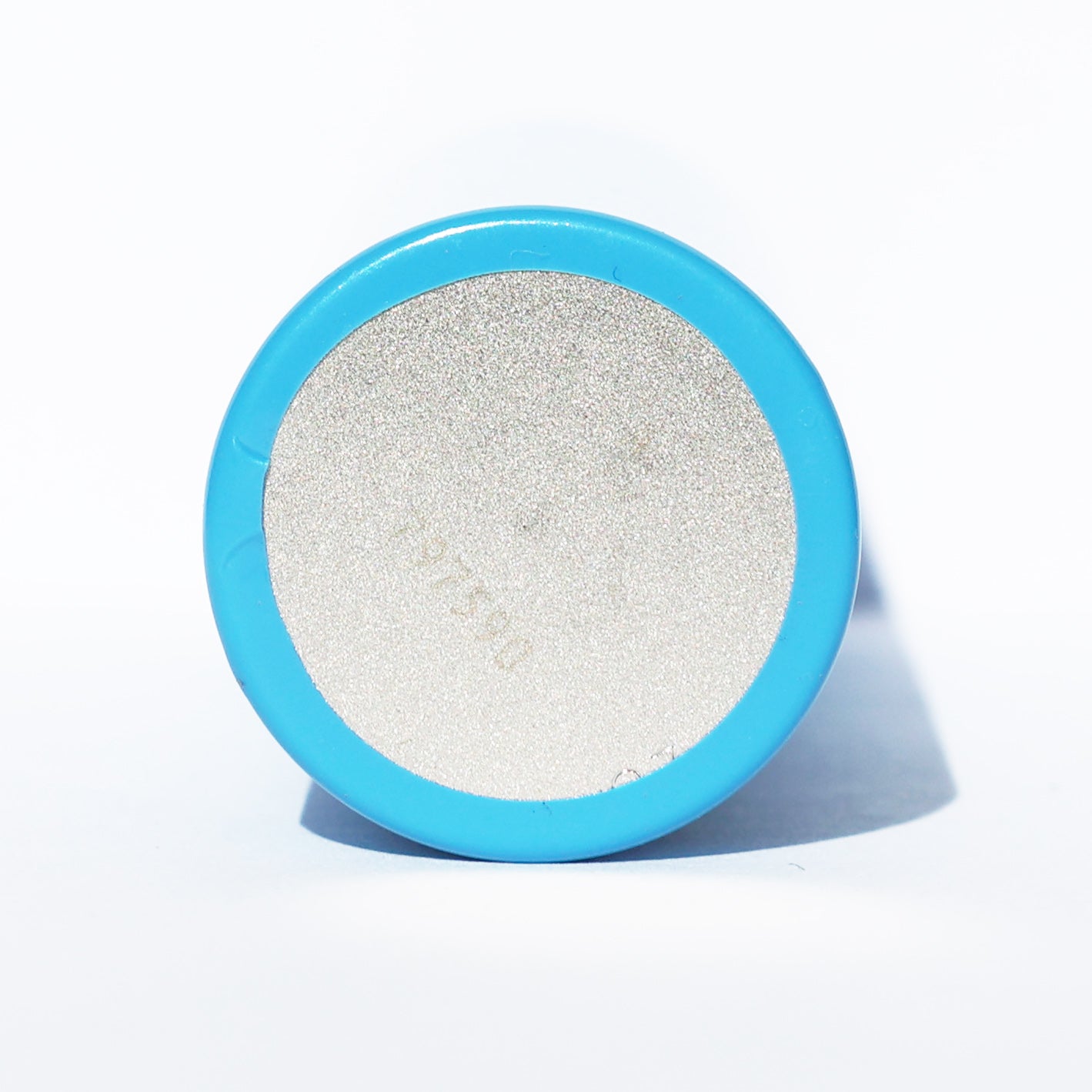


Samsung 50E 21700
5000mAh Class / 9.8A CDR
A professional-grade lithium-ion rechargeable cell optimized for long runtime, high energy per cell, stable moderate-current output, and engineered multi-cell battery packs. The Samsung INR21700-50E is best used where capacity and efficiency are prioritized over extreme high-drain performance.
Samsung INR21700-50E: high-energy 21700 cell for runtime-focused pack design.
The Samsung 50E is designed for applications that need more energy per cell than typical 18650 formats while operating within a moderate 9.8A continuous discharge limit. It is a strong choice for energy-storage modules, power banks, portable equipment, and e-bike or mobility packs that use enough parallel cells to keep per-cell current inside specification.
| Core Parameter | Technical Value |
|---|---|
| Manufacturer / Model | Samsung SDI INR21700-50E |
| Cell Format | 21700 cylindrical lithium-ion rechargeable cell |
| Retail Capacity Class | 5000mAh class |
| Samsung Minimum Capacity | 4900mAh at 0.2C discharge to 2.5V after standard charge |
| Rated Discharge Capacity | 4753mAh minimum at 1C / 4.9A discharge to 2.5V |
| Nominal Voltage | 3.6V nominal; 4.20V full-charge voltage |
| Continuous Discharge | 9.8A maximum continuous discharge per cell |
| Charge Method | CC-CV, 4.20V, 98mA termination under standard charge |
| Dimensions | Max. 21.25mm diameter × max. 70.80mm height with sleeve |
| Protection Circuit | None. Requires compatible device-level or pack-level protection. |
Voltage, charge control, and current limits for 21700 pack engineering.
Use the following values as the product-page engineering reference. Final pack design should be validated against the latest manufacturer data sheet, protection electronics, enclosure airflow, cell matching, and application duty cycle.
Cell Voltage Window
Single-cell voltage endpoints for charge and discharge control.
CC-CV Charge Profile
Standard charge and maximum charge settings from Samsung's cell specification.
How the 50E's C-rate values convert into real design limits.
Samsung defines 1C as 4.9A for the 50E. The cell's continuous discharge limit is 2C / 9.8A. The 3C / 14.7A value is explicitly not for continuous discharge and should not be used as the continuous pack-design rating.
C-Rate to Current Map
Reference currents derived from Samsung's 1C = 4.9A definition.
Approximate Constant-Current Runtime
Idealized runtime using 4.9Ah nominal capacity. Actual runtime changes with voltage sag, temperature, cut-off, and pack design.
Per-Cell Power at Nominal Voltage
Approximate electrical output using 3.6V nominal voltage.
Current Design Guidance
Keep the average and continuous current at or below the rated envelope after thermal derating.
Capacity retention metrics for long-runtime systems.
Capacity Reference Levels
Samsung specification values compared with the retail 5000mAh class label.
Energy Estimate
Approximate watt-hours using 3.6V nominal voltage.
Cycle-Life Criterion
Samsung criterion: capacity ≥3.802Ah after 500 cycles under listed charge/discharge conditions.
High-Temperature Storage Recovery
Recovery criterion after 30 days at 60°C, then discharge at 1C to 2.5V.
21700 physical dimensions and fitment considerations.
Cell Dimension Diagram
Manufacturer dimensional envelope with sleeve.
21700 vs. 18650 Size Context
Illustrative geometry comparison: 50E requires 21700-compatible hardware.
Thermal limits for charging, discharging, storage, and protection design.
Operating Temperature Envelope
Cell surface-temperature ranges from Samsung specification.
Storage Duration Envelope
Samsung storage guidance at ex-factory state of charge.
For long-term storage, keep cells dry, cool, isolated from conductive objects, and away from direct sunlight or heat sources.
Use series cells for voltage and parallel cells for capacity/current sharing.
The 50E is often most effective in packs where parallel groups reduce stress on each cell. The calculations below use 4.9Ah minimum capacity, 3.6V nominal voltage, and 9.8A continuous discharge per cell.
Vnom = S × 3.6VNominal pack voltage from series count.
Vmax = S × 4.20VFull-charge pack voltage from series count.
Ah = P × 4.9AhMinimum capacity from parallel count.
Acont = P × 9.8AContinuous current before pack-level derating.
Example Pack Outputs
Illustrative calculations only. Final BMS, busbar, nickel, fuse, enclosure, and thermal design must be validated.
| Configuration | Nominal Voltage | Full Charge | Minimum Capacity | Approx. Energy | Cell-Level CDR |
|---|---|---|---|---|---|
| 4S1P | 14.4V | 16.8V | 4.9Ah | 70.6Wh | 9.8A |
| 10S2P | 36.0V | 42.0V | 9.8Ah | 352.8Wh | 19.6A |
| 13S4P | 46.8V | 54.6V | 19.6Ah | 917.3Wh | 39.2A |
| 14S5P | 50.4V | 58.8V | 24.5Ah | 1234.8Wh | 49.0A |
Best for high-capacity, moderate-current, runtime-priority systems.
Custom battery packs
Good fit for multi-cell packs where parallel groups keep current per cell under 9.8A.
E-bike & mobility packs
Appropriate for energy-oriented packs with a properly sized BMS, fusing, and thermal design.
Power banks & backup
High energy per cell makes the 50E attractive for UPS-style and portable storage modules.
Solar / storage modules
Useful in protected storage arrays where cell balancing and thermal spacing are engineered.
Medical / industrial devices
Stable energy delivery for controlled-load equipment with compliant pack electronics.
Long-runtime flashlights
Use only in 21700-compatible lights whose driver current is within the cell envelope.
Portable electronics
Strong runtime for low-to-moderate drain devices that accept unprotected 21700 cells.
Engineering prototypes
Well suited for test fixtures when current, voltage, temperature, and charging are controlled.
Samsung 50E specification table.
| Specification | Samsung 50E Technical Detail |
|---|---|
| Model | INR21700-50E |
| Cell Type | Rechargeable lithium-ion cylindrical cell |
| Size | 21700 |
| Retail Listing Capacity | 5000mAh class |
| Minimum Standard Discharge Capacity | ≥4900mAh at 0.2C / 980mA to 2.5V after standard charge |
| Rated Discharge Capacity | ≥4753mAh at 1C / 4900mA to 2.5V after standard charge |
| Nominal Voltage | 3.6V |
| Full Charge Voltage | 4.20V |
| Charge Method | CC-CV, constant voltage with limited current |
| Standard Charge Current | 2450mA / 0.5C |
| Standard Charge Time | Approximately 3 hours under specified condition |
| Maximum Charge Current | 4900mA / 1C; not for cycle-life condition |
| Charge Termination | 98mA / 0.02C cut-off under standard charge condition |
| Maximum Continuous Discharge | 9800mA / 9.8A continuous |
| Non-Continuous Discharge Reference | 14,700mA / 14.7A; not for continuous discharge |
| Discharge Cut-off Voltage | 2.5V end-of-discharge voltage |
| Cycle Life Reference | Capacity ≥3802mAh after 500 cycles under listed 0.5C charge and 1C discharge condition |
| Recovery Characteristics | Capacity recovery ≥4278mAh after 30 days at 60°C, then 1C discharge to 2.5V |
| Weight | 69g maximum |
| Dimensions | Max. 21.25mm diameter × max. 70.80mm height with sleeve |
| Charge Temperature Range | 0°C to 45°C cell surface temperature |
| Discharge Temperature Range | -20°C to 60°C cell surface temperature |
| Storage Temperature Guidance | 1 year: -20~23°C; 3 months: -20~45°C; 1 month: -20~60°C at ex-factory state |
| Protection | Unprotected cell; use suitable device or pack protection |
| Assembly Method | Do not solder directly to the cell; use properly designed spot-welded interconnects |
Lithium-ion handling requirements.
Required Practices
- Use only with a charger designed for 4.20V lithium-ion cells.
- Keep current, voltage, and temperature within manufacturer limits.
- Use an appropriate BMS or protection circuit in battery packs.
- Store and transport cells in protective cases, never loose with metal objects.
- Inspect wrappers, insulators, and terminal rings before every installation.
- Use proper spot welding for pack assembly; avoid heat damage to terminals.
Do Not
- Do not short-circuit, overcharge, over-discharge, crush, puncture, or incinerate.
- Do not use a cell with damaged wrap, denting, leakage, rust, or abnormal heat.
- Do not mix old and new cells, different models, different batches, or mismatched states of charge.
- Do not solder directly to the cell body or terminals.
- Do not leave cells charging unattended or on combustible surfaces.
- Do not use in e-cigarettes, vaporizers, or similar devices.
- Do not use in any device that exceeds the cell's current, thermal, or voltage envelope.
Samsung 50E FAQ
Is the Samsung 50E a 5000mAh or 4900mAh cell?
It is sold as a 5000mAh-class cell. Samsung's specification lists 4900mAh minimum standard discharge capacity at 0.2C and 4753mAh minimum rated discharge capacity at 1C.
What is the continuous discharge rating?
The precise Samsung value is 9.8A continuous per cell. Product listings may round this to 10A, but 9.8A is the better engineering value for pack calculations.
What does the 14.7A rating mean?
Samsung lists 14.7A as not for continuous discharge. It should not be used as the continuous rating for devices or battery packs.
Is the Samsung 50E protected?
No. This is an unprotected industrial cell. It does not include built-in over-charge, over-discharge, over-current, short-circuit, or thermal protection.
What charger should I use?
Use a quality lithium-ion charger that supports CC-CV charging to 4.20V. Standard charge current is 2.45A; the maximum charge current is 4.9A under specified conditions.
What is the discharge cut-off voltage?
The specified end-of-discharge voltage is 2.5V per cell. A BMS or compatible device should prevent the cell from being over-discharged below this point.
How much energy does one cell store?
Using Samsung's 4.9Ah minimum capacity and 3.6V nominal voltage, one cell stores approximately 17.6Wh. The 5000mAh class value corresponds to approximately 18Wh nominal.
What devices are best for the 50E?
The 50E is best for long-runtime, moderate-current systems such as power banks, backup modules, energy-storage packs, portable industrial equipment, and multi-cell mobility packs.
Is it good for high-drain applications?
Not as a single-cell high-drain option. Choose the 50E when runtime and capacity matter most. For very high current, use more cells in parallel or select a cell designed for higher continuous discharge.
Will it fit in an 18650 device?
No, not unless the device specifically supports 21700 cells. The 50E is physically larger than an 18650, with a manufacturer maximum of 21.25mm diameter and 70.80mm height.
Can I use this cell in an e-bike or scooter pack?
Yes, when the pack is professionally designed with adequate parallel count, a correctly rated BMS, cell balancing, fusing, thermal design, and mechanical protection. Do not treat a loose cell as a complete protected battery pack.
Can this be used in e-cigarettes or vaporizers?
No. The product safety guidance prohibits use in e-cigarettes, vaporizers, or similar devices. Use only in compatible equipment that stays within the cell specification.
Can I solder directly to the cell?
No. Direct soldering can overheat the cell and damage safety-critical internal structures. Pack assembly should use properly designed spot-welded nickel or nickel-plated interconnects.
Can I mix Samsung 50E cells with other cells?
No. Do not mix models, ages, capacities, internal resistance values, batches, or states of charge in a battery pack. Use matched cells and maintain balanced groups.
What temperature range can it operate in?
Samsung specifies 0°C to 45°C for charging and -20°C to 60°C for discharging, based on cell surface temperature. Finished packs should include thermal protection.
How should the cells be stored?
Store cells in a cool, dry place in protective packaging or cases. For longer storage, cooler temperatures are preferred and cells should be isolated from conductive objects.
Is this safe to carry loose?
No. Never carry loose lithium-ion cells in a pocket, bag, or toolbox. Use an insulating battery case so terminals cannot contact keys, coins, tools, or other metal objects.