
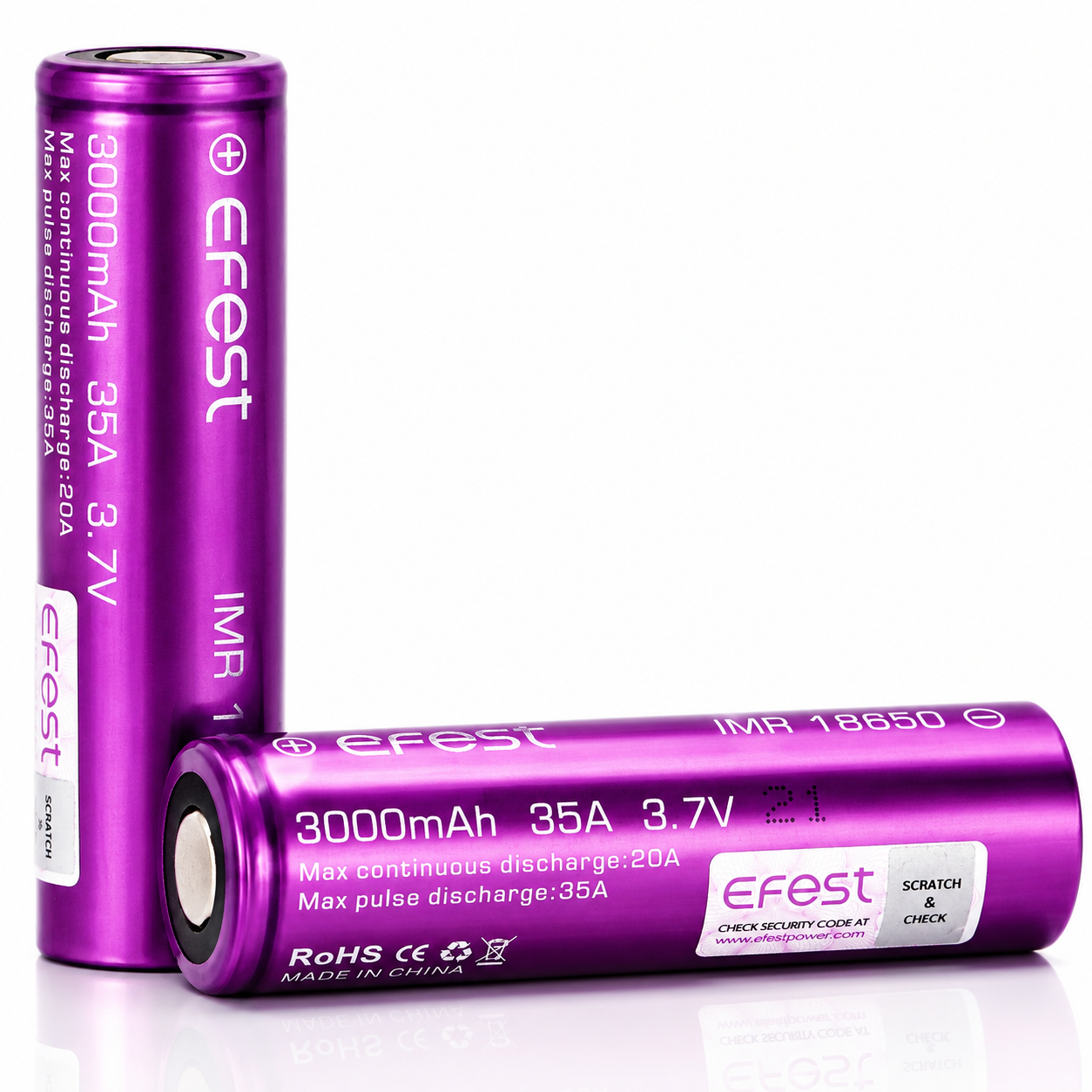
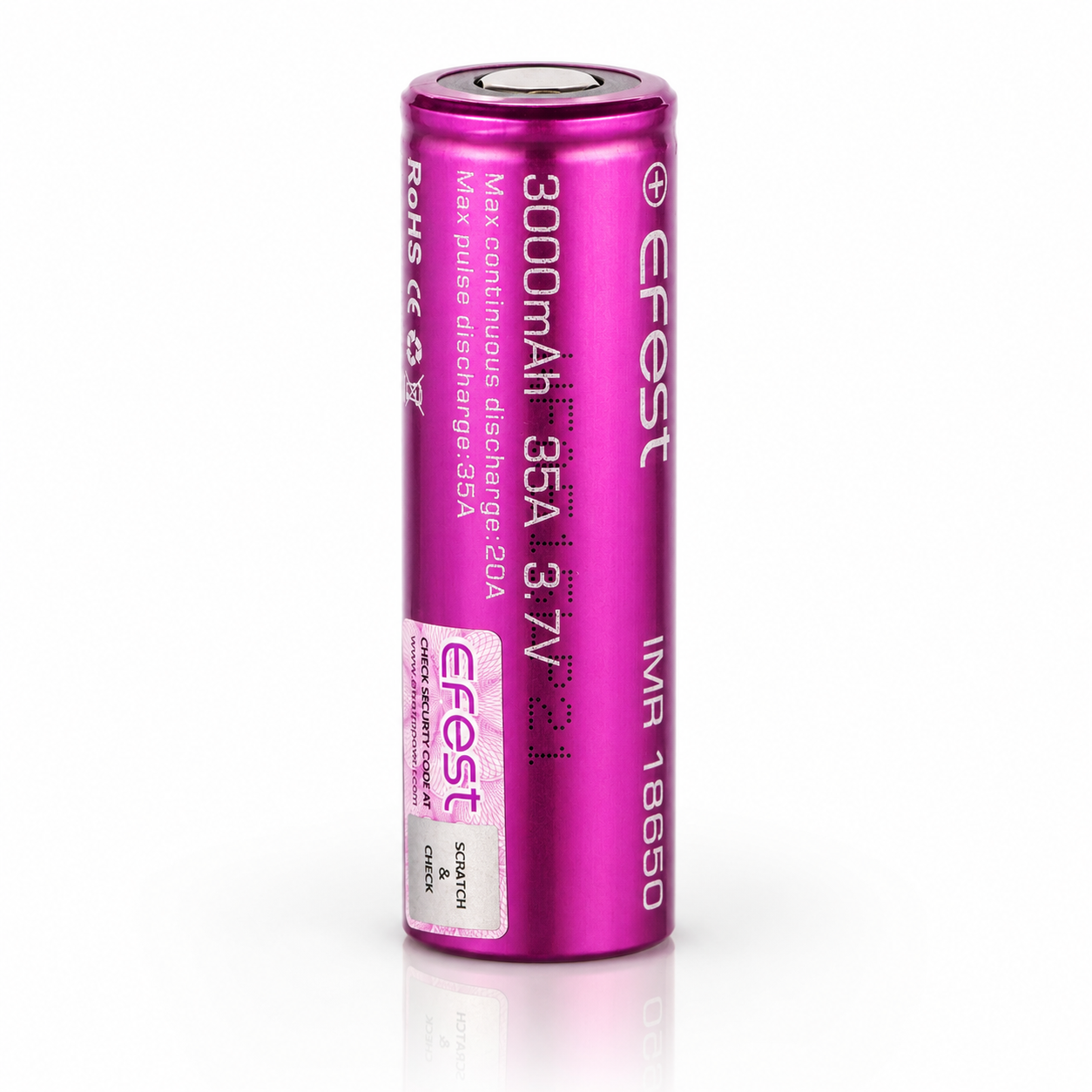
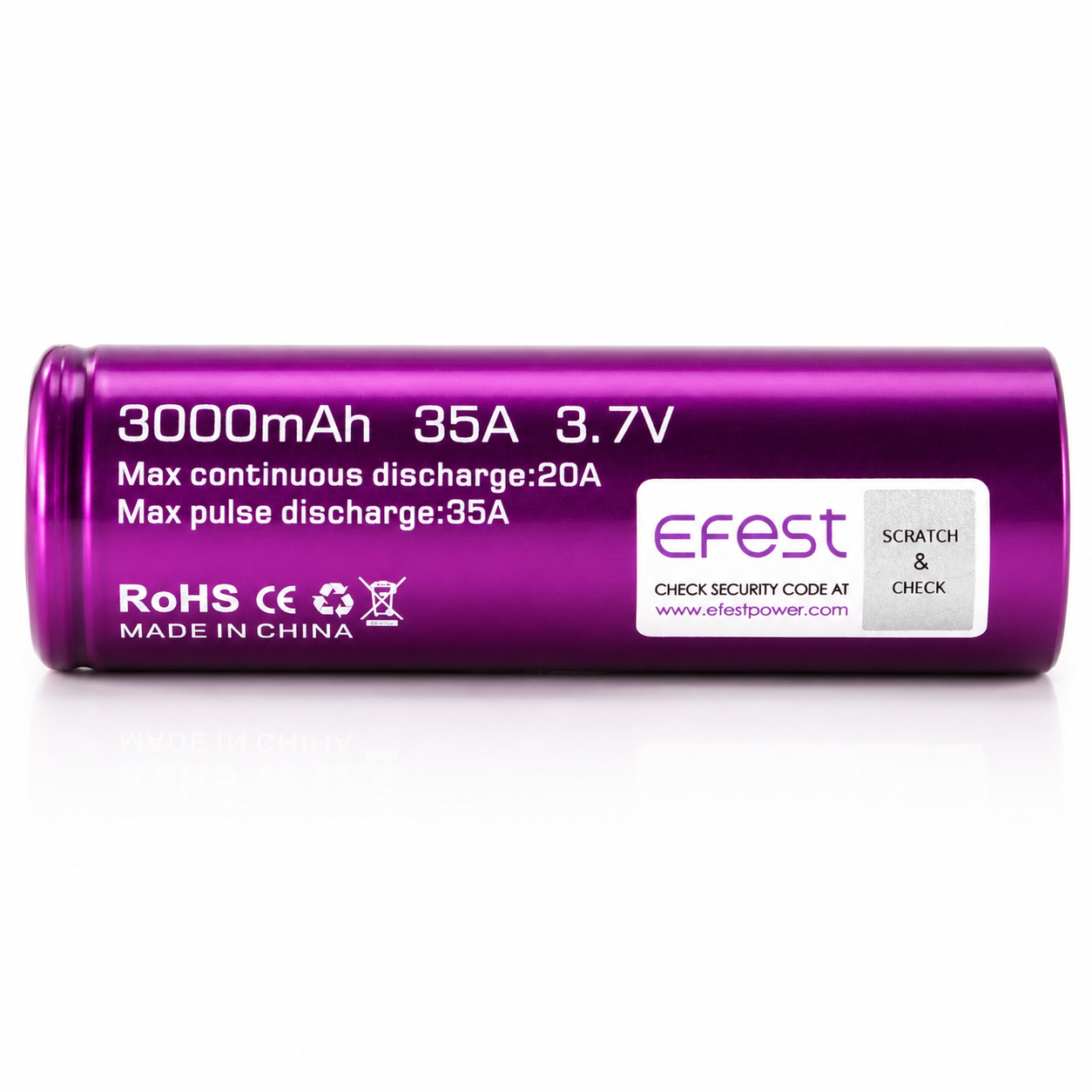
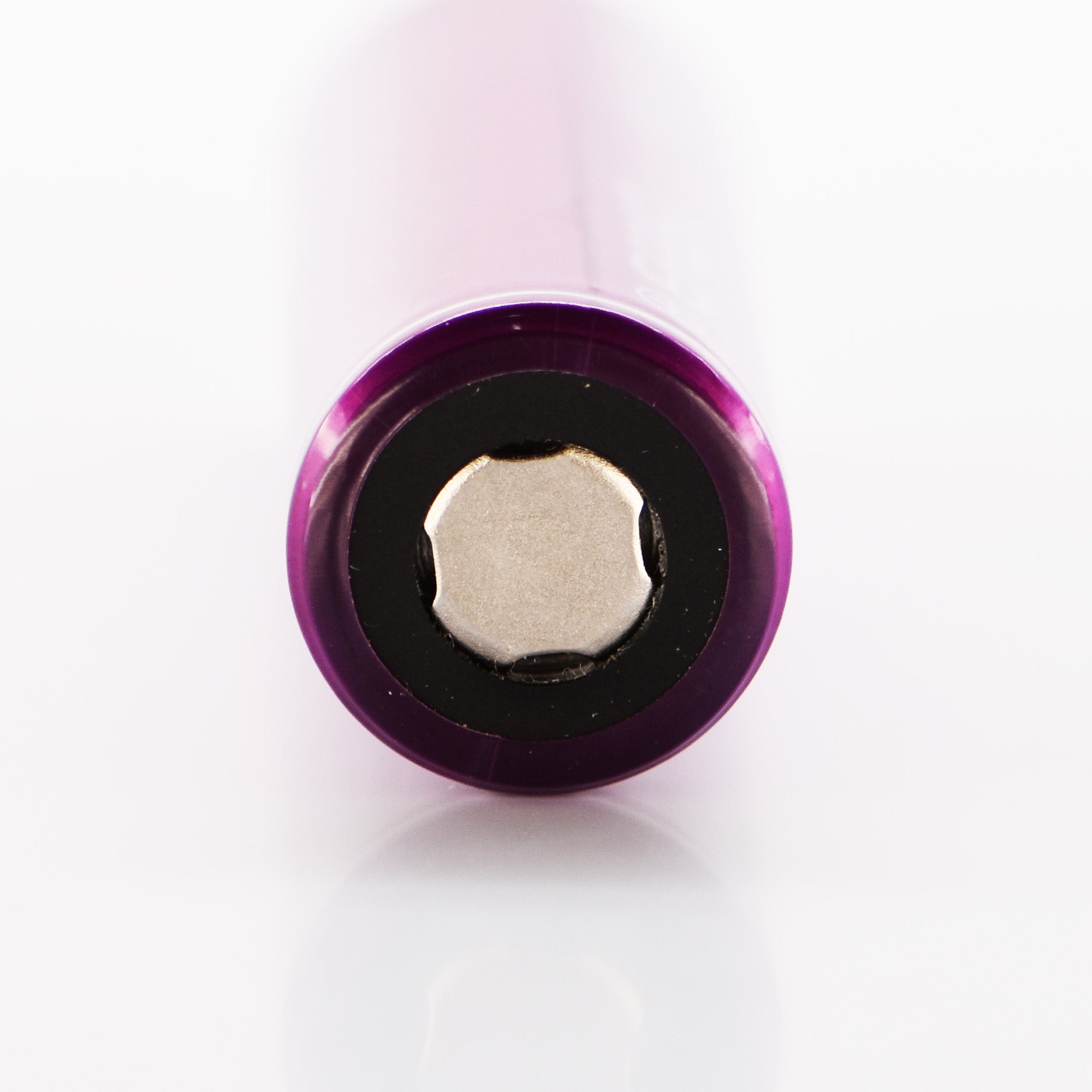


Efest 18650
3000mAh / 20A IMR
High-drain 3.0Ah 18650 lithium-ion cell positioned for buyers who need a balance of runtime, compact size, and strong 20A-class current delivery.
Efest 18650 3000mAh 20A IMR Battery
The Efest 18650 3000mAh 20A IMR cell is a high-drain, unprotected flat-top 18650 battery intended for applications that need a practical mix of runtime and discharge capability. Its 3000mAh capacity supports longer runtime than many lower-capacity power cells, while the 20A continuous discharge rating places it in the performance-oriented 18650 category.
| Brand / Model | Efest IMR18650V1 / 18650 3000mAh 20A IMR |
|---|---|
| Cell Type | 18650 cylindrical rechargeable lithium-ion IMR cell |
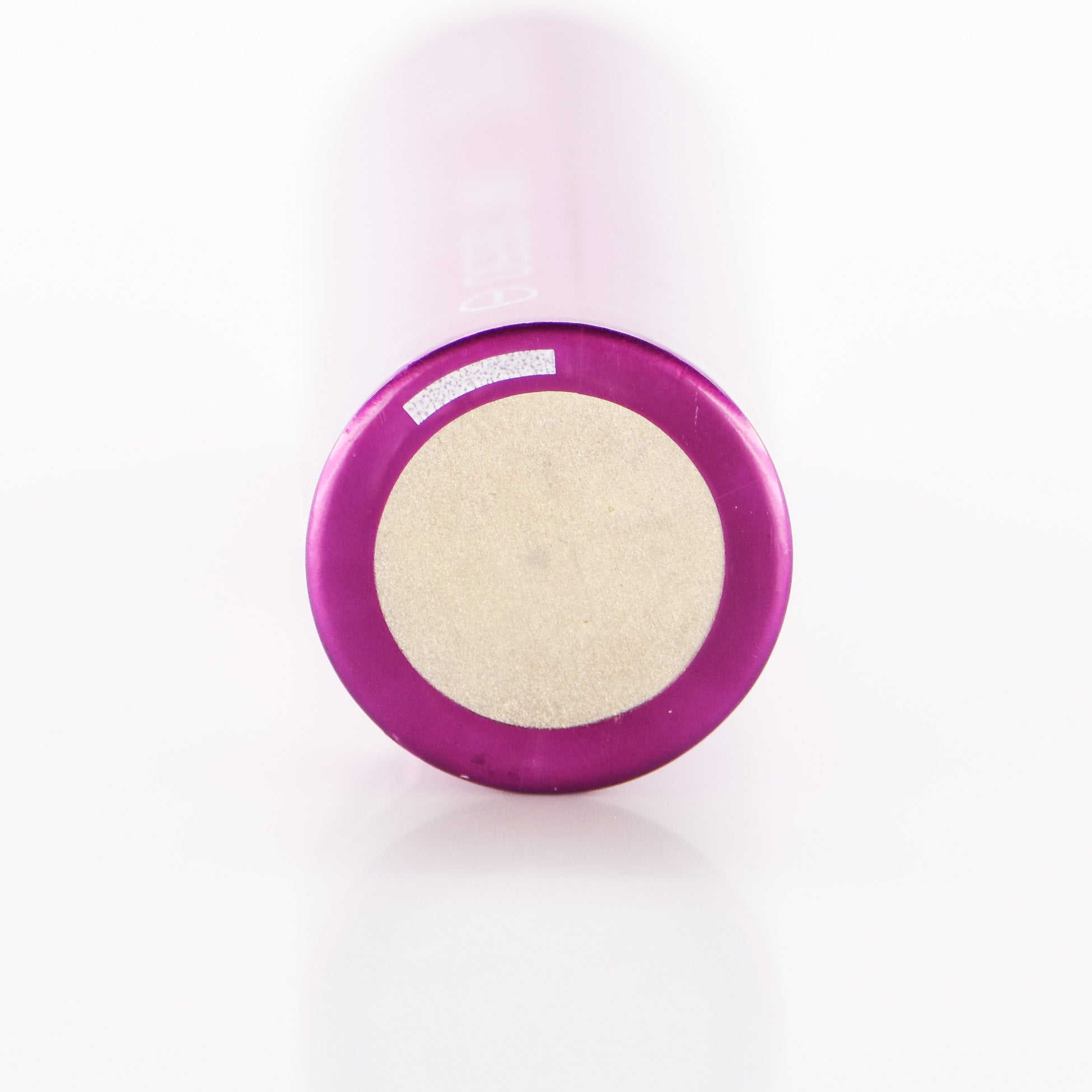
| Terminal | Flat top |
| Nominal Capacity | 3000mAh |
| Nominal Voltage | 3.7V |
| Maximum Charge Voltage | 4.20V |
| Discharge Cut-Off Voltage | 2.50V |
| Continuous Discharge Rating | 20A |
| Pulse / Burst Reference | 35A pulse / short high-load burst label Do not treat as unlimited continuous |
| Standard Charge Reference | 2A where listed by supporting specifications |
| Max Charge Reference | 4A where listed by supporting specifications |
| Protection | No — unprotected bare cell |
| Dimensions | Approx. 18.5mm × 65.2mm; live product listing also shows approx. 18.3mm × 65.0mm |
| Weight | Approx. 45.8g to 48g depending on listing/source |
| Rechargeable | Yes |
Electrical operating envelope at a glance.
These quick-reference visuals summarize current, voltage, C-rate, and energy behavior in a customer-friendly technical format.
1. Current Capability Stack
The 20A continuous rating should be treated as the normal design ceiling; 35A should be treated as a pulse or burst label.
2. Voltage Operating Window
Basic per-cell voltage limits for lithium-ion charge and discharge control.
3. Capacity and Energy Translation
Nominal watt-hours are calculated from capacity and nominal voltage.
4. C-Rate Conversion
For a 3000mAh cell, 1C equals approximately 3A.
| 2A | ≈0.67C standard charge reference |
|---|---|
| 4A | ≈1.33C max charge reference |
| 10A | ≈3.33C high-load use |
| 20A | ≈6.67C continuous discharge rating |
| 35A | ≈11.67C short burst / pulse label |
Voltage sag and delivered capacity change as current increases.
At light loads, a 3000mAh cell can approach its headline capacity. As current rises, voltage sag increases, heat generation rises, and useful delivered capacity depends more heavily on the device cut-off voltage and pack thermal design. The simplified discharge graph below explains this trade-off in a visual way.
Because a detailed manufacturer discharge curve was not available on the live product page, the curve below is a simplified, explanatory model rather than a digitized lab curve. It is still valuable for customers because it clearly communicates the main engineering point: higher current causes earlier voltage depression and shorter practical runtime.
Current rating interpretation
| 20A | Use as continuous-discharge product-page rating |
|---|---|
| 35A | Use as pulse / short burst label, not unlimited continuous |
| 3.0Ah | Capacity headline for runtime comparison |
| 2.5V | Discharge cut-off reference |
| 4.2V | Maximum charge voltage |
5. Simplified Discharge-Curve Graph
Voltage vs. capacity illustration for 5A, 10A, 20A, and 35A pulse/burst loading. Simplified for product-page visualization.
6. Estimated Runtime by Current
Idealized runtime from 3.0Ah capacity before voltage sag, cut-off, heat, and efficiency losses.
Charge behavior, thermal control, and cycle expectations.
Because detailed manufacturer curves are not published in the live listing, the charts below use the listing values and supporting retail/spec references to communicate practical operating behavior.
7. Charge Profile Reference
A standard 4.20V lithium-ion CC/CV profile with current taper near full charge.
8. Thermal Operating Guidance
Use conservative thermal limits because high-current cells heat rapidly under heavy load.
| Charge | Charge only within safe lithium-ion charger/device limits; avoid charging below freezing or when hot. |
|---|---|
| Discharge | 20A continuous loads require airflow, metal mass, or pack-level heat management. |
| 35A label | Treat as short burst / pulse usage only. Stop use if the cell becomes hot. |
| Storage | Store cool, dry, and isolated from conductive objects. |
| Pack design | Measure real cell-surface temperature in the enclosure under worst-case load. |
9. Stress Map by Current
Illustrates increasing heat and sag as load current rises.
10. Cycle-Life Expectation
Cycle life is highly dependent on current, heat, depth of discharge, and charge current.
18650 dimensional envelope for holders, chargers, and pack CAD.
Use the larger published approximation for clearance planning, especially when designing sleds, holders, weld fixtures, or tightly packed battery assemblies.
11. Cell Dimension Diagram
Mechanical envelope based on published reseller specifications.
12. Pack Scaling Formulas
Quick math for series/parallel planning. Validate finished pack current thermally and electrically.
Pack Voltage ≈ Series Count × 3.7V
Pack Capacity ≈ Parallel Count × 3.0Ah
Pack Energy ≈ S × P × 11.1Wh
Conservative Pack Current ≈ P × 20A
13. Example Parallel Scaling
Approximate scaling using 20A continuous product-page rating.
| 1P | 3.0Ah, 11.1Wh, 20A continuous reference |
|---|---|
| 2P | 6.0Ah, 22.2Wh, 40A continuous reference |
| 3P | 9.0Ah, 33.3Wh, 60A continuous reference |
| 4P | 12.0Ah, 44.4Wh, 80A continuous reference |
| 5P | 15.0Ah, 55.5Wh, 100A continuous reference |
14. Common Series Voltage Examples
Nominal voltage examples only. Full-charge and cut-off pack voltages scale separately.
| 1S | 3.7V nominal / 4.2V full / 2.5V cut-off |
|---|---|
| 3S | 11.1V nominal / 12.6V full / 7.5V cut-off |
| 4S | 14.8V nominal / 16.8V full / 10.0V cut-off |
| 5S | 18.5V nominal / 21.0V full / 12.5V cut-off |
| 10S | 37.0V nominal / 42.0V full / 25.0V cut-off |
| 13S | 48.1V nominal / 54.6V full / 32.5V cut-off |
Use inside a protected lithium-ion electrical system.
The Efest 3000mAh 20A is an unprotected bare 18650. Safe implementation requires a charger/BMS strategy that respects voltage, current, temperature, and short-circuit limits.
15. Suggested Control Threshold Map
System-level control guidance for product integration.
| Charge upper limit | 4.20V per cell |
|---|---|
| Discharge floor | 2.50V per cell |
| Continuous current | Use 20A as conservative continuous product-page rating |
| Pulse current | Use 35A only as short burst / pulse reference |
| Thermal check | Stop use if the cell becomes hot; validate pack temperature in enclosure |
16. Risk-Control Checklist
Recommended pack-building and use practices.
- Use only in devices or packs designed for lithium-ion 18650 cells.
- Use a BMS or controller that monitors voltage, current, and temperature.
- Do not charge above 4.20V or discharge below 2.50V per cell.
- Never carry loose cells with conductive objects such as keys, coins, tools, or metal cases.
- Spot weld for pack assembly; do not solder directly to the cell body.
- Inspect wraps and top insulator rings before use.
- Validate busbar, nickel, fuse, wiring, and BMS sizing under real load.
Best suited for balanced runtime and high-drain 18650 use.
High-Output Flashlights
- Good fit for regulated lights that need both 3000mAh runtime and 20A-class current support.
- Verify flat-top compatibility before use.
Battery Packs
- Useful for custom packs requiring balanced energy and current capability.
- Requires matched cells, protection, insulation, and pack validation.
Portable Electronics
- Appropriate for high-current portable systems that provide proper lithium-ion protection.
- Not intended for unmanaged loose-cell operation.
Robotics / RC
- Can support short bursts and sustained current loads when cooled adequately.
- Use current limiting and temperature monitoring in demanding duty cycles.
Tools & DIY Projects
- Useful in moderate-power tool and DIY packs where 20A per cell is sufficient.
- Use spot welding, not direct soldering.
Backup / Energy Modules
- 3000mAh capacity gives useful runtime in compact systems.
- Higher-capacity cells may be better when current demand is low.
17. Selection Bias: Power vs. Runtime
for shoppers comparing high-power and high-energy cells.
18. Application Suitability Matrix
Simple product-page fit guidance.
| High-output flashlights | Strong fit |
|---|---|
| Custom packs | Not recommended |
| Robotics / RC | Not recommended |
| Maximum runtime per cell | Not recommended |
| Unmanaged consumer devices | Not recommended |
Safety, Handling & Compatibility Notice
This product is an unprotected lithium-ion cell. It should only be used by customers who understand cell-level lithium-ion safety and who are using the battery in compatible hardware, managed packs, or professionally designed assemblies. Improper use can lead to overheating, venting, fire, or explosion.
- Charge only with lithium-ion chargers or managed battery systems designed for the correct chemistry and cell count.
- Never short circuit, crush, puncture, incinerate, or expose the cell to water.
- Do not use cells with damaged wraps, dented cans, or missing top insulator rings.
- Do not mix with cells of different age, capacity, model, or state of charge in the same pack.
- For assembly, use spot welding rather than direct soldering to reduce heat damage risk.
- Store and transport in non-conductive cases; never carry loose cells in pockets or bags.
- Keep away from children and from applications for which the product is not specified.
- Not for e-cigarette, vape, or similar use.
Common technical questions about the Efest 18650 3000mAh 20A.
What is the capacity?
The product is listed as a 3000mAh 18650 cell.
Is the discharge rating 20A or 35A?
Use 20A as the conservative continuous-discharge rating. The 35A figure should be treated as a pulse or short burst reference, not a continuous design promise.
Is this a protected battery?
No. This is an unprotected flat-top 18650 cell and should be used only in compatible protected devices or engineered battery packs.
What charger should be used?
Use a lithium-ion smart charger with a 4.20V CC/CV profile. Do not use chargers intended for other chemistries.
What is the discharge cut-off voltage?
The product specifications list a 2.50V cut-off voltage.
What is the nominal voltage?
The product is listed at 3.7V nominal voltage.
What are the approximate dimensions?
Supporting product specifications list approximately 18.5mm × 65.2mm; the live 18650BatteryStore listing also shows approximately 18.3mm × 65.0mm.
Can I solder directly to the cell?
No. Direct soldering can overheat the cell. Use proper spot welding for battery pack assembly.
Can I mix this cell with other cells?
No. Do not mix brands, capacities, ages, or states of charge in a series or parallel pack. Use matched cells only.
What applications fit this battery best?
It is best for protected high-drain 18650 applications such as flashlights, custom battery packs, robotics, portable electronics, and moderate-duty DIY power systems.
Can I carry this battery loose?
No. Loose transport is unsafe because conductive objects can short the terminals. Always use a non-conductive battery case.