
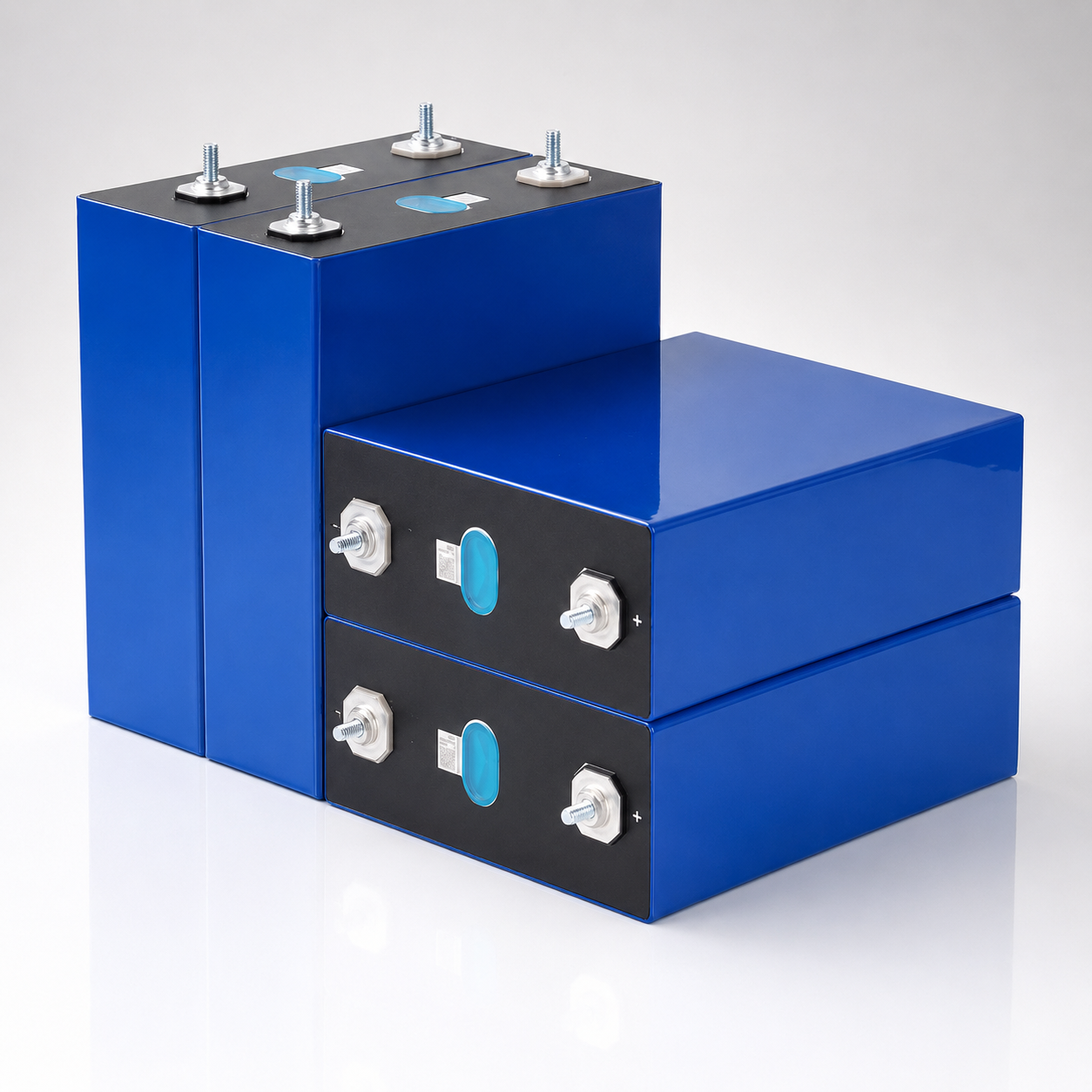


EVE MB31 LiFePO4
314Ah Prismatic Cells
Grade A 3.2V 314Ah lithium iron phosphate prismatic cells supplied as a pack of 4 cells with busbars. This Shopify-ready page converts the live listing and MB31 specification into a professional, technical, chart-heavy description for customers comparing energy, voltage behavior, cycle life, thermal limits, pack architecture, and ESS suitability.
EVE MB31 Grade A 3.2V LiFePO4 314Ah Prismatic Battery Cells (Pack of 4)
The EVE MB31 is a high-capacity LiFePO4 prismatic cell built for long-life energy storage, off-grid power, RV and marine battery systems, UPS modules, and large-format battery banks. Unlike high-drain cylindrical cells, this product is optimized around high stored energy, long cycle life, thermal stability, and pack-level serviceability.
The live listing is for a pack of 4 cells with busbars included. A common 4-cell series configuration creates a 12.8V nominal LiFePO4 module with approximately 314Ah capacity and about 4.02kWh nominal energy before BMS, wiring, enclosure, and usable-depth-of-discharge limits.
| Brand / Model | EVE MB31 Grade A LiFePO4 prismatic cell |
|---|---|
| Listing Package | Pack of 4 cells with busbars included |
| Terminal | Single M6 stud |
| Chemistry | Lithium Iron Phosphate / LiFePO4 / LFP |
| Nominal Capacity | 314Ah |
| Nominal Energy | 1004.8Wh per cell |
| Nominal Voltage | 3.2V |
| End-of-Charge Voltage | 3.65V standard charge voltage |
| Discharge Cut-Off Voltage | 2.5V when cell temperature is above 0°C; MB31 spec also lists 2.0V when cell temperature is at or below 0°C |
| Listing CDR / Max Charge | 0.5C / 157A |
| Datasheet Power Rating | 0.5P standard and maximum continuous charge/discharge power; 502.4W per cell at 25°C |
| Initial AC Resistance | 0.18mΩ ± 0.05mΩ at AC 1kHz, delivery SOC, fresh cell |
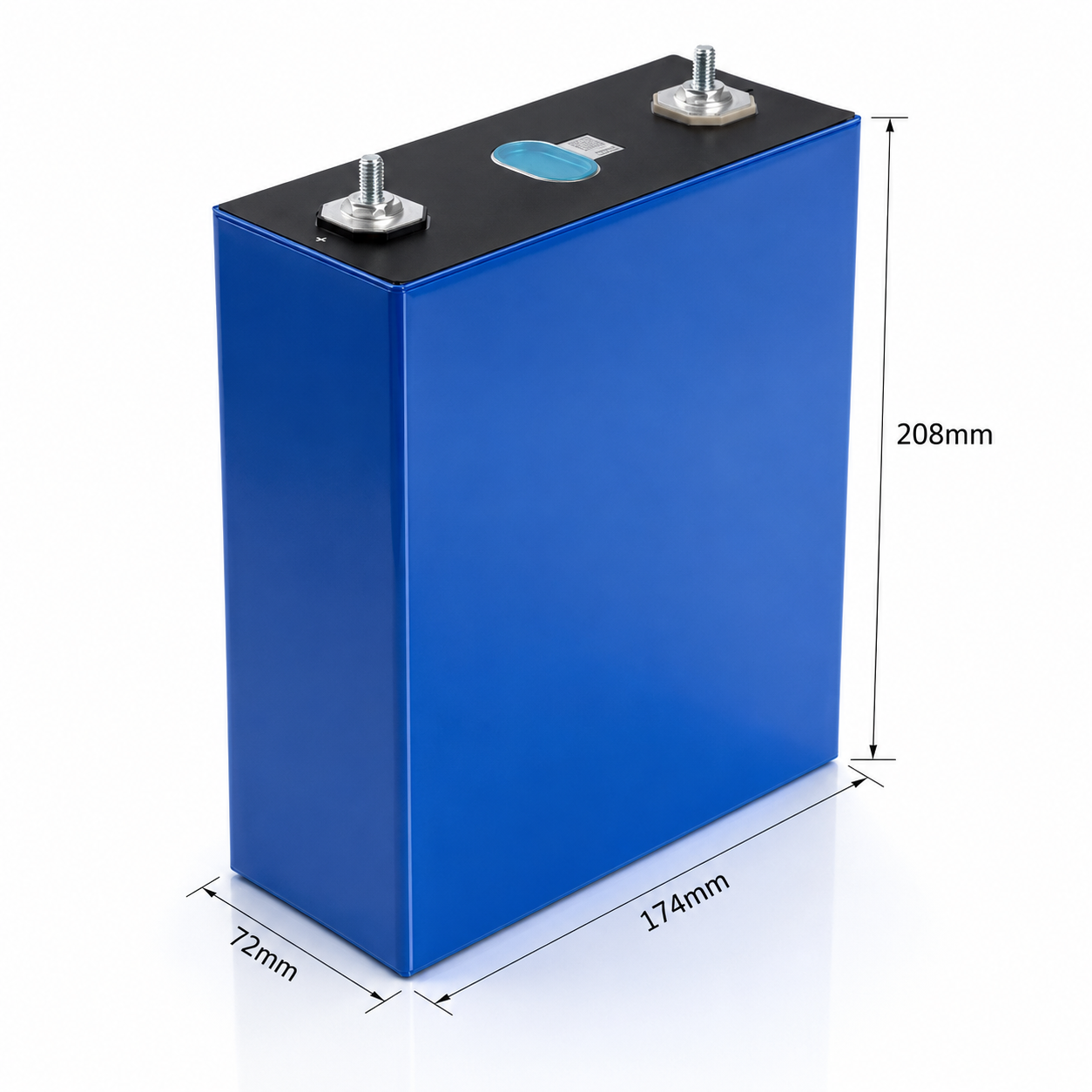
| Cell Dimensions | 207.2mm ±0.5mm with terminal; 204.6mm ±0.5mm without terminal; 173.7mm ±0.5mm length; 71.7mm ±0.8mm thickness |
| Weight | 5600g ±300g datasheet value; retail listing approx. 5.4kg |
| Cycle Life | 8000 cycles at 25°C to 70% SOH in MB31 specification; live listing states 8000+ charge cycles |
| Operating Temperature | Charging 0°C to 60°C; discharging −30°C to 60°C in product table |
| Storage | 1 year: 0°C to 35°C; 1 month: −20°C to 45°C at delivery SOC status |
Electrical operating envelope at a glance.
These quick-reference visuals summarize the MB31’s voltage window, power/current interpretation, energy translation, and C-rate/P-rate mapping.
1. Cell Voltage Operating Window
LiFePO4 cells have a relatively flat discharge plateau between full charge and cut-off.
2. Power / Current Translation
EVE uses 0.5P constant-power ratings; the retail listing translates 0.5C to 157A.
3. Capacity and Energy Translation
Nominal watt-hours are calculated from nominal capacity and nominal voltage.
4. Common 4-Cell Configuration
A 4S1P pack configuration is a typical 12V-class LiFePO4 module topology.
| Cells Included | 4 individual MB31 cells with busbars |
|---|---|
| Example 4S Nominal Voltage | 12.8V nominal |
| Example 4S Full Charge | 14.6V full charge |
| Example 4S Capacity | 314Ah |
| Example 4S Energy | ≈4.02kWh nominal |
| Example 4S Cut-Off | 10.0V at 2.5V/cell above 0°C |
LiFePO4 voltage stays flat for most of the discharge curve.
The MB31’s most important electrical behavior is not a dramatic voltage slope; it is the stable LiFePO4 plateau. This gives ESS and RV systems predictable voltage output over a wide state-of-charge range, but it also means SOC estimation should rely on coulomb counting and a calibrated BMS, not voltage alone.
The simplified discharge graph below visualizes typical LiFePO4 behavior: a fast drop from full-charge voltage, an extended flat plateau, and a steep knee near cut-off. Actual voltage depends on current, temperature, cell age, compression, busbar resistance, BMS calibration, and rest time.
Plateau interpretation
| 3.65V | Standard charge voltage limit |
|---|---|
| ≈3.35V–3.25V | Typical loaded/resting plateau region |
| 3.2V | Nominal voltage reference |
| 2.5V | Standard discharge cut-off above 0°C |
| 2.0V | MB31 data sheet low-temperature cut-off reference at or below 0°C |
5. Simplified Discharge-Curve Graph
Voltage vs. capacity illustration for LiFePO4 plateau behavior. Simplified for product-page visualization.
6. Low Resistance / High Energy Scale
The MB31 is a large-format storage cell with very low AC resistance.
Thermal, storage, cycle-life, and mechanical-control visuals.
Large prismatic LFP cells should be treated as structural energy-storage components. Temperature, compression, terminal connection, balancing, and BMS logic are all part of safe pack integration.
7. Charge Power vs. Temperature
Continuous charge modes by cell temperature, expressed as P-rate in the MB31 data sheet.
8. Discharge Temperature Envelope
Continuous discharge P-rate remains 0.5P through most of the usable temperature range.
9. High / Low Temperature Performance
Published discharge-energy performance versus 25°C reference energy E0.
10. Cycle-Life Visualization
MB31 specification: 8000 cycles at 25°C to 70% SOH under the specified 0.5P cycle test.
11. Storage & Self-Discharge
Storage windows and self-discharge values from the MB31 product specification.
| 1 Year Storage | 0°C to 35°C at delivery SOC status |
|---|---|
| 1 Month Storage | −20°C to 45°C at delivery SOC status |
| Self-Discharge First Month | ≤3.5% per month at delivery SOC, 25°C ±2°C |
| After First Month | ≤3.0% per month at 25°C ±2°C storage |
| 50% SOC Recovery | ≥98% E0 after 25°C / 28 days; ≥97% E0 after 45°C / 28 days |
12. Swelling Force & Compression Context
Large-format prismatic cells require mechanical attention over cycle life.
Prismatic cell dimensional envelope and pack architecture.
Use the larger datasheet dimensional envelope for CAD, busbar clearance, enclosure design, and terminal-stack planning. The live listing rounds the size to 72mm × 174mm × 207mm.
13. Cell Dimension Diagram
Mechanical envelope based on MB31 specification dimensions.
14. Pack Scaling Formulas
Common LiFePO4 pack math for series/parallel planning.
Pack Voltage ≈ Series Count × 3.2V
Pack Capacity ≈ Parallel Count × 314Ah
Pack Energy ≈ S × P × 1004.8Wh
Listing Current Class ≈ Parallel Count × 157A
15. Series Voltage Examples
Nominal and full-charge values for common LFP architectures.
| 4S1P | 12.8V nominal / 14.6V full / ≈4.02kWh |
|---|---|
| 8S1P | 25.6V nominal / 29.2V full / ≈8.04kWh |
| 16S1P | 51.2V nominal / 58.4V full / ≈16.08kWh |
| 16S2P | 51.2V nominal / 58.4V full / ≈32.15kWh |
| 20S1P | 64.0V nominal / 73.0V full / ≈20.10kWh |
16. Module Integration Checklist
Technical checks before installation into an ESS, RV, marine, or industrial system.
- Verify all cell QR codes, voltages, polarity, and physical condition on arrival.
- Use a LiFePO4-compatible BMS with cell-level voltage, current, and temperature protection.
- Balance cells before service and verify busbar contact resistance.
- Follow proper terminal hardware, torque, insulation, and anti-loosening practices.
- Use an enclosure that prevents shorts, moisture exposure, vibration damage, and terminal contact.
- Validate current path, conductor sizing, fuse selection, and heat rise at the actual load.
Designed for high-energy storage, not unmanaged loose-cell use.
The MB31 is a large-format energy-storage cell. It is intended for protected battery packs and modules, not loose-cell consumer use. A suitable BMS, enclosure, compression/module design, and LiFePO4 charger are required.
17. ESS Protection Threshold Map
Recommended system-level controls derived from the product/specification values.
| Charge upper limit | 3.65V per cell standard; absolute charging voltage max 3.8V in data sheet protection language |
|---|---|
| Discharge floor | 2.5V per cell above 0°C; special low-temperature cut-off handling required at ≤0°C |
| Charge temperature gate | 0°C to 60°C cell temperature |
| Discharge temperature gate | Product table: −30°C to 60°C; absolute discharge temp in spec: −35°C to 65°C |
| Cycle design point | 0.5P charge/discharge at 25°C for 8000-cycle / 70% SOH specification |
| Mechanical control | Consider compression, swelling force, busbar resistance, vibration, and thermal expansion |
18. Safety Checklist
Use in protected LiFePO4 systems only.
- Use only with a LiFePO4-compatible charger and BMS.
- Do not short circuit, puncture, crush, disassemble, incinerate, or expose to water.
- Do not connect series/parallel modules without balancing and a proper protection system.
- Do not use cells with swelling, leakage, crushed cases, terminal damage, or abnormal voltage.
- Do not solder directly to terminals; use proper mechanical terminal hardware and busbars.
- Use correct fusing and disconnects for pack-level fault protection.
- Store in a dry, cool place away from direct sunlight and heat sources.
- Only qualified users should assemble large LiFePO4 battery packs.
Best suited for ESS, RV, marine, and industrial energy-storage systems.
Solar ESS
- Strong fit for off-grid and hybrid solar battery banks.
- High cycle life supports daily cycling when properly managed.
Home Backup
- Useful for 12V, 24V, and 48V backup power modules.
- Requires a suitable BMS, enclosure, fusing, and charger/inverter settings.
RV / Van Power
- High capacity per cell reduces part count for mobile power systems.
- Mechanical mounting and vibration control are important.
Marine Systems
- LiFePO4 chemistry offers stable energy storage for protected marine packs.
- Moisture protection and terminal insulation are mandatory.
Industrial UPS
- Suitable for large backup systems where long calendar and cycle life matter.
- BMS telemetry and cabinet-level monitoring are recommended.
DIY Battery Builds
- Appropriate only for experienced builders with LiFePO4 pack knowledge.
- Pre-balance, BMS validation, and safe busbar assembly are required.
19. Selection Bias: Energy Storage vs. Power Cell
MB31 is optimized for stored energy and long cycle life, not compact high-drain cylindrical use.
20. Application Suitability Matrix
Simple product-page fit guidance.
| Solar ESS | Strong fit |
|---|---|
| Home backup | Strong fit |
| RV / marine | Strong fit with enclosure |
| EV / mobility modules | Engineer carefully |
| Loose-cell consumer use | Not appropriate |
| High-current compact tools | Use cylindrical power cells |
Receiving-inspection notes.
Receiving checklist
- Record serial numbers and QR codes.
- Measure and log resting voltage for every cell.
- Inspect terminals, cases, vents, and corners for shipping damage.
- Verify busbars and terminal hardware are present.
- Top-balance or pre-balance before building a series pack.
- Confirm BMS cell-count and LiFePO4 settings before energizing the system.
Do not skip
- Do not build a pack without cell balancing.
- Do not operate without a BMS or equivalent protection controller.
- Do not exceed voltage, current, temperature, or compression limits.
- Do not allow terminals or busbars to contact conductive enclosures.
- Do not install in wet, vibrating, or high-heat environments without protection.
- Do not assume charger settings for lead-acid batteries are LiFePO4 compatible.
Common technical questions about the EVE MB31.
Is the listing for one cell or four cells?
The live product listing states that the price is for a pack of 4 cells with busbars included.
What is the nominal voltage?
Each MB31 cell is 3.2V nominal. Four cells in series make a 12.8V nominal LiFePO4 battery module.
How much energy is in one cell?
The MB31 data sheet lists nominal energy of 1004.8Wh per cell. A 4-cell set is approximately 4019Wh, or about 4.02kWh nominal.
What is the correct full-charge voltage?
The standard end-of-charge voltage is 3.65V per cell. A 4S pack charges to 14.6V, while a 16S pack charges to 58.4V.
What is the discharge cut-off voltage?
The live listing states 2.5V. The MB31 data sheet lists 2.5V when cell temperature is above 0°C and 2.0V when cell temperature is at or below 0°C. Pack designers typically select a conservative cut-off based on the BMS, operating temperature, and desired cycle life.
What is the continuous discharge current?
The live listing states 0.5C, or 157A. The MB31 data sheet uses 0.5P constant-power language, equal to 502.4W standard and maximum continuous discharge power at 25°C reference conditions.
Can these be used for a 12V battery?
Yes. Four cells in series are commonly used to build a 12.8V nominal LiFePO4 battery, but the cells must be used with a proper BMS, fusing, enclosure, balancing, and LiFePO4-compatible charger.
Can I connect cells directly without a BMS?
No. These cells should be used in a protected battery system with cell-level voltage, temperature, and current monitoring.
What are the dimensions?
The live listing gives 72mm × 174mm × 207mm. The MB31 data sheet lists 207.2mm height with terminal, 204.6mm without terminal, 173.7mm length, and 71.7mm thickness.
How long do they last?
The product listing states 8000+ cycles. The MB31 data sheet specifies 8000 cycles to 70% SOH at 25°C under its listed 0.5P cycling procedure.
Do the cells need compression?
Large prismatic cells should be mechanically supported in a proper module or enclosure. The data sheet includes thickness conditions under 300kgf ±20kgf compression and swelling-force criteria, so pack mechanical design should not be ignored.
Can these be used in cold weather?
Discharging is listed down to −30°C in the product table, but charging is 0°C to 60°C. A BMS should prevent charging below allowed temperature limits and should enforce low-temperature cut-off logic.
What charger should be used?
Use a LiFePO4-compatible charger or inverter/charger profile. Do not use an incompatible lead-acid or lithium-ion profile that exceeds the correct cell or pack voltage.
Are busbars included?
Yes. The product listing states that busbars are included and that the terminal is a single M6 stud.